
Best Personal Alarm Keychains for Everyday Carry

The Fauxomor personal alarm keychain is the strongest fit for most people here because it combines a 140-decibel siren, strobe light and low-battery alert in a three-pack. Choose a different model if you prefer USB charging, a single compact alarm or a six-pack.
A personal alarm is a small sound-and-light device meant to attract attention; it is an alerting tool, not a substitute for getting to a safe place or contacting emergency services.
We earn a commission if you buy through links on this page. As an Amazon Associate I earn from qualifying purchases. Products are compared on manufacturer specifications, not hands-on testing.
- Best overall: Fauxomor 140dB Alarm, 3-Pack – Pairs a 140-decibel siren and strobe with a low-battery alert, and comes as a three-pack.
- Best for USB charging: TECKNET Rechargeable 130dB Alarm – Rechargeable design with a low-battery notice and a claimed 500 days of standby.
- Best for sharing: KOSIN 140dB Alarm, 6-Pack – Six alarms in a pack, each with LED lights and a 140-decibel siren.
| Product | Best for | Power | Pack count | Shop |
|---|---|---|---|---|
| Fauxomor 140dB Alarm, 3-Pack | Multi-person carry | Batteries; low-battery alert | 3 alarms | Check Price on Amazon |
| She’s Birdie 3.0 | Ring-pull activation | Rechargeable | 1 alarm | Check Price on Amazon |
| KOSIN 140dB Alarm, 6-Pack | Group distribution | 3 AG13/LR44 batteries | 6 alarms | Check Price on Amazon |
| TECKNET Rechargeable 130dB Alarm | Rechargeable carry | USB rechargeable | 1 alarm | Check Price on Amazon |
Best Personal Alarm Keychains
Compare activation style, power and included features to choose an alarm that fits your routine.
Fauxomor 140dB Alarm, 3-Pack
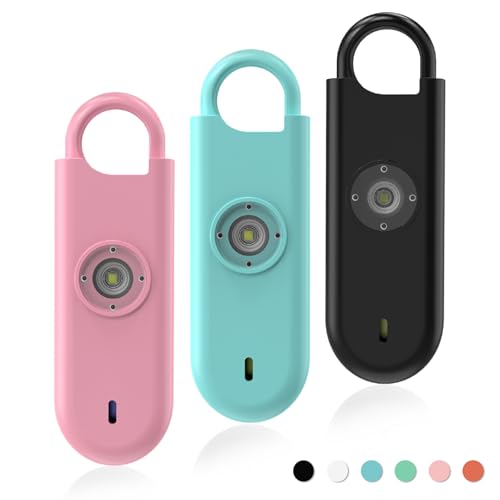
The Fauxomor set stands out for pairing a 140-decibel siren with a strobe and a low-battery alert across three alarms. Pull the top pin to activate the sound and light, then reinsert it to stop them. The compact alarms measure 3.66 inches long and come in pink, blue and black. This set suits households or people who want more than one alarm available. Its pin-based activation may be less convenient than a ring-pull design for someone who prefers to attach an alarm to a bag and pull a ring.
Bottom line: Pick this set if you want three pin-activated alarms with a low-battery warning.
She’s Birdie 3.0

She’s Birdie 3.0 is the ring-pull option: pulling the top ring activates its 130-decibel siren and flashing strobe, and pushing it back deactivates the alarm. The reusable design has a rechargeable battery and measures 3.7 inches long. Its straightforward pull-and-push operation suits someone who wants a single alarm rather than a multipack. The tradeoff is its lower stated siren rating than the 140-decibel options here; sound ratings alone do not guarantee how clearly an alarm will be heard in a particular setting.
Bottom line: Choose this if ring-pull activation and rechargeable power matter most.
KOSIN 140dB Alarm, 6-Pack
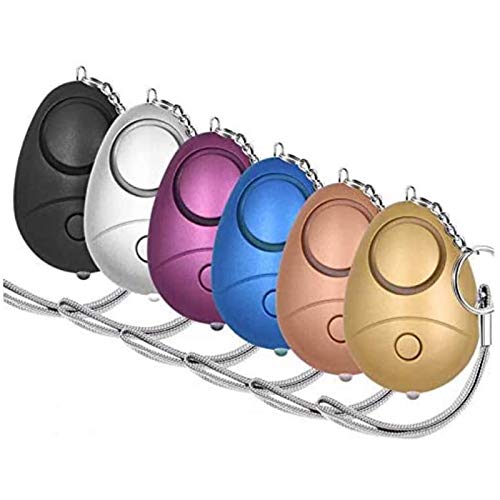
The KOSIN set provides six alarms, more than any other option here, with a 140-decibel siren and LED lights on each. Each alarm uses three AG13/LR44 batteries. The maker says the siren can run continuously for 50 minutes and claims a sound reach of 606.9 feet; actual audibility depends on surroundings, distance and obstacles. This multipack fits groups who need several devices. Unlike the rechargeable choices, it relies on replaceable button-cell batteries, so plan to keep compatible replacements available.
Bottom line: Pick this multipack when six battery-powered alarms are useful.
TECKNET Rechargeable 130dB Alarm

The TECKNET distinguishes itself with USB-rechargeable power and a low-battery notice, avoiding the replaceable batteries used by the KOSIN set. It pairs a 130-decibel siren with an SOS strobe and measures 3.94 inches high. The maker claims up to 500 days of standby, 90 minutes of alarm sound and five hours of flashing. This option suits someone who wants one rechargeable alarm with a status warning. Its 130-decibel rating is lower than the 140-decibel models, and charging requires keeping track of the device’s charge.
Bottom line: Choose this for rechargeable power and a low-battery notice.
How to Choose a Personal Alarm Keychain
Choose by activation, power and how many people need an alarm, rather than by the loudness number alone. A pin-pull alarm stops when its pin is replaced, while ring-pull models use a ring to activate and deactivate; select the motion you can perform quickly while holding your bag or keys. Rechargeable alarms avoid swapping cells, but need charging; replaceable-battery models need compatible spares. A higher decibel rating does not guarantee better warning at a distance, since walls, traffic and other noise affect audibility. Keep an alarm reachable rather than buried inside a bag, and do not treat it as a replacement for a phone or a safety plan.
What the Decibel Rating Means
A decibel rating is a measure of sound level, not a promise that a siren will be heard at a particular distance. Sound weakens as it travels, and walls, closed doors, traffic and indoor reverberation change what nearby people hear. Ratings are most useful as a comparison only when measured under similar conditions, which product specifications may not make clear. Avoid activating a loud alarm near anyone’s ears: intense sound at close range can harm hearing. Test a new alarm briefly in an open area, away from people and pets, and learn how its activation mechanism works before relying on it.
Pin-Pull, Ring-Pull and Rechargeable Types
Pin-pull and ring-pull describe how an alarm activates; rechargeable and replaceable-cell describe how it gets power. These are separate choices, so decide which operation feels accessible first, then consider upkeep. For example, a rechargeable model can still use either activation style, while a battery-powered model may have a pull pin. A low-battery warning can prompt a recharge or battery change, but it does not eliminate periodic checks. The table separates these purchase decisions so a user can match an alarm to their carry routine.
| Need | Feature to prioritize | Tradeoff |
|---|---|---|
| Quick activation | Pin or ring you can reach and pull | Practice the motion |
| Less battery swapping | Rechargeable power | Keep charge maintained |
| Several users | Multi-alarm pack | Track each unit’s readiness |
Where to Carry and How to Maintain an Alarm
Carry a personal alarm where one hand can reach it without searching; an outer bag loop or key ring is more accessible than a packed compartment. Check the activation pin or ring and the power status periodically, especially before a commute, walk or trip. Recharge a low-charge unit or replace its specified batteries, and test only briefly in an open space because close, prolonged siren exposure risks hearing damage. Do not assume the strobe will be visible through clothing, a closed bag or bright daylight. An alarm can attract attention, but keep a phone accessible and know a route toward people or a staffed place.
Frequently Asked Questions
Can a personal alarm keychain be heard through a wall?
A wall can substantially reduce how much of a siren reaches someone on the other side, and there is no dependable distance that applies to every building. Keep the alarm accessible and use it to draw attention nearby, not as a guaranteed signal through barriers.
How often should I check a personal alarm?
Check it periodically and before situations when you expect to rely on it, confirming the power indicator and that the activation mechanism is intact. Briefly test the siren outdoors and away from ears, since close exposure to loud sound can damage hearing.
Are rechargeable personal alarms better than battery models?
Rechargeable alarms avoid replacing disposable cells, while battery models can work without waiting for a charge if fresh compatible batteries are installed. Pick rechargeable power if you can keep a charging routine; choose replaceable cells if maintaining spares is easier.
Where should I attach a personal alarm keychain?
Attach it somewhere reachable with one hand, such as an exterior bag loop or key ring. Avoid burying it in a packed bag, where finding and activating it can take longer.
Can I carry a personal alarm on a plane?
Rules can vary by airline, airport and destination, so confirm current requirements before travel. Keep the alarm’s power type and activation mechanism in mind, and prevent the pin or ring from being pulled accidentally while packed.