
Electric Scooter With Seat 3 Wheels: 3 Models Compared

For a seated three-wheel electric scooter with everyday mobility controls, the iScooter X01 stands out with a 0–5 mph speed range and a design for short local trips. Choose another model if you need a higher top speed, longer stated range, or a folding design.
Three-wheel mobility scooters use a front steering wheel and two rear wheels to provide a tight turning footprint; intended surfaces, speed and portability differ substantially.
We earn a commission if you buy through links on this page. As an Amazon Associate I earn from qualifying purchases. Products are compared on manufacturer specifications, not hands-on testing.
- Best overall: iScooter X01 Three-Wheel Mobility Scooter – Its 0–5 mph control range suits short neighborhood, home and store trips.
- Best for compact travel: Vive Three-Wheel Mobility Scooter – Its folding, collapsible design is intended for travel and weighs 84 pounds.
- Best for longer stated range: 200W Three-Wheel Mobility Scooter – The maker gives a maximum range of 24 miles per charge.
| Product | Best for | Top speed | Maximum range | Weight | Shop |
|---|---|---|---|---|---|
| iScooter X01 Three-Wheel Mobility Scooter | Short local trips | 5 mph | — | — | Check Price on Amazon |
| Vive Three-Wheel Mobility Scooter | Travel portability | 3.7 mph | 12.4 miles | 84 lb | Check Price on Amazon |
| 200W Three-Wheel Mobility Scooter | Longer daily range | 6.8 mph | 24 miles | 77 lb | Check Price on Amazon |
Electric Scooters With Seats and 3 Wheels
Compare the models by their speed, range, and physical weight before choosing for your routes and storage space.
iScooter X01 Three-Wheel Mobility Scooter

The iScooter X01 is the only model here with a 0–5 mph speed adjustment and a 12° slope capability under suitable conditions, making it oriented toward controlled short trips. It has forward and reverse selection plus a control panel for lights and horn. Its three-wheel layout is designed for maneuvering through hallways, doorways and narrow aisles; the dimensions are 43.3 inches long and 19.7 inches wide. A detachable basket and cup holder add carrying convenience. The main limitation is its 5 mph ceiling, which may not suit buyers seeking faster outdoor travel.
Bottom line: Choose this for short trips where low-speed control and compact width matter.
Vive Three-Wheel Mobility Scooter
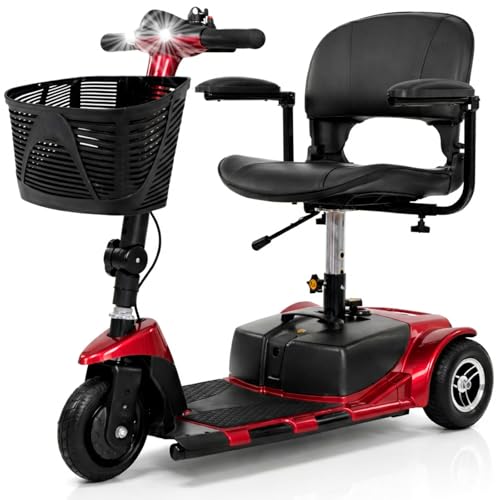
The Vive model prioritizes folding portability and swivel seating rather than higher speed: it tops out at 3.7 mph and weighs 84 pounds. Its 16.9-inch padded seat rotates to make getting on and off easier, and the seat height adjusts. The maker gives a maximum supported weight of 265 pounds, a 12.4-mile distance per charge, and 8-inch flat-free, non-marking tires. A basket and charger are included. The lower speed and shorter range make it a less suitable choice for buyers whose routes require faster travel or longer distances.
Bottom line: Choose this when folding for travel and swivel seating are priorities.
200W Three-Wheel Mobility Scooter

The 200W model pairs a claimed 24-mile range with a 6.8 mph maximum speed, making it the longer-range choice among the conventional mobility scooters here. It uses a 36V 10Ah battery, 8-inch honeycomb tires, a dual brake system and a removable folding seat. The scooter measures 42 inches long and 24.4 inches wide, so check the available doorway and storage width before choosing it. The maker says the battery passed UL 2272 certification. Its wider footprint may be less convenient in tight hallways than narrower designs.
Bottom line: Pick this for its range if the 24.4-inch width fits your routes.
How to choose a three-wheel scooter with a seat
Choose by matching route length, walking-speed needs and storage clearance rather than by wheel count alone. The conventional mobility models here top out between 3.7 and 6.8 mph; the fat-tire model reaches 28 mph, a different riding category. For a route under 12 miles, a model with a 12.4-mile or greater range may fit on paper, but hills, rider load, temperature and repeated starts can reduce battery distance. Measure the narrowest doorway and storage space before buying: listed widths range from 19.5 to 36 inches. If a route requires more than 6.8 mph, only the fat-tire model’s speed reaches that threshold, but its large size and use category call for separate checks.
Three-wheel mobility scooter fit and turning space
Three-wheel scooters generally turn more tightly than comparable four-wheel layouts, but a small turning footprint does not guarantee doorway fit. Measure clear opening width at the narrowest point, including handles or trim; among these models, widths run from 19.5 to 36 inches. A 19.7-inch body still needs extra clearance to steer through a doorway, so avoid choosing based on nominal door size alone. Seat height, legroom and reach to the tiller also affect comfortable control, and the maker gives dimensions but not those fit measurements. Test the planned route at low speed where possible, including a full turn in the smallest hallway or aisle.
Mobility scooter range, speed and surface choice
Battery range and top speed are different selection factors: the conventional models span 3.7–6.8 mph and 12.4–24 miles, while the fat-tire scooter claims 28 mph and up to 25 miles. Range figures are maximums, not a guarantee for every trip; slopes, rider weight, tire pressure and frequent acceleration affect energy use. Small 8-inch tires on the mobility scooters are intended for smoother everyday routes, while 18-inch fat tires are designed for rougher surfaces. Use mobility scooters at walking pace around pedestrians, and slow further on turns or uneven ground. A claimed 12° slope capability applies only under suitable conditions, so avoid treating that angle as a universal safe-grade rating.
Safety and storage checks before choosing
Check the scooter’s carrying capacity against the rider plus anything carried: the iScooter supports 264 pounds and the Vive supports 265 pounds. Do not assume a basket or trunk adds to that rating. Three-wheel scooters can tip if turned sharply, especially at speed or on cross-slopes, so reduce speed before turns and keep wheels on stable ground. Charging and battery rules matter too: use the charger and keep batteries away from heat and moisture; lithium-ion batteries should not be charged unattended or near flammable materials. For the fat-tire scooter, verify that local rules allow the intended speed and route before riding, since its 28 mph maximum differs sharply from mobility scooter pacing.
Frequently Asked Questions
How far can a three-wheel mobility scooter travel?
The models here give maximum ranges from 12.4 to 24 miles for conventional mobility scooters. Hills, rider load, temperature and stop-start travel can reduce actual distance, so leave a reserve rather than planning a trip at the full claimed range.
Will a three-wheel scooter fit through a doorway?
Measure the doorway’s clear width and compare it with the scooter’s width, then allow extra steering clearance. These models range from 19.5 to 36 inches wide, and a tight turn may require more room than the body width alone.
Can mobility scooters handle hills safely?
Slope ability depends on the scooter, rider load, surface and battery condition; the iScooter claims support for slopes up to 12° only under suitable conditions. Approach gradients slowly and avoid cross-slopes, which can increase tipping risk.
How fast should a seated mobility scooter go?
The conventional scooters in this group list maximum speeds from 3.7 to 6.8 mph, while the fat-tire model lists 28 mph. Ride slowly around pedestrians and reduce speed before turns, ramps and uneven sections.
What should I check before charging a scooter battery?
Use the charger made for the scooter and charge on a dry, stable surface away from heat and flammable materials. Do not leave a lithium-ion battery charging unattended, and stop using it if the battery or charger becomes unusually hot or damaged.