
Curtain Rod Holders No Drill: Compare 4 Adhesive Options

For most renters choosing curtain rod holders with no drilling, No-Drill Spring-Lock Brackets is the straightforward pick because its spring lock fits rods from 0.55 to 1.2 inches and the adhesive setup supports up to 20 pounds. Choose Dual-Install Brackets, 8-Pack instead when you need eight brackets or a nail-assisted option for rough walls; adhesive-only mounting is not suited to heavy curtains.
We earn a commission if you buy through links on this page. As an Amazon Associate I earn from qualifying purchases. Products are compared on manufacturer specifications, not hands-on testing.
- Best overall: No-Drill Spring-Lock Brackets – Spring lock and 0.55–1.2-inch rod fit, with an adhesive limit of up to 20 pounds.
- Best for rough walls: Dual-Install Brackets, 8-Pack – Offers adhesive mounting on smooth surfaces and nail-assisted mounting on rough drywall or paint.
- Best for wide rods: JHCJHC Adhesive Brackets, 4-Pack – Fits curtain rods from 0.6 to 1.5 inches; each adhesive pair supports up to 20 pounds.
| Product | Best for | Rod diameter fit | Adhesive load limit | Pack size | Shop |
|---|---|---|---|---|---|
| No-Drill Spring-Lock Brackets | Secure rod seating | 0.55–1.2 in | Up to 20 lb | 4 brackets | Check Price on Amazon |
| Dual-Install Brackets, 8-Pack | Rough wall option | 0.55–0.78 in | 10 lb adhesive; 30 lb nailed | 8 brackets | Check Price on Amazon |
| JHCJHC Adhesive Brackets, 4-Pack | Wide rod range | 0.6–1.5 in | Up to 20 lb per pair | 4 brackets | Check Price on Amazon |
| Transparent Adhesive Brackets, 8-Pack | Transparent finish | 0.39–0.78 in | Up to 13 lb per pair | 8 brackets | Check Price on Amazon |
No-drill curtain rod holders compared
Match the rod diameter, mounting surface and curtain load before choosing a bracket set.
No-Drill Spring-Lock Brackets
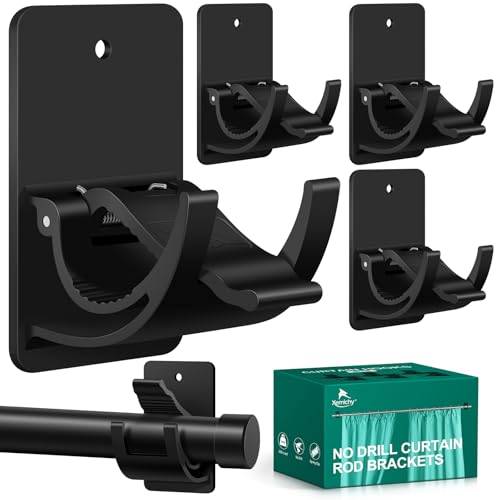
The spring lock is the distinguishing feature here: it is designed to keep the rod from sliding out of the holder. The four self-adhesive brackets fit rods from 0.55 to 1.2 inches, and the maker says the set supports up to 20 pounds without nails. Allow 24–48 hours after applying the adhesive before use. The fit range covers many common curtain rods, but this set is not the match for rods wider than 1.2 inches or rough surfaces that need a mechanical fastener.
Bottom line: Choose this set for a spring-lock design and a rod no wider than 1.2 inches.
Dual-Install Brackets, 8-Pack
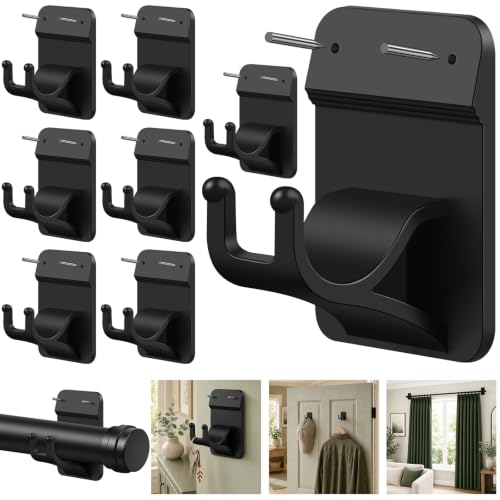
This eight-bracket set offers two mounting methods, unlike adhesive-only alternatives: the maker rates adhesive installation at 10 pounds and nail-assisted installation at 30 pounds. It fits rods from 0.55 to 0.78 inches and uses adhesive on smooth tile, glass or metal; reinforced invisible nails are intended for rough drywall or painted surfaces. That flexibility suits a renter who can use adhesive or a homeowner willing to fasten the brackets. The rod range is comparatively narrow, and the higher load limit applies to nail-assisted installation, not adhesive alone.
Bottom line: Pick this option when the rod is narrow and you need a nail-assisted mounting choice.
JHCJHC Adhesive Brackets, 4-Pack

The wider rod fit is the main distinction: these four holders accommodate diameters from 0.6 to 1.5 inches, broader than the other adhesive sets here. Their construction combines thickened plastic and stainless steel, and the maker says each pair holds up to 20 pounds with adhesive installation. Clean and dry the surface, press the holders firmly, then wait 24 hours before hanging a rod. This is a useful match for a wider rod, but the load limit is given per pair, so account for the number and placement of brackets in the complete setup.
Bottom line: Choose this set for a rod between 1.2 and 1.5 inches in diameter.
Transparent Adhesive Brackets, 8-Pack

These transparent holders offer the smallest minimum rod fit in the group, starting at 0.39 inches, and come eight to a pack. The maker says two brackets support up to 13 pounds and suggests adding brackets for heavier rods and curtains. Plastic and stainless steel construction suits a simple adhesive installation on a smooth wall. The support is lower than the 20-pound-per-pair claim for JHCJHC Adhesive Brackets, 4-Pack, so avoid treating extra brackets as a substitute for checking how the curtain load is distributed across the rod.
Bottom line: Pick these for a slim rod and a transparent bracket appearance.
How to choose no-drill curtain rod holders
Start with rod diameter and the mounting surface, then check the load rating for the installation method you will actually use. Measure the rod at the point where it rests in the bracket; common curtain rods range around 0.5 to 1.5 inches, and the holders here cover different portions of that span. Adhesive needs a clean, dry, smooth surface such as tile, glass or metal; textured paint and dusty drywall reduce contact. As a practical rule, if the rod exceeds 1.2 inches, choose a holder whose fit reaches that diameter rather than forcing the rod into a narrower hook. Curtains pull downward and outward when opened, so place brackets near the rod ends and add a center support on long or heavily loaded rods.
Adhesive load ratings and safe setup
Adhesive load limits apply to the mounting method and support arrangement stated for each holder, not automatically to every bracket in the pack. A 20-pound rating per pair means the pair is the relevant support unit; do not assume four brackets double the safe capacity unless the maker gives that calculation. Clean residue and oils from the wall, let the surface dry fully, press the adhesive evenly, and observe the product’s cure wait: one set calls for 24 hours, while another recommends 24–48 hours. Do not hang a curtain before that wait is over. A loaded rod can fall and injure someone or break nearby objects, so keep beds, cribs and walkways clear during installation and avoid loads above the applicable rating.
Rod diameter and bracket fit
Rod diameter is the measurement that determines whether a curtain holder can cradle the bar without binding or slipping. Measure across the rod, not around it, with a ruler or caliper; if the measurement is near an endpoint, leave a little tolerance rather than assuming a precise fit. A holder with a 0.55-inch minimum will not securely accept a 0.4-inch rod, and a 1.2-inch maximum should not be stretched to fit a thicker bar. Also consider end caps and decorative joints: the rod section resting inside each bracket must be the same diameter as the measured bar. Check the spring or hook geometry against any unusually shaped rod before mounting.
Choosing adhesive or nail-assisted mounting
Adhesive-only brackets avoid holes but depend on a smooth, dry wall and careful curing; they are most appropriate for lighter curtains and surfaces with full adhesive contact. Nail-assisted mounting uses small fasteners where a surface is too rough for adhesive, but it still makes a hole and the wall material must hold the fastener. Never assume an adhesive rating carries over to nailed installation or vice versa: one dual-mount set gives separate limits of 10 pounds adhesive-only and 30 pounds when nailed. If the wall is textured or the curtain is heavy, confirm the load and fastener compatibility before ordering, and do not rely on a decorative cover or adhesive alone to compensate for a weak surface.
Frequently Asked Questions
How long should adhesive curtain brackets cure?
Wait at least 24 hours before loading an adhesive bracket when its directions call for that cure period; one set recommends 24–48 hours. Apply only after the surface is clean and dry, since moisture or residue weakens the bond.
Can no-drill holders support blackout curtains?
They can only if the curtain, rod and accessories stay within the applicable load rating and the wall gives the adhesive a suitable smooth surface. Blackout fabric can be heavier than a sheer, so weigh the complete hanging load rather than estimating by panel count.
Do adhesive curtain brackets work on textured walls?
Adhesive performs best on smooth surfaces with full contact, such as tile, glass or metal. Textured paint and rough drywall can leave gaps under the pad; use an appropriate mechanical fastener or a dual-install design rated for that method.
How do I measure a curtain rod for brackets?
Measure the rod’s outside diameter across the section that will sit in the holder, in inches. A 0.55-inch minimum fit will not reliably hold a thinner rod, so choose a bracket range that includes the measured diameter.
Where should curtain rod brackets go?
Place a support close to each end of the rod and add a center bracket when the span or curtain load needs extra support. Keep each bracket on a sound surface and follow the load per pair or per installation method.