
Self-Propelled Lawn Mowers With Side Discharge Compared

The PowerSmart 21-inch mower is the closest match for self-propelled mowing with side discharge because its 3-in-1 setup includes that discharge mode. Choose a different option if you need a push mower or a replacement chute for a specific mower rather than a complete self-propelled mower.
We earn a commission if you buy through links on this page. As an Amazon Associate I earn from qualifying purchases. Products are compared on manufacturer specifications, not hands-on testing.
- Best overall: PowerSmart 21-Inch 170cc Self-Propelled Mower – Its 3-in-1 setup includes side discharge, mulching and rear bagging, plus rear-wheel drive.
- Best for a wider deck: SENIX 201cc 22-Inch Self-Propelled Mower – The 22-inch deck is wider than the 21-inch decks, and the mower is self-propelled.
- Best for push mowing: SENIX 21-Inch 144cc Push Mower – Its 21-inch steel deck supports side discharge, but the mower is push-powered.
| Product | Best for | Mower type | Cutting width | Cut height | Shop |
|---|---|---|---|---|---|
| PowerSmart 21-Inch 170cc Self-Propelled Mower | Self-propelled mowing | Self-propelled mower | 21 in. | 1.5–3.9 in. | Check Price on Amazon |
| SENIX 201cc 22-Inch Self-Propelled Mower | Wider cutting deck | Self-propelled mower | 22 in. | — | Check Price on Amazon |
| SENIX 21-Inch 144cc Push Mower | Push mowing | Push mower | 21 in. | 1.25–3.75 in. | Check Price on Amazon |
| Wanotine 731-07486 MTD Side Chute | MTD chute replacement | Replacement chute | 21-in. deck | — | Check Price on Amazon |
| 115-8447 Toro Recycler Side Chute | Toro chute replacement | Replacement chute | 22-in. mower | — | Check Price on Amazon |
Self-propelled lawn mowers with side discharge
Compare complete mowers with side-discharge capability against replacement chutes intended for specific mower models.
PowerSmart 21-Inch 170cc Self-Propelled Mower

The PowerSmart combines rear-wheel drive with an expressly supported side-discharge mode, unlike the push mower and standalone chutes here. Its 170cc OHV four-stroke engine, steel deck and 3-in-1 setup also allow mulching or rear bagging. Six cutting-height positions span 1.5 to 3.9 inches, adjusted with dual levers. The rear-wheel drive is a useful fit for slopes and uneven ground, while the foldable handle helps with storage. This mower suits buyers seeking a complete self-propelled machine; its 21-inch deck is narrower than the 22-inch option in this group.
Bottom line: Choose it for self-propelled mowing when side discharge is a must.
SENIX 201cc 22-Inch Self-Propelled Mower

The SENIX stands out with a 22-inch cutting width, an inch wider than the two 21-inch mower decks in this group. It has a 201cc four-cycle OHV engine, a steel deck and rear-wheel-drive self-propulsion with 11-inch rear wheels. Those specifications make it a related option for shoppers prioritizing a wider self-propelled mower. The specifications do not confirm a side-discharge mode, so it is not as direct a match as a mower that expressly supports that function. Choose it only if side discharge is not a requirement or you confirm that mode before buying.
Bottom line: Pick it if the wider deck matters more than confirmed side discharge.
SENIX 21-Inch 144cc Push Mower
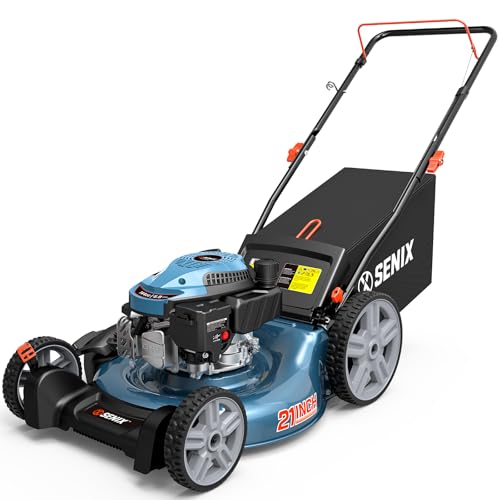
The SENIX is the push-powered alternative, with side discharge, mulching and rear bagging supported by its 3-in-1 steel deck. Its 144cc four-cycle OHV engine and 21-inch cutting width suit buyers who want those discharge options but do not need self-propulsion. The cut-height range is 1.25 to 3.75 inches, and a 1.7-bushel grass bag is included for bagging. The key limitation is the drive type: pushing the mower requires the operator to supply the forward movement, so it is a less suitable choice on slopes or for anyone specifically seeking self-propulsion.
Bottom line: Choose it if push mowing is acceptable and side discharge is needed.
Wanotine 731-07486 MTD Side Chute

The Wanotine is a replacement side-discharge chute, not a complete mower. It is identified for MTD 21-inch-deck self-propelled mowers and names Troy-Bilt TB110, TB130 and TB1100 among compatible walk-behind models; the fields also cite Craftsman, Cub Cadet, Yard Man, Yard Machines, Bolens and Husky. Its part number is 731-07486. This is relevant if your existing mower needs a chute rather than a new machine. It does not provide a deck, engine or self-propelled system of its own, so it cannot meet a request for a complete mower. Check your mower model and part number before ordering.
Bottom line: Choose it to replace a compatible MTD-family side chute.
115-8447 Toro Recycler Side Chute

The 115-8447 is a side-discharge chute for specified Toro 22-inch Recycler mower models, rather than a complete self-propelled mower. The model list includes several 20330, 20332 and 20333 variants, among others. Its role is therefore different from the complete mowers: it is for an owner whose compatible Toro needs a replacement chute. The specifications do not establish compatibility with every 22-inch Recycler or identify this as a mower, so do not rely on deck width alone. Verify the mower model and part number before ordering.
Bottom line: Choose it only for a compatible Toro Recycler needing a chute.
How to choose a side-discharge mower
Choose by drive type first, then check that side discharge is an actual mowing mode. A self-propelled mower drives its wheels while the operator steers; a push mower relies on the operator for forward movement. Rear-wheel drive is a common arrangement for walk-behind mowers and can help maintain traction on slopes, but it does not make a mower suitable for every incline. For a new mower, compare cutting width and height range as well as discharge modes. Side discharge leaves clippings on the lawn, while bagging collects them and mulching cuts them into finer pieces beneath the deck. If your priority is a replacement chute, match the chute part number and mower model rather than choosing by deck width alone.
Side-discharge mower fit and chute compatibility
Match a replacement chute to the mower’s model and part number; a 21- or 22-inch deck measurement alone is not a reliable compatibility check. Chutes are shaped to attach to particular deck openings and guards, so a similar-looking part may not fit or latch correctly. Complete mowers also differ in cutting width: a wider deck covers more ground per pass, but maneuverability and storage space matter in tight yards. Measure gates and storage openings before choosing a wider mower, and confirm the mower’s cutting-height range covers your lawn’s needs. Confirm the mower model and chute part number before ordering a replacement.
When to use side discharge, mulch or bag
Side discharge is useful when grass is too long or plentiful to leave finely mulched, because the mower can expel clippings rather than collecting them in a bag. Mulching works best when the grass is cut regularly and only a modest amount is removed at a time; taking off more than about one-third of the blade height can leave clumps and stress turf. Bagging is useful when you want to collect clippings, but it adds stops to empty the catcher. Avoid mowing wet grass when possible: damp clippings can clump and clog the discharge path. Keep people clear of the discharge side, and never reach beneath a mower deck while the blade could rotate.
Cutting height and mowing decisions
Set the mower to remove no more than one-third of the grass blade in a single pass; if the lawn is overgrown, raise the deck and lower it gradually over later cuts. Grass type and season affect the appropriate final height, so use the range your mower allows without scalping the lawn. A height range of 1.5 to 3.9 inches provides more adjustment span than a fixed-height setting, but the range is not a recommendation to mow at its lowest point. For thick growth, mow slowly and avoid forcing a heavy layer of clippings through the deck. Clear sticks and debris before mowing, and stop the engine before inspecting a blocked chute or deck.
Frequently Asked Questions
How often should I mow before using side discharge?
Mow often enough to remove no more than about one-third of the grass blade per cut. Faster growth may require shorter intervals, while dry or slow-growing conditions can lengthen them.
Can side discharge handle tall or wet grass?
Side discharge can move clippings out of the deck, but very tall grass may still clog or leave clumps. Avoid wet mowing when possible, and take off no more than one-third of blade height at a time.
Does a 22-inch mower cut faster than a 21-inch mower?
A 22-inch deck covers one inch more width per pass than a 21-inch deck. Actual mowing time also depends on obstacles, turns and lawn shape, so a wider deck can be less convenient in tight areas.
How do I choose the right mower cutting height?
Choose a setting that leaves the grass long enough for its type and conditions, and remove no more than one-third of blade height per cut. If the lawn is too tall, raise the deck and reduce the height over successive mowings.
How can I identify a compatible side-discharge chute?
Match the mower’s model and the chute’s part number, rather than relying on deck width alone. The chute must fit the deck opening and attach securely; verify both identifiers before ordering.