
Grinding Stones for Metal: 3 Shank and Shape Options

For metal grinding with a 1/4-inch-shank rotary tool, JUNLIXN Aluminum Oxide Grinding Wheels is a practical starting point because its three wheel diameters cover different contact areas. Choose Luo ke 80-Grit Grinding Stone Set instead for varied point shapes, or JUNLIXN 10-Piece Hex-Shank Stones if your tool accepts a 1/4-inch hex shank.
These mounted abrasive stones attach to a powered tool for grinding, shaping or polishing. A carbide burr or a large angle-grinder cup is a different tool type, so match the attachment and shank to your tool before choosing.
We earn a commission if you buy through links on this page. As an Amazon Associate I earn from qualifying purchases. Products are compared on manufacturer specifications, not hands-on testing.
- Best overall: JUNLIXN Aluminum Oxide Grinding Wheels – Three wheel diameters—40, 50 and 60 mm—offer different contact areas.
- Best for varied shapes: Luo ke 80-Grit Grinding Stone Set – The six-piece set includes wheel, cylinder and cone shapes.
- Best for hex-shank tools: JUNLIXN 10-Piece Hex-Shank Stones – Its 1/4-inch hex shank fits rotary tools and compatible drills.
| Product | Best for | Abrasive | Shank | Set | Shop |
|---|---|---|---|---|---|
| JUNLIXN Aluminum Oxide Grinding Wheels | Wheel grinding | Aluminum oxide | 1/4 in | 3 wheels | Check Price on Amazon |
| Luo ke 80-Grit Grinding Stone Set | Mixed point shapes | Corundum sand | 1/4 in | 6 points | Check Price on Amazon |
| JUNLIXN 10-Piece Hex-Shank Stones | Hex-shank drills | Aluminum oxide | 1/4 in hex | 10 stones | Check Price on Amazon |
Grinding stones for metal
Compare the abrasive, shank style and included shapes to find a stone set that fits your tool and task.
JUNLIXN Aluminum Oxide Grinding Wheels

Three wheel diameters distinguish this set: 40, 50 and 60 mm stones give you different contact areas for grinding and polishing. Each wheel is 13 mm thick and has a 1/4-inch shank for compatible rotary tools, drills, grinders or pneumatic tools. The aluminum oxide abrasive is intended for steel, alloys and other materials, including nonmetals. Wet or dry use is described, with water recommended to reduce dust. Choose these when wheel shapes suit the work; this set does not provide the assorted point shapes found in a multi-shape kit.
Bottom line: Pick this set if you want three wheel sizes for a compatible 1/4-inch-shank tool.
Luo ke 80-Grit Grinding Stone Set
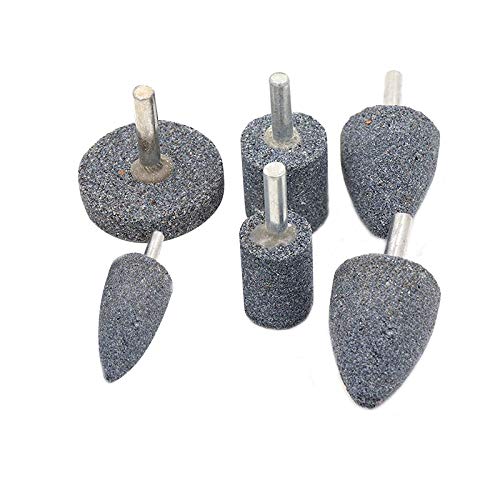
Wheel, cylinder and cone shapes make this six-piece set the option for work that needs more than a wheel profile. The stones use corundum sand and are described as 80 grit, with a 1/4-inch shank for rotary tools, die grinders and bench drills. The maker lists metal, stainless steel, glass, ceramics and gems among suitable materials. Wet or dry use is mentioned, and water is recommended to reduce dust. Confirm that the selected shape can reach the work area; a wheel-only set may be simpler for broad, flat contact.
Bottom line: Choose this set when the job calls for wheel, cylinder and cone points.
JUNLIXN 10-Piece Hex-Shank Stones

A 1/4-inch hex shank sets this ten-piece aluminum oxide kit apart from the round-shank options. It is intended for rotary tools, impact and regular driver drills, die grinders and hand drills that accept that shank style. The product calls out cylindrical stones for surface work, deburring and rust removal, as well as grinding and shaping metal, glass and alloys. This format suits buyers who need a hex connection or multiple stones.
Bottom line: Pick this kit if your tool accepts a 1/4-inch hex shank.
How to choose grinding stones for metal
Choose by the work surface, the stone profile and the tool connection, in that order. A wheel presents a broader contact face, while a cylinder or cone can reach narrower areas; a rotary attachment also needs a shank your collet or chuck can grip. If the tool accepts only a 1/4-inch round shank, do not assume a 1/4-inch hex shank will fit. A set with several diameters or shapes is useful when one profile cannot reach every surface, but a single profile can be easier to control for repeated, similar work. For small parts, use a stable clamp rather than holding the work near a rotating stone.
Shank fit and tool compatibility
Match the attachment shank to the tool’s collet or chuck before powering up; a matching nominal size alone does not guarantee a secure fit if the shape differs. The products here specify 1/4-inch shanks, with one set using a hex profile and the others describing mounted stones or points. Insert the shank fully and tighten the collet or chuck securely, as required for the tool. Do not use a loose or visibly damaged stone. A stone that wobbles, vibrates unusually or has a crack should be taken out of service. Follow the tool maker’s maximum speed and the abrasive maker’s limits, since an attachment rated for a lower speed can fail if run too fast.
Stone shapes and contact areas
Wheel stones are suited to accessible surfaces, while cylindrical and cone profiles help concentrate contact on edges, corners or narrower areas. The best shape depends on access and how much surface you need to touch at once. Use light, controlled contact rather than forcing the stone into the metal; excess pressure can overheat the work or wear the abrasive unevenly. Keep the stone moving across the work when a fixed point could dig in, and test the setup on a safe area when finish matters. For a broad flat surface, prefer a profile with a broader face; for a recess, select a profile that reaches it without rubbing the shank against the work.
Safe use and dust control
Wear eye protection whenever using a powered grinding stone, and keep hands, loose clothing and cords away from the rotating attachment. Metal grinding can produce sparks and fine dust, so clear combustible material from the work area and use suitable dust control. Water can reduce airborne dust where the tool, stone and workpiece are appropriate for wet use; never introduce water to an electrical tool unless its maker permits wet operation. Secure the workpiece, use the correct guard where supplied, and stay within the attachment’s rated speed. Stop the tool before changing stones, and wait for the wheel to stop completely before setting it down.
Frequently Asked Questions
Can grinding stones remove rust from metal?
Some mounted stones are intended for rust removal, but removal rate depends on the stone profile, abrasive and rust thickness. Use light pressure and avoid grinding into the base metal more than necessary.
Should I use grinding stones wet or dry?
Some mounted stones permit either method, and water can help reduce dust. Use wet grinding only when both the tool and the abrasive are suitable for water exposure.
How do I stop a grinding stone from wobbling?
Seat the shank fully and clamp it securely in a compatible collet or chuck before starting. Stop immediately if the stone still wobbles, since an unbalanced or damaged attachment can break at speed.
What safety gear should I wear when grinding metal?
Wear eye protection, and use appropriate respiratory and hearing protection for the work and tool. Keep sparks away from combustible materials and secure the workpiece before bringing the stone into contact.