
Clear Coat for Plastic: 4 Sprays Compared by Use

For a general-purpose clear coat for plastic, Rust-Oleum Painter’s Touch 2X Gloss Clear is the closest match because its oil-based formula is specified for plastic and its gloss clear finish suits a protective topcoat. Choose Rust-Oleum Acrylic Enamel 2X Gloss Clear if you want a paint-and-primer formula for most plastic; for automotive paint or crafts, use a product made for that purpose instead.
We earn a commission if you buy through links on this page. As an Amazon Associate I earn from qualifying purchases. Products are compared on manufacturer specifications, not hands-on testing.
- Best overall: Rust-Oleum Painter’s Touch 2X Gloss Clear – Its oil-based formula is specified for plastic and it comes in a gloss clear finish.
- Best for paint and primer: Rust-Oleum Acrylic Enamel 2X Gloss Clear – Its all-in-one paint-and-primer formula is specified for most plastic.
- Best for auto paint: U-POL Expert Color Protective Clearcoat – It is designed as a protective clearcoat over Expert Color Pro Grade Auto Paint.
| Product | Best for | Finish | Volume | Shop |
|---|---|---|---|---|
| Rust-Oleum Painter’s Touch 2X Gloss Clear | General plastic projects | Gloss clear | 12 oz | Check Price on Amazon |
| Rust-Oleum Acrylic Enamel 2X Gloss Clear | Paint-and-primer coating | Gloss clear | 12 oz | Check Price on Amazon |
| Krylon COLORmaxx Acrylic Clear Finish | Indoor outdoor finish | Gloss crystal clear | 11 oz | Check Price on Amazon |
| U-POL Expert Color Protective Clearcoat | Automotive paint repairs | High gloss | 7.4 oz | Check Price on Amazon |
Clear Coats for Plastic
Match the clear coat to the plastic surface and the coating beneath it before choosing a finish.
Rust-Oleum Painter’s Touch 2X Gloss Clear

For a general-purpose plastic clear coat, this Rust-Oleum spray is the most direct match in the group: its oil-based formula is specified for plastic, as well as wood, metal, plaster, masonry and unglazed ceramic. The maker says it dries to the touch in 20 minutes and covers up to 12 square feet per can. Its gloss finish works for projects where added shine is wanted. The limitation is the oil-based spray format; buyers coating delicate or solvent-sensitive plastic should test a hidden area first and let it dry fully before coating the full piece.
Bottom line: Choose this for a gloss protective coat on a plastic project when an oil-based aerosol suits the surface.
Rust-Oleum Acrylic Enamel 2X Gloss Clear
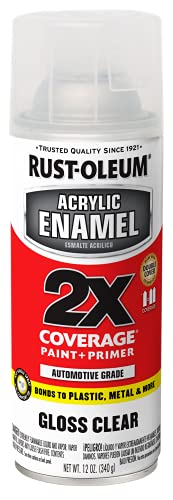
This Rust-Oleum option combines paint and primer in one spray, making it distinct from a clearcoat positioned only as a protective layer. It is specified for metal, wood and most plastic, and the maker says it dries to the touch in 20 minutes and covers up to 12 square feet per can. The product is described as creating a smooth finish with double the coverage. Because it is a paint-and-primer formula, it may not be the right choice when the project calls for a dedicated clear topcoat over an existing finish; confirm the intended coating system before applying it.
Bottom line: Pick this when a gloss paint-and-primer spray for most plastic matches the project.
Krylon COLORmaxx Acrylic Clear Finish

Krylon COLORmaxx is an acrylic clear finish in an 11-ounce aerosol, rather than a product with plastic compatibility specified in its features. The name identifies a gloss crystal-clear finish for indoor and outdoor use, so it may suit a project where those traits matter and the underlying surface is compatible. Its limitation for plastic work is the missing surface-specific confirmation: plastic types and existing coatings react differently to solvents and finishes. Test a concealed spot and allow it to dry before committing to the whole piece, particularly on flexible or glossy plastic.
Bottom line: Consider this when an acrylic gloss finish is the priority and a compatibility test confirms the plastic.
U-POL Expert Color Protective Clearcoat

This U-POL clearcoat is the automotive-focused choice, designed for use over Expert Color Pro Grade Auto Paint rather than as a general plastic topcoat. The maker says its coating protects paint repairs from scratches and chips and provides a high-gloss finish; it also describes a fan spray nozzle. That target use makes it relevant when a plastic vehicle part has first been painted with the specified auto-paint system. It is not the straightforward option for bare plastic or craft surfaces, so buyers should verify that the substrate and paint system match the intended repair process.
Bottom line: Choose this for an automotive repair using the matching Expert Color paint system.
How to choose a clear coat for plastic
Choose by the plastic type, the finish beneath the clear coat and whether the product is meant to be a topcoat or a paint-and-primer. Plastic is not one uniform surface: rigid ABS, polypropylene and polyethylene can differ in how well coatings adhere, and a coating made for one may not bond to another. Gloss also makes surface defects more visible than satin or matte. For a topcoat over an existing color, favor a product explicitly intended for that coating system; for bare plastic, check that the product names plastic as a compatible surface. If you cannot confirm the plastic or coating compatibility, test a hidden area first rather than coating the full part.
Preparing plastic before spraying
Clean plastic with mild soap and water, then rinse and let it dry completely; dust, oils and handling residue can interfere with adhesion. Lightly scuffing a compatible rigid surface with fine abrasive can help create a key, but avoid sanding thin, textured or flexible parts unless the finish can tolerate it. Mask surrounding areas and spray in a ventilated location, away from flames or sparks, because aerosol coatings release flammable vapors. Apply several light passes rather than one heavy coat to reduce runs and pooling. A concealed test patch is especially important on glossy, flexible or unknown plastics: stop if the surface wrinkles, softens or stays tacky.
Using spray clear coat on plastic
Hold an aerosol about 8 to 12 inches from the surface as a general starting point, keep the can moving, and overlap each pass slightly; the product directions take priority if they specify another distance. Begin and end each pass just beyond the workpiece to avoid concentrated wet spots at the edges. Thin coats are safer than a single wet coat because pooled solvent can mar plastic or lift an underlying finish. Temperature and humidity affect drying, so use a dry, well-ventilated work area within the product’s conditions. Touch-dry does not necessarily mean fully cured; avoid handling or exposing the finished part to abrasion until the coating has hardened.
Clear coat types and project fit
General-purpose plastic-compatible sprays are the simplest match for bare plastic projects; paint-and-primer sprays are a different category and may change the surface color or build. Automotive clearcoats are designed around a compatible paint system and are not interchangeable with every plastic coating. Acrylic craft varnishes generally target painted artwork and craft substrates, not every kind of plastic. Use this rule: when a clear protective layer over existing color is the goal, choose a product that identifies that exact surface and coating system; when the product is specified only for another use, do not assume it will bond to plastic. The table distinguishes these use cases.
| Product type | Best fit | Check before coating |
|---|---|---|
| Plastic-compatible general spray | Bare compatible plastic | Plastic type and test patch |
| Paint-and-primer spray | Color plus coating in one product | Whether a clear-only layer is needed |
| Automotive clearcoat | Matching automotive paint system | Substrate and paint compatibility |
Frequently Asked Questions
Can clear coat be sprayed directly on plastic?
Yes, when the coating specifically identifies the plastic as compatible. Clean and dry the surface first, then test a hidden area because some plastics can soften, wrinkle or resist adhesion.
How many coats of clear spray should I apply?
Several light coats are generally safer than one heavy coat, which can run or pool. Follow the product’s recoat timing and let the finish cure before handling it.
Should plastic be sanded before clear coating?
Light scuffing can help on compatible rigid plastic, but sanding can damage thin or textured parts. Clean first and test the preparation method on a concealed spot.
How far away should I spray clear coat?
About 8 to 12 inches is a common starting distance for aerosol paint, with the can moving steadily across the surface. Adjust to the product directions and avoid wet buildup.
Can automotive clear coat go on bare plastic?
Automotive clearcoat is generally intended to go over a compatible paint system, not directly on bare plastic. Verify the specified primer, paint and substrate pairing before coating a vehicle part.