
Best Wood Stove Fan No Electricity: 5 Models Compared

Freedom Stoves 13-Inch 4-Blade Fan suits most people because its maker gives a concrete airflow figure of up to 348 CFM and designs it for flat-top stoves. A heat-powered stove fan uses heat from the stove to drive its blades, so output rises and falls with stove temperature.
Choose another model if you need a smaller fan, prefer a specific blade count, or want an included thermometer; confirm that your stove has a suitable flat top before choosing a fan.
We earn a commission if you buy through links on this page. As an Amazon Associate I earn from qualifying purchases. Products are compared on manufacturer specifications, not hands-on testing.
- Best overall: Freedom Stoves 13-Inch 4-Blade Fan – Its airflow reaches up to 348 CFM, and it is designed for flat-top stoves.
- Best for thermometer included: JossaColar Large Heat-Powered Fan – The package includes a magnetic thermometer, and the fan measures about 7.7 inches high.
- Best for six-blade design: Six-Blade Anodized Aluminum Fan – Its six angled blades are intended to direct warmth sideways.
| Product | Best for | Height | Fan design | Included extra | Shop |
|---|---|---|---|---|---|
| Freedom Stoves 13-Inch 4-Blade Fan | Larger flat tops | 13 in | 4 blades; up to 348 CFM | — | Check Price on Amazon |
| JossaColar Large Heat-Powered Fan | Thermometer included | 7.7 in | Curved aluminum blades | Magnetic thermometer | Check Price on Amazon |
| VODA XX-Large Heat-Powered Fan | Larger fan footprint | 8.3 in | — | — | Check Price on Amazon |
| Six-Blade Anodized Aluminum Fan | Sideways airflow design | 8.5 in | 6 blades; anodized aluminum | — | Check Price on Amazon |
| Eight-Blade Medium Heat-Powered Fan | Eight-blade design | 8.6 in | 8 blades | Stove thermometer | Check Price on Amazon |
Wood Stove Fans With No Electricity
Compare the dimensions and features that matter for fitting a heat-powered fan to your stove and room.
Freedom Stoves 13-Inch 4-Blade Fan

For a larger room and a flat-top stove, this fan stands apart with its maximum airflow of 348 CFM. Its 13-inch, four-blade design uses heat from wood, pellet, or log-burning stoves to turn the blades, without cords, batteries, or an outlet. The maker says its speed increases as the stove top warms and slows as it cools. Its size and flat-top requirement are the main limitations: check the available surface before choosing it, especially if the stovetop is crowded or not flat.
Bottom line: Choose this when the stove has a suitable flat top and higher stated airflow is the priority.
JossaColar Large Heat-Powered Fan

The included magnetic thermometer distinguishes this JossaColar fan from models sold without an extra. Its curved aluminum blades are intended to spread heat, and the fan runs on stove heat without batteries. At about 7.7 inches high, it is a compact option compared with the 13-inch model. The maker also includes a one-year replacement warranty for quality problems. The maker does not give an airflow figure, so buyers who need to compare expected air movement numerically should choose a model with a CFM rating instead.
Bottom line: Choose this if the included magnetic thermometer matters more than a published airflow figure.
VODA XX-Large Heat-Powered Fan
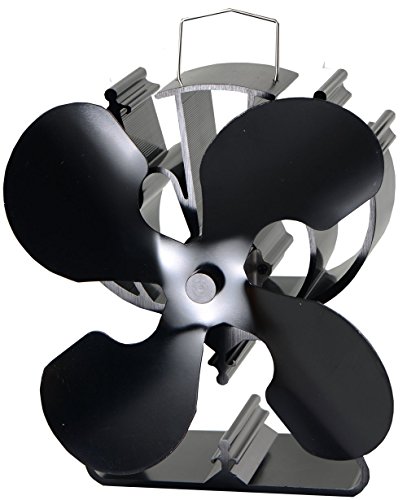
With an 8.3-inch height and width, this VODA is the larger-footprint option among the compact fans with dimensions provided. It uses heat from the stovetop rather than electricity or batteries, and the maker says its working efficiency can vary with stove temperature. That temperature dependence is typical of this fan style, so airflow can change as a fire burns down.
Bottom line: Choose this if its larger stated footprint fits your stove and room.
Six-Blade Anodized Aluminum Fan

This six-blade model is the option whose design specifically aims to send warmth sideways rather than straight upward. It is made of anodized aluminum and is intended for smooth, flat wood, coal, and pellet stove tops. The maker gives an operating temperature range of 185°F to 660°F and claims noise below 25 dB; these are maker claims rather than independent measurements. At 8.5 inches high, it needs room above the stovetop.
Bottom line: Choose this if sideways-directed airflow and an operating range suit your setup.
Eight-Blade Medium Heat-Powered Fan

The eight-blade design and included stove thermometer set this medium-size model apart. The maker says heat from the stove generates electricity for the fan and that blade speed rises as the stove heats up. Its dimensions are 8.6 inches high, 5.7 inches long, and 4.3 inches wide, useful measurements when stovetop space is limited.
Bottom line: Choose this if you want an eight-blade design and an included stove thermometer.
How to Choose a Wood Stove Fan With No Electricity
Start with fit, then compare stated airflow and fan design. A heat-powered fan sits on a warm stove top and uses a thermoelectric generator to power its motor; it does not circulate air when the stove is cold. Among these options, only Freedom Stoves 13-Inch 4-Blade Fan gives a CFM figure, up to 348 CFM, while other products emphasize dimensions, blade configuration, or an included thermometer. CFM is the volume of air moved per minute, but it does not by itself guarantee even room temperatures: room layout, ceiling height, and obstructions affect circulation. Measure the usable flat surface before selecting a fan. If you need an airflow comparison rather than a feature comparison, prioritize a model with a CFM figure.
Stove-Top Fit and Placement
A flat, level surface is the key fit condition for these stove-top fans. The Freedom Stoves model explicitly requires a suitable flat top, and the six-blade model also calls for a smooth, flat surface. Measure the available area in inches and compare it with the fan’s footprint: Freedom Stoves 13-Inch 4-Blade Fan is 10.5 inches wide and 3 inches long, while JossaColar Large Heat-Powered Fan is about 6.5 inches wide and 3.3 inches long. Place a fan where it can draw cooler room air behind it and push warmed air toward the living area, rather than directly into a wall. Keep it clear of stovepipe connections and controls. Stove placement and clearances matter; do not let a fan interfere with the appliance’s required safe clearances.
Heat-Powered Fan Features Compared
Blade count, stated airflow, and extras are not interchangeable measures. A higher blade count alone does not establish higher CFM, and a thermometer helps read stove temperature but does not show room airflow. Use this comparison to narrow by the feature you actually need, then check dimensions against the stove.
| Need | Feature to compare | Option |
|---|---|---|
| Stated airflow figure | CFM | Freedom Stoves 13-Inch 4-Blade Fan: up to 348 CFM, maker claim |
| Temperature reading accessory | Thermometer included | JossaColar Large Heat-Powered Fan: magnetic; Eight-Blade Medium Heat-Powered Fan: included |
| Specific blade design | Blade count or direction | Six-Blade Anodized Aluminum Fan: six angled blades; Eight-Blade Medium Heat-Powered Fan: eight blades |
Choose a published airflow figure when output is the deciding factor; choose by footprint or accessory when fit and monitoring matter more.
Safe Use and Care for Stove Fans
Keep a stove fan on a stable, level stove-top area and handle it only after it has cooled. Stove surfaces and nearby metal can become hot enough to burn, so do not reposition a running fan by hand; use heat-resistant gloves only when a move is necessary and safe. Heat-powered fans change speed as the stove warms and cools, and that behavior is described for Freedom Stoves 13-Inch 4-Blade Fan and Eight-Blade Medium Heat-Powered Fan. Stay within the specific model’s temperature range when one is given: Six-Blade Anodized Aluminum Fan states 185°F to 660°F. Dust can restrict blade movement over time, so inspect and clean the fan only when cool, following its care guidance. Never use a stove fan to replace required ventilation, smoke alarms, or safe stove clearances.
Frequently Asked Questions
How does a wood stove fan work without electricity?
A heat-powered stove fan converts heat at its base into electricity for a small motor, which turns the blades. It slows or stops as the stove cools, so it is not a stand-alone heater.
Where should I place a stove fan on the stovetop?
Use a stable, level section near the rear or side of the stove, where cooler room air can reach it and its outlet is not aimed into a wall. Keep the fan clear of stovepipe connections, controls, and required appliance clearances.
Can a stove fan sit on a stovetop that is not flat?
These products are intended for flat or smooth stove tops, and Freedom Stoves 13-Inch 4-Blade Fan specifically requires a suitable flat surface. Do not balance a fan on an uneven top; confirm the surface is stable and large enough for its footprint.
When should I move or clean a stove fan?
Move or clean a stove fan only after it has cooled fully; the stove and fan can remain hot after the fire dies down. Dust the blades and base periodically, since buildup can impede blade movement.
Does more fan blades mean more airflow?
Not necessarily: blade count alone does not establish airflow in CFM. Compare a CFM rating when available, and account for room layout and stove temperature, which also affect circulation.