
T10 Mobile Hotspot: Models Compared by Fit

The Franklin T10 is the closest fit for a T10 mobile hotspot search because it is a T-Mobile-only 4G LTE model that supports up to 15 Wi-Fi devices. Choose a different option if you need a Verizon-specific hotspot or a travel-focused device advertised for other networks.
Mobile hotspots use a cellular connection for internet access and share it over Wi-Fi, so carrier compatibility and your data plan matter as much as the Wi-Fi device limit.
We earn a commission if you buy through links on this page. As an Amazon Associate I earn from qualifying purchases. Products are compared on manufacturer specifications, not hands-on testing.
- Best overall: Franklin T10 RT410 – T-Mobile-only 4G LTE service, support for up to 15 devices, and concurrent 2.4GHz and 5GHz Wi-Fi.
- Best for Verizon: Verizon Ellipsis Jetpack MHS800L – A Verizon Wireless Jetpack that supports up to 8 Wi-Fi devices and has an OLED display.
- Best for travel: Portable LTE CAT4 Wi-Fi Hotspot – Advertised for road trips, camping, and remote work, with support for up to 18 devices.
| Product | Best for | Cellular network | Wi-Fi device limit | Wi-Fi bands or speed | Shop |
|---|---|---|---|---|---|
| Franklin T10 RT410 | T-Mobile users | T-Mobile 4G LTE | Up to 15 | 2.4GHz and 5GHz | Check Price on Amazon |
| Franklin T10 Mobile Hotspot Router | Home or office | Not identified | Not identified | Not identified | Check Price on Amazon |
| Verizon Ellipsis Jetpack MHS800L | Verizon users | Verizon Wireless 4G LTE | Up to 8 | — | Check Price on Amazon |
| Portable LTE CAT4 Wi-Fi Hotspot | Road-trip groups | Unlocked; SIM slot | Up to 18 | 300Mbps advertised | Check Price on Amazon |
T10 mobile hotspot options
Compare carrier fit and device capacity first, then check that the hotspot matches your intended cellular network.
Franklin T10 RT410

The Franklin T10 RT410 is the only T10 model here with a carrier and Wi-Fi band combination: it is for T-Mobile, supports up to 15 devices, and offers concurrent 2.4GHz and 5GHz Wi-Fi. The maker says its antennas are designed for indoor and outdoor hotspot performance. That device capacity suits a small group connecting laptops, tablets, or other Wi-Fi equipment. The key limitation is carrier fit: this model is T-Mobile-only, so it is not the choice for a Verizon line or another carrier unless compatibility is confirmed before ordering. It is also a renewed unit.
Bottom line: Pick this if you use T-Mobile and need dual-band Wi-Fi for as many as 15 devices.
Franklin T10 Mobile Hotspot Router

The Franklin T10 Mobile Hotspot Router is presented as a home- or office-oriented wireless option, unlike the T-Mobile-specific RT410. Its features describe multi-room Wi-Fi coverage, simultaneous connections, and a simple setup process, but do not establish a carrier or device limit. Those gaps matter if you plan to use a particular SIM or connect a fixed number of devices. The name also gives a 256GB figure, which should not be treated as data-plan capacity or a Wi-Fi speed. Confirm the exact model and cellular compatibility before choosing this over the T-Mobile-specific T10.
Bottom line: Consider it only if you can confirm the exact model and carrier fit.
Verizon Ellipsis Jetpack MHS800L
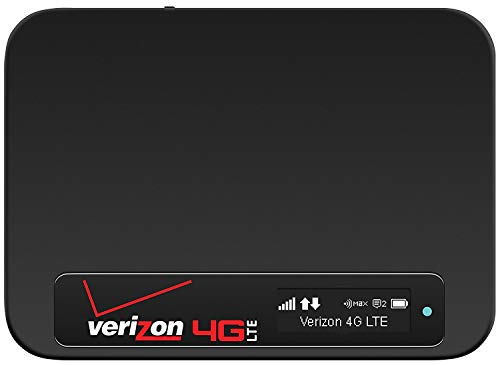
The Verizon Ellipsis Jetpack MHS800L is the clear alternative for a Verizon-focused buyer, while the Franklin T10 is identified for T-Mobile. This credit-card-size hotspot connects up to 8 Wi-Fi devices and has a 0.9-inch OLED display with real-time data-usage reporting. The display can help when you want to check usage on the device itself. Its lower stated connection limit makes it a less suitable match for a group that needs more than eight simultaneous connections. Verify that the Verizon service and plan you intend to use support this model before relying on it.
Bottom line: Choose this for Verizon service when eight connections are enough.
Portable LTE CAT4 Wi-Fi Hotspot
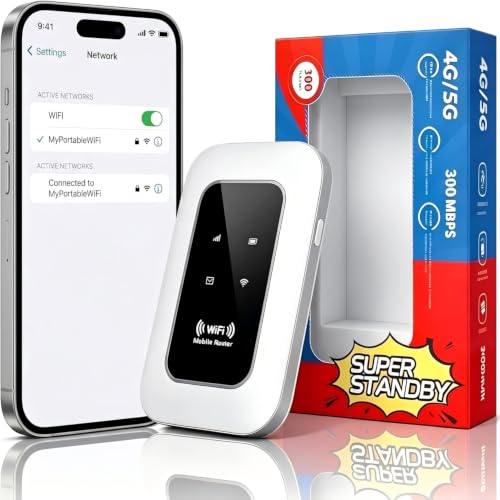
The Portable LTE CAT4 Wi-Fi Hotspot is the travel-oriented option, with a SIM slot and a capacity of up to 18 devices—three more than the T10. Its name advertises 300Mbps and 4G/5G, while its maker describes 4G/5G connectivity; however, CAT4 identifies an LTE category, so verify the actual network capabilities and supported carrier bands before buying. The maker positions it for camping, motorhomes, road trips, and remote work. This option may suit a larger travel group, but the specifications do not establish a particular carrier or battery runtime.
Bottom line: Consider it for travel only after confirming its network compatibility.
How to choose a T10 mobile hotspot
Choose a T10 hotspot by matching its cellular carrier first, then its Wi-Fi capacity and bands. The Franklin T10 RT410 is identified as T-Mobile-only; a Wi-Fi device limit does not mean the hotspot can use every carrier. Cellular service requires a compatible plan, and hotspot data may be subject to a separate allowance or throttling policy, so compare plan terms before relying on a device for video or work. For a small group, up to 15 Wi-Fi devices can be sufficient, but the number connected does not guarantee enough bandwidth for simultaneous high-data tasks. If the hotspot will serve more than one person, estimate how many devices will be active at once rather than counting devices that are merely saved to the network.
What 2.4GHz and 5GHz Wi-Fi mean
Dual-band Wi-Fi gives devices a choice between 2.4GHz and 5GHz, which trade range against congestion and speed. The 2.4GHz band generally reaches farther and passes through walls more effectively, but it has fewer non-overlapping channels and shares spectrum with common household equipment. The 5GHz band typically offers more channel capacity and can be faster at short range, but walls and distance weaken it sooner. Choose 2.4GHz for a device farther from the hotspot or separated by walls; use 5GHz nearby when the connection supports it. Wi-Fi band capability describes the local link from hotspot to device, not the speed of the cellular connection feeding the hotspot.
How LTE category and advertised speed compare
LTE category describes a modem’s technical capability, while real-world internet speed depends on the carrier network, signal, congestion, and plan. LTE Category 4 has a theoretical maximum of 150Mbps downlink and 50Mbps uplink under ideal conditions; actual speeds can be lower. A 300Mbps figure in a product name should not be assumed to mean 300Mbps of cellular internet, especially when the same name refers to LTE CAT4 and advertises 4G/5G. Check the model’s supported cellular bands and confirm what the speed measures before choosing. A strong Wi-Fi signal inside a room cannot compensate for weak cellular reception outside the hotspot.
Match hotspot type to your travel needs
Carrier-specific hotspots and unlocked SIM-slot models solve different problems. A carrier-specific model is a clearer fit when you already know which network you will use; an unlocked label alone does not guarantee compatibility with every carrier or band. For travel, confirm coverage along the route, supported network bands, SIM requirements, and whether the plan permits hotspot use. A device limit such as 18 connections is not a measure of battery life or coverage distance. Use a table of needs to narrow the type, then validate the cellular fit for your destination.
| Need | Type to consider | Check before choosing |
|---|---|---|
| Known T-Mobile service | T-Mobile-specific hotspot | Plan and device compatibility |
| Known Verizon service | Verizon Jetpack | Model support and plan |
| Changing travel locations | SIM-slot hotspot | Carrier bands and coverage |
Frequently Asked Questions
Does the Franklin T10 work with every carrier?
No, the Franklin T10 RT410 is identified as T-Mobile-only. Confirm carrier compatibility and the required plan before using it on another network.
How many devices can connect to the Franklin T10?
The Franklin T10 supports up to 15 Wi-Fi devices. The practical number for demanding tasks may be lower because all connected devices share the cellular connection.
Is 5GHz Wi-Fi always faster on a hotspot?
Not at every distance: 5GHz can offer more capacity nearby, while 2.4GHz generally reaches farther through walls. Choose 5GHz when the device is close and 2.4GHz when range matters more.
What does LTE CAT4 mean for hotspot speed?
LTE Category 4 has theoretical maximum rates of 150Mbps down and 50Mbps up in ideal conditions. Carrier coverage, network load, and the plan affect actual performance.
Does an unlocked hotspot work with any SIM card?
No; an unlocked label does not guarantee that a hotspot supports a carrier’s cellular bands or service requirements. Confirm the model’s bands and carrier compatibility, especially when traveling.