
Lanus Triple Camera 8K Drone: Specs and Fit Compared

The Lanus Triple Camera 8K Drone is the direct match, with optical-flow positioning, three included batteries and a foldable design. Choose a GPS model instead if you want advertised return-to-home or follow-me functions; choose the Bwine if a three-axis gimbal and 4K/30fps video matter more.
We earn a commission if you buy through links on this page. As an Amazon Associate I earn from qualifying purchases. Products are compared on manufacturer specifications, not hands-on testing.
- Best overall: Lanus Triple Camera 8K Drone – The only model explicitly named as the Lanus Triple Camera 8K Drone.
- Best for GPS modes: V918M 8K GPS Drone – Its modes include Follow Me, Waypoint Flight and Circle Fly.
- Best for stabilized video: Bwine F7MINI – It pairs 4K/30fps video with a three-axis gimbal.
| Product | Best for | Camera features | Flight features | Stabilization | Shop |
|---|---|---|---|---|---|
| Lanus Triple Camera 8K Drone | Lanus model match | 8K; 50X zoom; triple camera | Optical flow; 3 batteries | Optical flow positioning | Check Price on Amazon |
| V918M 8K GPS Drone | GPS flight modes | 8K; 50x zoom; adjustable lens | GPS; Follow Me; Waypoint; Circle Fly | Brushless motors | Check Price on Amazon |
| V918 MAX 8K GPS Drone | Screen controller | 8K; 120-degree lens | GPS; 90-minute flight claim | 360-degree obstacle avoidance | Check Price on Amazon |
| Bwine F7MINI | Gimbal video | 8K photos; 4K/30fps video | GPS; Follow Me; Waypoint | 3-axis brushless gimbal | Check Price on Amazon |
Lanus Triple Camera 8K Drone and Alternatives
Compare the named Lanus model with related camera drones by imaging, flight functions and stabilization.
Lanus Triple Camera 8K Drone

The Lanus is the only model here explicitly named as the Triple Camera 8K Drone. Its maker describes an 8K camera, 50X zoom, optical-flow positioning and a foldable form; the package details also include three batteries and two spare fan blades. Those extras suit someone looking for the named product and backup power in one package. The maker does not explain whether all three cameras capture at 8K or how long each battery flies, so buyers who need a particular camera arrangement or flight duration should verify those points before choosing.
Bottom line: Choose this if the Lanus name and three-battery bundle are your priorities.
V918M 8K GPS Drone

The V918M is the GPS-focused alternative, with Follow Me, Waypoint Flight and Circle Fly named among its modes. That makes it a better fit than the Lanus if those automated flight options decide the purchase. The advertised obstacle avoidance and safe-return behavior are maker claims, not a substitute for maintaining visual line of sight or checking the flight area.
Bottom line: Pick this when GPS-assisted modes matter more than an exact Lanus match.
V918 MAX 8K GPS Drone
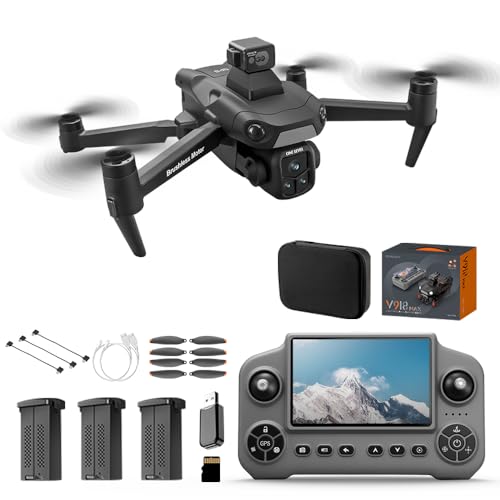
The maker claims up to 90 minutes of flight time and describes GPS return and 360-degree obstacle avoidance. This combination may suit buyers who want an included display and media storage rather than the Lanus’s three-battery package. The flight-time figure is a maker claim, and actual usable time can change with wind, flight style and battery condition; the model is not the named Lanus drone.
Bottom line: Choose this if an integrated screen and included media storage are the draw.
Bwine F7MINI

The Bwine F7MINI is the only alternative here with a specified three-axis brushless gimbal and 4K/30fps video, alongside 8K photos. The maker describes it as under 249 grams and claims 96 minutes of flight time. Those distinctions suit buyers prioritizing a stabilized-video specification over a triple-camera name. It is not a Lanus model, and its video specification is 4K/30fps rather than 8K video.
Bottom line: Pick this if the gimbal and stated 4K video mode fit your needs.
How to choose an 8K camera drone
Choose by the kind of image and flight control you need, not by an 8K label alone. Video resolution, still-photo resolution, sensor size, lens adjustment and stabilization describe different parts of the camera system. For smoother moving video, look for a gimbal; a three-axis gimbal compensates for movement across three axes, while optical flow is a positioning aid rather than a camera stabilizer. GPS modes such as return-to-home or waypoint flight are separate from optical flow. If your main goal is video, compare the video mode and stabilization first; if it is automated routes, compare the named flight modes. A claim such as 50x zoom does not by itself explain whether the zoom is optical or digital, so verify that distinction when image detail is critical.
Understanding optical flow and GPS positioning
Optical flow uses visual movement cues to estimate how a drone shifts relative to the ground; it is most useful when the camera can see a textured surface. Smooth, reflective or dark surfaces and poor lighting can make visual positioning less reliable. GPS uses satellite signals for outdoor positioning and can support return-to-home features, but buildings, trees and signal conditions can affect reception. These systems are not interchangeable: optical flow does not establish GPS return capability, and GPS does not guarantee obstacle detection. For close indoor flying, avoid treating obstacle-avoidance claims as a safety barrier; keep the aircraft clear of people, pets and fragile objects. For outdoor flights, maintain visual line of sight and check local airspace requirements before takeoff.
U.S. rules and weight checks for camera drones
In the United States, recreational flyers must pass the TRUST safety test, follow airspace restrictions and keep the drone within visual line of sight. The FAA generally requires registration when a recreational drone weighs more than 0.55 pounds (250 grams); drones that must be registered are also generally subject to Remote ID requirements unless an exception applies. A drone’s weight alone does not authorize flight in restricted airspace or near emergency response activity. Check current FAA rules and airspace restrictions for the location and type of operation.
What to compare in camera and flight claims
Compare like with like: 8K still-photo claims do not establish 8K video, and a zoom figure does not say whether the lens zooms optically. Flight-time figures also need context: wind, repeated acceleration, temperature and battery age can reduce actual flight duration. For a safer planning margin, set a return point well before the battery reaches its minimum-power warning rather than planning to use every advertised minute. Avoid flying in strong wind beyond the aircraft’s capability, and do not rely on automated return as a replacement for monitoring the aircraft.
Frequently Asked Questions
What does optical flow do on a drone?
Optical flow estimates movement relative to visible ground features to help hold position. It can be less reliable over smooth or reflective surfaces and in poor light.
Do recreational drone pilots need a safety test?
Yes, recreational flyers in the United States must pass the FAA’s TRUST test. Registration generally applies when a recreational drone weighs more than 0.55 pounds (250 grams).
How much clearance should I leave around a camera drone?
Leave several feet from people, pets, walls and branches, and more in gusty conditions or when learning the controls. Do not count advertised obstacle avoidance as permission to fly close to people or property.
Can GPS return-to-home replace keeping a drone in sight?
No, recreational operators must keep the drone within visual line of sight. GPS return can assist with recovery, but signal conditions and obstacles can affect its route.