
Kolice Ice Cream Machines: 4 Models Compared

For most shops seeking a Kolice hard ice cream machine, Kolice ETL Countertop Gelato Machine offers a practical balance of countertop size and up to 9–11 gallons per hour. Choose Kolice 4-Gallon Countertop Hard Ice Cream Machine for lower output and a smaller footprint, or Kolice 23–27-Gallon Gelato Machine for much higher output if its 220V power suits your setup.
These machines freeze and churn hard ice cream, gelato, or similar products in a batch; buyers seeking soft serve need a different machine type.
We earn a commission if you buy through links on this page. As an Amazon Associate I earn from qualifying purchases. Products are compared on manufacturer specifications, not hands-on testing.
- Best overall: Kolice ETL Countertop Gelato Machine – Countertop design and 9–11 gallons per hour suit a broad range of commercial needs.
- Best for small shops: Kolice 4-Gallon Countertop Hard Ice Cream Machine – Its 4-gallon-per-hour output and 65-pound weight make it the smallest-capacity option here.
- Best for high output: Kolice 23–27-Gallon Gelato Machine – It reaches 23–27 gallons per hour, with a 31-liter cylinder and 220V power.
| Product | Best for | Output | Power | Weight | Shop |
|---|---|---|---|---|---|
| Kolice ETL Countertop Gelato Machine | Countertop production | 9–11 gal/hour | 110V, 2000W | 176 lb | Check Price on Amazon |
| Kolice 4-Gallon Countertop Hard Ice Cream Machine | Lower-volume shops | 4 gal/hour | 110V, 1400W | 65 lb | Check Price on Amazon |
| Kolice Vertical ETL Hard Ice Cream Machine | Vertical floor setup | 9–11 gal/hour | 110V, 2200W | 231 lb | Check Price on Amazon |
| Kolice 23–27-Gallon Gelato Machine | Highest output | 23–27 gal/hour | 220V, 5800W | 250 lb | Check Price on Amazon |
Kolice ice cream machines
Compare the hard ice cream models by output, power needs, and countertop or floor placement.
Kolice ETL Countertop Gelato Machine

Kolice ETL Countertop Gelato Machine combines a countertop format with output up to 9–11 gallons per hour, placing it between the smaller 4-gallon model and the higher-output floor machine. Its 14-liter cylinder is designed for Italian water ice, sorbet, gelato, and hard ice cream. A 4.3-inch touch panel, timer, automatic operation, and auto-wash function are included; the manufacturer says the machine has ETL certification.
At 176 pounds and 20.5 by 26.8 by 30.7 inches, it needs a sturdy counter with enough clearance. Its output is lower than the 23–27-gallon model, so it is a less suitable fit for a shop needing the highest throughput.
Bottom line: Choose this model for countertop placement and midrange stated output.
Kolice 4-Gallon Countertop Hard Ice Cream Machine

Kolice 4-Gallon Countertop Hard Ice Cream Machine is the lowest-output hard ice cream option here, producing 4 gallons per hour with a 4.5-liter freezing cylinder. Its 65-pound weight and 17.13-by-19.29-by-25.2-inch dimensions make it substantially smaller than the other hard ice cream machines in this comparison. The machine has 110V, 1400W power, an intelligent control panel, timer control, automatic operation, and auto washing.
This model suits a smaller operation that does not need the higher hourly output of Kolice ETL Countertop Gelato Machine or the floor machines. The 4-gallon-per-hour rate is the key tradeoff for a business with larger or more frequent production needs.
Bottom line: Pick this for a smaller footprint and modest production volume.
Kolice Vertical ETL Hard Ice Cream Machine

Kolice Vertical ETL Hard Ice Cream Machine provides 9–11 gallons per hour in a vertical floor-standing format rather than a countertop layout. Its 14-liter food-grade stainless steel cylinder and extra-strong door are intended for making Italian water ice, sorbet, gelato, or hard ice cream. The manufacturer says it has ETL certification and has passed NSF testing. Automatic operation, auto washing, and timer control are also included.
At 231 pounds and 52.36 inches tall, this machine requires floor space and a clear route into the work area. Its output matches Kolice ETL Countertop Gelato Machine, so the choice between them is mainly about placement and the construction, not a higher production rate.
Bottom line: Choose this vertical model if floor placement and its stronger door suit your setup.
Kolice 23–27-Gallon Gelato Machine
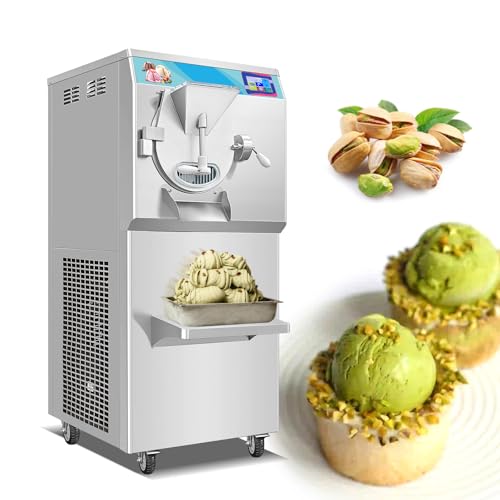
Kolice 23–27-Gallon Gelato Machine has the highest production rate in this group: 23–27 gallons per hour from a 31-liter cylinder. Its 220V, 5.8-kilowatt single-phase power and double commercial compressors set it apart from the 110V machines. It has a stainless steel door and supports vertical feeding, allowing small pieces of chocolate, biscuits, or fresh fruit to be added while it runs. The manufacturer says it has ETL certification.
This model is aimed at commercial operations with a high output requirement and compatible electrical service. Its larger power demand and floor-machine dimensions—25 by 34.25 by 56.5 inches—make it a poor match for a compact counter or a 110V-only setup.
Bottom line: Pick this when high throughput and compatible 220V service are priorities.
How to choose a Kolice hard ice cream machine
Start with the amount you need to produce per hour, then match the machine’s power and footprint to the shop. These hard ice cream machines range from 4 gallons per hour on a 110V countertop model to 23–27 gallons per hour on a 220V floor model. The 9–11-gallon models sit between those capacities. For a small operation below 4 gallons per hour, the larger units may use more space and power than the workload calls for; for a demand above 11 gallons per hour, compare the 23–27-gallon option first.
Batch freezer output is a rate, not a guarantee that one batch will be ready instantly: mix temperature, recipe, and serving texture affect the freezing cycle. Compare the cylinder capacity as well as hourly output when planning how much mix to prepare at once.
Power, space, and installation fit
Check the electrical supply before choosing a machine: these models use either 110V or 220V, and the largest model draws 5.8kW. Confirm the available outlet and circuit capacity before ordering, especially when selecting the 220V unit. Voltage alone does not establish whether an existing circuit is suitable; an electrician can verify the equipment load and connection.
Countertop units still need a firm surface and room for ventilation and operation. The two countertop models weigh 65 and 176 pounds, while the vertical floor model weighs 231 pounds. Measure doorway, counter depth, and overhead clearance against the machine dimensions, and account for the space needed to load mix and clean the cylinder. A unit that fits its final location may still be difficult to move through a narrow entrance.
Batch freezers versus soft-serve machines
Hard ice cream and gelato machines freeze a mix into a denser product that is removed from the cylinder in batches; soft-serve equipment dispenses a softer product directly from a serving head. The right choice follows the finished product and service style, not just the word “ice cream.” Batch machines are suited to scooping and storing portions, while a soft-serve setup is built for dispensing at service time.
Before comparing capacity, decide whether the business will serve scoops, Italian water ice, or soft-serve cones. A gallons-per-hour figure on a hard ice cream machine should not be compared as if it were a soft-serve dispensing rate. Also account for batch preparation and cleaning time when estimating how much product can be ready during a busy period.
Planning production and cleaning
Plan batches around cylinder capacity and expected service intervals rather than relying on hourly output alone. The 4.5-liter cylinder on the smallest model is less than one-third the 14-liter cylinders on the 9–11-gallon machines; the highest-output option lists a 31-liter cylinder. Larger cylinders can process more mix in a cycle, but the machine still needs time to freeze each batch.
Cleaning is part of production planning because dairy and other mix residues should not sit in food-contact equipment between service periods. Two models list one-key auto washing, but that feature does not establish every cleaning step or sanitation procedure. Build time for manual checks and cleaning into the workflow, and verify the manufacturer’s procedure for the specific machine before scheduling continuous use.
Frequently Asked Questions
What is the difference between hard ice cream and soft serve machines?
Hard ice cream machines freeze and churn batches that are removed for scooping, while soft-serve machines dispense a softer product from a serving head. Choose by the texture and service style you plan to sell, not by hourly gallons alone.
How much ice cream can a 14-liter cylinder hold?
A 14-liter cylinder holds about 3.7 gallons by volume. The amount of finished product per cycle can differ from the mix volume because freezing incorporates air and the batch needs room to move.
Can a 220V ice cream machine run on a 110V outlet?
No, a 220V machine needs compatible 220V electrical service. Verify the outlet and circuit capacity for the machine’s 5.8kW load before installation.
How much room does a countertop ice cream machine need?
Measure the full machine footprint and leave working clearance for loading, cleaning, and ventilation. The countertop models here are 17.13–20.5 inches long and 19.29–26.8 inches wide, but a firm surface must also support their weight.
How often should a commercial ice cream machine be cleaned?
Clean food-contact parts after use and whenever changing mixes or flavors to avoid residue and cross-contact. Auto-wash functions do not replace the machine’s sanitation steps, so include a complete cleaning cycle in the daily schedule.