
Ski Boot Covers for Warmth: 5 Options by Fit

DryGuy Bootglove Medium is the strongest match for most skiers seeking ski boot covers for warmth because its reflective interior strips are designed to retain up to 20 degrees of warmth. Choose another option if you need warmer pockets, a larger size range, or two pairs in one package.
Ski boot covers, also called boot gloves, fit over ski boots to add a barrier against wind and cold.
We earn a commission if you buy through links on this page. As an Amazon Associate I earn from qualifying purchases. Products are compared on manufacturer specifications, not hands-on testing.
- Best overall: DryGuy Bootglove Medium – Reflective interior strips are designed to retain up to 20 degrees of warmth.
- Best for warmer pockets: Orbis Ski Boot Covers Large – Inner pouches hold warmers, and its large size fits men’s 9+ or women’s 10+.
- Best for two pairs: Tryly Ski Boot Covers Large, 2 Pairs – The package includes two pairs, with a large option for men’s 9–15 or women’s 9.5+.
| Product | Best for | Fit range | Material or feature | Shop |
|---|---|---|---|---|
| DryGuy Bootglove Medium | Reflective insulation | Medium | Neoprene; reflective strips | Check Price on Amazon |
| Orbis Ski Boot Covers Large | Warmer pockets | Men’s 9+ / women’s 10+ | Neoprene; warmer pouches | Check Price on Amazon |
| Tryly Ski Boot Covers Large, 2 Pairs | Two-pair set | Men’s 9–15 / women’s 9.5+ | Stretch neoprene; side pads | Check Price on Amazon |
Ski Boot Covers for Warmth Compared
Compare the fit ranges and design features to find covers that suit your boots and warmth needs.
DryGuy Bootglove Medium

Reflective interior strips distinguish these covers, which are designed to retain up to 20 degrees of warmth. The neoprene shell is wind- and water-resistant, and an adjustable heel strap helps secure each cover around a ski boot. Abrasion-resistant side patches reinforce high-wear areas. DryGuy is a direct choice for skiers who want an added wind barrier and reflective insulation rather than warmer pockets or a multi-pair set. The size is medium, so check that it matches your boot before choosing it.
Bottom line: Choose these for reflective insulation in a medium fit.
Orbis Ski Boot Covers Large
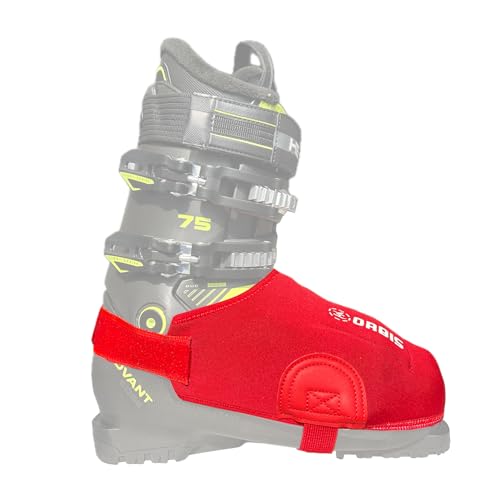
Inner pouches for holding warmers set these covers apart from the other options. The Orbis design also uses a stretchable toe, an adjustable hook-and-loop strap, and toe straps positioned beneath the sole arch to reduce walking wear and avoid binding interference. The large size is specified for men’s 9+ or women’s 10+ boots. Choose it if you want the option to add warmers and your boots fall within that range; the red color and single stated size may not suit every preference or fit.
Bottom line: Pick these if you want warmer pockets and wear a large-range boot.
Tryly Ski Boot Covers Large, 2 Pairs

A two-pair package is the key distinction here, and this large version fits men’s sizes 9–15 or women’s 9.5 and up. Stretch neoprene, an adjustable hook-and-loop heel strap, and abrasion-resistant side pads make up the cover design. Tryly offers a practical option for households or skiers who want a spare pair, but this size is aimed at larger boots. The maker also offers a medium size for men’s 6–10 or women’s 7–10.5, so choose by the boot-size range rather than assuming a universal fit.
Bottom line: Choose this set for two pairs in the large size range.
How to choose ski boot covers for warmth
Start with boot fit, then choose the insulation design that addresses your cold-weather need. Covers that are too tight can be difficult to pull over the boot, while loose covers can shift; match the men’s or women’s size range rather than relying on the word “large.” Neoprene acts as a wind and moisture barrier, while reflective lining or a pocket for a warmer adds a different approach to warmth. A cover’s warming claim does not establish a guaranteed temperature inside a boot: fit, weather, activity, and the boot itself all affect comfort. For this selection, choose reflective strips if insulation is the priority, and choose warmer pockets if you plan to add a separate heat source.
Fit and sizing for ski boot covers
Use the maker’s boot-size range as the deciding fit rule, because ski boot shells vary in shape and covers stretch differently. The sizes here range from men’s 6–10 or women’s 7–10.5 up to men’s 9–15 or women’s 9.5+, with one XL option aimed at US sizes over 10.5. Those overlaps mean a boundary size may fit more than one model; compare the range and cover dimensions instead of treating size labels as standardized. Where a product gives dimensions rather than a full size chart, measure the intended boot and confirm the fit before ordering. Check that any heel strap and toe area can sit in place without blocking boot functions.
Neoprene, reflective lining, and warmer pockets
Neoprene covers add a shell around the boot, but the insulation features differ. Reflective interior strips are intended to retain heat, while inner pouches allow a skier to add a warmer; a simple wind barrier is a more basic design. The table separates these choices by the feature that most affects how the cover addresses cold feet. A warmer pocket offers flexibility but requires the skier to use a compatible warmer according to its packaging. Boot covers can also encounter snow, walking, and binding contact, so designs with abrasion-resistant patches or toe straps positioned under the sole arch may matter for repeated use. Avoid assuming every cover has every feature.
Use this feature comparison to match the cover design to the cold-weather need.
| Need | Cover feature | Selection rule |
|---|---|---|
| Wind barrier | Neoprene shell | Choose a cover made to fit the boot size |
| Reflective insulation | Interior reflective strips | Choose when a built-in lining matters |
| Added heat source | Inner warmer pouch | Use only with a warmer intended for the pouch |
Using boot covers around ski bindings
Keep the boot sole and binding interface clear whenever a cover goes on a ski boot. A toe strap that sits under the sole arch is designed to reduce wear from walking and avoid interference with bindings, but the cover still needs to sit securely without covering or altering the boot’s binding contact surfaces. Before skiing, inspect the boot and binding area and remove any cover that obstructs proper engagement. Walking on abrasive surfaces can wear cover material faster, especially around the toe and heel; reinforced side patches and repositioned straps address wear points but do not make a cover indestructible. Fit and unobstructed binding contact matter more than adding a layer for warmth.
Frequently Asked Questions
Do ski boot covers make boots warmer?
Ski boot covers add an outer barrier against wind and wet conditions, and some designs add reflective strips or pockets for warmers. One product here claims retention of up to 20 degrees, but actual comfort depends on fit and conditions.
How should ski boot covers fit over boots?
Choose the size range that includes your boot size, and make sure the cover stays secure without blocking the sole or binding interface. Size ranges overlap, so compare the boot’s size with the maker’s range rather than relying on “medium” or “large” alone.
Can ski boot covers interfere with bindings?
A cover must not obstruct the boot’s binding contact surfaces or proper engagement. Check the sole and toe area before skiing, especially if straps cross beneath the boot.
Are neoprene ski boot covers waterproof?
Neoprene cover designs can provide a wind and moisture barrier, but the product claims differ: one is specifically described as water-resistant and another as waterproof. Treat those as product-specific claims rather than assuming every neoprene cover is fully waterproof.
Can you put hand warmers inside ski boot covers?
A cover with an inner warmer pouch is designed to hold a warmer; the Orbis option has these pockets. Use a warmer according to its packaging and avoid placing it directly against skin.