
Sans Air Purifier for Dust: Mini Compared by Fit

For a room up to 490 square feet, the Sans Mini is the closest fit for dust, with Sans Mini HEPA Air Purifier, White offering a three-stage HEPA system and Sans Mini Air Purifier, Midnight adding a carbon layer and automatic air-quality response. Choose a smaller purifier for a compact room or a higher-capacity model for a large open space.
Air purifiers capture airborne particles as air passes through a filter; they do not pick up dust that has already settled on surfaces.
We earn a commission if you buy through links on this page. As an Amazon Associate I earn from qualifying purchases. Products are compared on manufacturer specifications, not hands-on testing.
- Best overall: Sans Mini HEPA Air Purifier, White – Its 490-square-foot coverage and three-stage HEPA filtration match the dust-focused search.
- Best for odor control: Sans Mini Air Purifier, Midnight – It combines the same 490-square-foot coverage with a carbon layer for odor absorption.
- Best for large spaces: Blueair Blue Pure 211i Max – Its coverage reaches 3,235 square feet per hour, well beyond the Sans Mini’s room rating.
| Product | Best for | Room coverage | Filter system | Shop |
|---|---|---|---|---|
| Sans Mini HEPA Air Purifier, White | Dust-focused rooms | 490 sq ft | 3-in-1 HEPA | Check Price on Amazon |
| Sans Mini Air Purifier, Midnight | Dust and odors | 490 sq ft | H13 HEPA + carbon | Check Price on Amazon |
| Levoit Core Mini-P, White | Small rooms | — | Pre-filter + main filter | Check Price on Amazon |
| Blueair Blue Pure 211i Max | Large open rooms | 3,235 sq ft/hour | HEPASilent + pre-filter | Check Price on Amazon |
Sans Air Purifiers for Dust and Alternatives
Compare the room-size claims and filter approaches before choosing a purifier for airborne dust.
Sans Mini HEPA Air Purifier, White
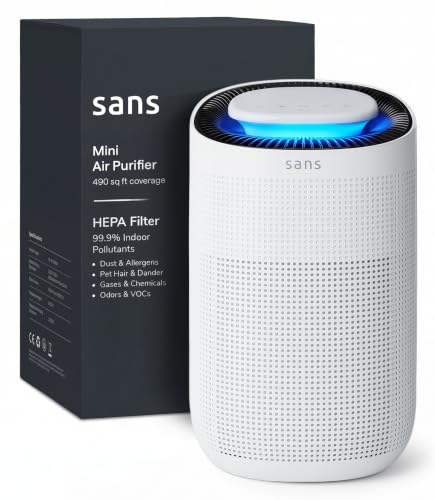
For dust-focused use, this Sans Mini pairs a 490-square-foot hourly coverage with a three-stage HEPA filtration system. The compact white unit measures 14 × 8 × 9 inches and weighs 7 pounds, making its size a consideration for a bedroom, office, or apartment. The maker says its filtration captures up to 99.9% of particles, but that figure does not tell you the clean-air delivery rate for your particular room. Choose it when its coverage fits your space; buyers needing a specified noise rating or a separately described carbon quantity should compare those points before deciding.
Bottom line: Pick this when you want a compact Sans purifier with a 490-square-foot rating and HEPA filtration.
Sans Mini Air Purifier, Midnight

Unlike the white Sans Mini, this midnight version emphasizes a pound of activated carbon alongside H13 HEPA filtration. The maker says the filter captures 99.97% of airborne particles down to 0.3 microns and absorbs household odors; it also gives a 25 dB noise rating. The unit is sized for rooms up to 490 square feet and has automatic fan-speed adjustment based on air quality. Those added claims make it a better match when odors matter alongside dust. Its coverage is still limited to the same room-size class as the other Sans Mini, so it is not the choice for a much larger open plan.
Bottom line: Choose this when odor absorption and an explicit noise rating matter alongside dust filtration.
Levoit Core Mini-P, White

The Levoit Core Mini-P is a small-room alternative rather than a direct match for the Sans Mini’s coverage. Its pre-filter and main filter capture lint, hair, pet dander, fine airborne pollutants, and smoke particles, according to the maker. The unit weighs 2.2 pounds and measures about 6.3 inches high and long, with a width of about 10.2 inches. That compact format may suit a desktop or dorm-room setting where a large-room rating is not the priority. The maker does not give a room-coverage figure, so do not assume it can serve the same area as either Sans model.
Bottom line: Pick this for a compact setting where a large-room coverage figure is not essential.
Blueair Blue Pure 211i Max

For a space far larger than the Sans Mini is rated for, the Blueair Blue Pure 211i Max gives a coverage of 3,235 square feet in an hour. The maker also says it can clean 674 square feet in 12.5 minutes. Its HEPASilent system works with a washable pre-filter that captures larger airborne particles, and its noise rating is 23 dB. At 22.7 inches high and 14.4 inches wide and long, it takes more floor space than the compact Sans units. Choose it for a large room, not merely because its coverage figure is bigger than needed.
Bottom line: Choose this when a large open room needs substantially more stated coverage than the Sans Mini provides.
How to choose an air purifier for dust
For airborne dust, compare clean-air delivery rate (CADR) with room area, not just a marketing coverage claim. A common AHAM sizing rule is a smoke CADR of at least two-thirds of the room’s square footage for an 8-foot ceiling; taller ceilings need more airflow. CADR uses cubic feet per minute, while room coverage is an area, so the figures are not interchangeable. Aim for about five air changes per hour when choosing a purifier for particle control, and allow more capacity if the room is open to adjoining spaces. A purifier helps with dust while particles are airborne; regular damp dusting and vacuuming address settled material.
| Room area at 8-foot ceiling | Minimum smoke CADR by 2/3 rule |
|---|---|
| 150 sq ft | 100 cfm |
| 300 sq ft | 200 cfm |
| 450 sq ft | 300 cfm |
Use the table as a sizing starting point, not a substitute for a product’s independently measured CADR.
HEPA and carbon filters for household dust
HEPA filtration targets airborne particles, while activated carbon is primarily useful for gases and odors; carbon does not replace particle filtration. A true HEPA filter is commonly defined as capturing at least 99.97% of particles at 0.3 microns under test conditions, but a product’s complete-room performance also depends on airflow and sealing. Dust includes particles of many sizes, and larger particles often settle quickly instead of remaining airborne. A washable or permanent pre-filter can catch larger lint and hair before they reach the main filter. Check replacement-filter availability and the maker’s replacement interval before choosing a model, since a loaded filter can restrict airflow.
Room coverage and purifier placement
Coverage depends on ceiling height, doorway openings, and the fan speed used to reach the rate. With a ceiling higher than 8 feet or a room open to a hall, choose a purifier sized for more area than the floor plan alone suggests. Leave clear space around the air inlet and outlet; placing a unit against curtains or furniture can obstruct circulation. Keep the purifier in the room where dust is generated or where people spend the most time, and run it continuously when the goal is ongoing particle removal. A large purifier on a low setting may be quieter, but use a verified CADR to check that its output still matches the room.
Dust control beyond the purifier
Air cleaning works best as one part of dust control, because walking, bedding, and fabrics continually put settled particles back into the air. Damp wiping captures dust more effectively than dry dusting, which can send particles airborne again. A vacuum with a sealed HEPA system helps keep collected particles from escaping back into the room. Keep windows closed during outdoor dust or smoke events when practical, and replace furnace or HVAC filters on their recommended schedule; a higher-efficiency filter may require system compatibility checks. For a room under 150 square feet, a correctly sized purifier can be more useful than paying attention to a very large maximum-coverage figure.
Frequently Asked Questions
Does an air purifier remove settled household dust?
No, a purifier mainly captures particles while they are airborne and passing through its filter. Damp wiping and vacuuming are needed for dust already on floors, shelves, and furniture.
What CADR do I need for a dusty room?
For an 8-foot ceiling, a common sizing rule is smoke CADR of at least two-thirds the room’s area in square feet. A 300-square-foot room therefore calls for about 200 cfm, with extra capacity for high ceilings or open doorways.
How often should an air purifier filter be changed?
Many HEPA purifier filters have replacement intervals around 6 to 12 months, though dust load and run time can shorten that interval. Follow the model’s filter indicator or maintenance schedule and keep its intake unobstructed.
Where should I put an air purifier for dust?
Place it in the room where people spend time or where dust is generated, with clear space around the intake and outlet. Avoid corners, curtains, or furniture that block airflow.
Are ionizing air purifiers safe to use indoors?
Some ionizing air cleaners can produce ozone, which can irritate lungs; choose a device certified to UL 2998 for zero ozone emissions if ozone is a concern. Avoid relying on ionization as a substitute for particle filtration.