
FinalPress Coffee Maker: 5 Models Compared by Fit

The FinalPress V3 suits most FinalPress buyers because its twist-off bottom lid makes cleanup easier, while its compact stainless steel design travels well. Choose the Original for its smaller stated dimensions, or a 34-ounce pot-style press if you want to brew multiple servings at once.
A micro French press brews directly in a mug, unlike a traditional French press with a separate carafe.
We earn a commission if you buy through links on this page. As an Amazon Associate I earn from qualifying purchases. Products are compared on manufacturer specifications, not hands-on testing.
- Best overall: FinalPress V3 – Its twist-off bottom lid makes it easier to empty used grounds, and it holds 5 g more than the earlier version.
- Best for compact storage: FinalPress Original – Its width and length are both 1.3 inches, and it collapses to fit in a pocket, the maker says.
- Best for a larger pot: Secura 34-Ounce Stainless Steel Press – The 34-ounce stainless steel carafe brews more than a single mug at a time.
| Product | Best for | Capacity | Height | Brewing feature | Shop |
|---|---|---|---|---|---|
| FinalPress V3 | Easy cleanup | — | 6.7 in | Twist-off bottom lid | Check Price on Amazon |
| FinalPress Original | Narrow packing | — | 6.5 in | Spring plunger | Check Price on Amazon |
| Secura 34-Ounce Stainless Steel Press | Larger servings | 34 oz | 9.8 in | Three-layer filter | Check Price on Amazon |
| Veken 34-Ounce Glass Press | Glass carafe | 34 oz | 8.39 in | Four-level filter | Check Price on Amazon |
| AeroPress Original | Versatile brewing | — | 9.5 in | Three brew styles | Check Price on Amazon |
FinalPress coffee makers and alternatives
Compare the two FinalPress versions with larger carafe-style presses and another compact manual brewer.
FinalPress V3

The V3 adds a twist-off bottom lid for emptying grounds, making cleanup its main distinction from the Original. This portable stainless steel maker is dishwasher-safe, and the maker says it holds 5 g more coffee or tea than the earlier version. That extra capacity may suit someone who wants a stronger mug without switching to a countertop carafe. Its 6.7-inch height is still travel-friendly, but the V3 is wider than the Original, so buyers prioritizing the narrowest packed shape should compare the two dimensions before choosing.
Bottom line: Pick this version if easier cleanup matters more than the Original’s narrower listed width.
FinalPress Original

The Original is the narrower FinalPress option, with a 1.3-inch listed width compared with the V3’s 2.35 inches. Its stainless steel spring plunger brews directly in a mug, and the maker says it handles hot, iced, and cold-brew coffee or tea in about 2 minutes. That makes it a fit for travelers who want one compact brewer for different drinks. The limitation is its small, single-mug format: choose a carafe press instead if you need to serve several people at once.
Bottom line: Choose it when narrow packing and direct-to-mug brewing matter most.
Secura 34-Ounce Stainless Steel Press
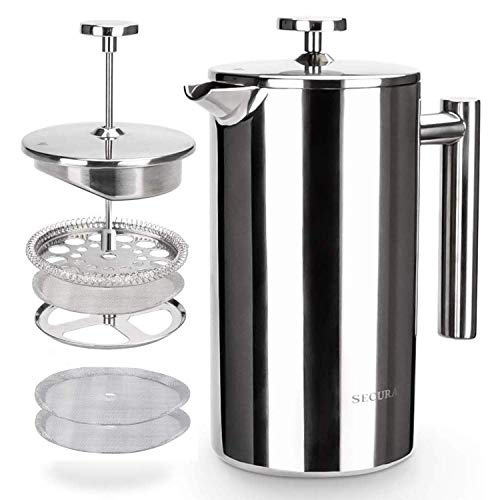
The Secura is a countertop carafe rather than a pocket-sized FinalPress, with 34 ounces of capacity for larger batches. Its 304 stainless steel interior and exterior pair with a three-layer filter structure, and the maker includes two extra screens. The cool-touch handle and knob are useful when pouring a hot brew. At 9.8 inches tall and 2.4 pounds, it is a less compact choice for travel than either FinalPress model; pick it for batch brewing and a metal carafe instead.
Bottom line: Pick it for a larger stainless steel batch brewer, not a mug-sized travel press.
Veken 34-Ounce Glass Press

The Veken pairs a 34-ounce carafe with thickened borosilicate glass, making it the pot-style choice for watching the brew and serving several cups. Its four-level stainless steel filter and 304 stainless steel components distinguish it from the Secura’s three-layer filter structure. The maker gives the glass a temperature range of -40°F to 302°F. Glass offers visibility, but it is a different travel proposition from the FinalPress steel micro brewers; consider it for a kitchen counter rather than a pocket.
Bottom line: Choose it for a visible glass carafe and multi-cup brewing.
AeroPress Original

The AeroPress offers a different compact approach: its maker describes it as combining French press, pour-over, and espresso-style brewing in one manual device. The maker says it produces a cup in under two minutes and is designed for travel and camping. Its 9.5-inch listed height makes it taller than either FinalPress model, and it is not the direct-to-mug spring-plunger design of the FinalPress. Choose it if experimenting with several brew styles matters more than the smallest packed dimensions.
Bottom line: Pick it if several manual brew styles matter more than a micro-sized design.
How to choose a FinalPress coffee maker
Choose between the FinalPress versions by prioritizing cleanup or packed width: the V3 has a twist-off bottom lid, while the Original is narrower. Both are small, direct-to-mug brewers, unlike a 34-ounce carafe press that can serve more than one cup. Coffee brewing also depends on grind and contact time: a coarse, even grind is the usual starting point for immersion brewing, while a finer grind can leave more sediment in the cup. For a practical decision, if you need to make several servings in one batch, choose a carafe with a capacity rather than a micro press. If you mainly want one mug on the go, choose between the FinalPress versions by packing shape and cleanup preference.
How French press brewing differs
A traditional French press steeps grounds in a carafe and separates them with a plunger filter; a micro press pushes coffee into the mug itself. Immersion methods commonly use water around 195°F to 205°F and steep for about 4 minutes, though grind size and taste preference affect the result. A common starting ratio is about 1 ounce of coffee per 16 ounces of water by weight. A carafe’s ounce capacity is not necessarily the same as a single serving size, so consider how many mugs you need. For safety, hot water can scald; set a press on a stable, heat-resistant surface and pour slowly, especially with glass carafes.
FinalPress and carafe press types compared
Use the table to match the brewer format to the amount and setting: micro presses focus on one mug and portability, while carafe presses hold a larger batch.
| Brewer type | Typical use | Trade-off |
|---|---|---|
| Micro press | One mug, travel | Small batch size |
| Stainless steel carafe | Countertop, multiple mugs | Bulkier to pack |
| Glass carafe | Countertop, visible brewing | Requires careful handling |
Carafe presses use a plunger and mesh filter, so a small amount of fine sediment is normal. A paper-filter method typically leaves less sediment, while a metal mesh retains more of the coffee’s oils. Cold-brew concentrate is generally steeped in cool water for roughly 12 to 24 hours, which is a different process from a quick hot brew. Do not assume that a brewer marketed for iced or cold coffee makes concentrate by the same method; choose based on the drink and process you want.
Cleaning and safe handling
Clean a French press after each batch, before dried grounds harden around the mesh and plunger. Separate removable filter pieces when the design allows, rinse them under running water, and use a soft brush to dislodge trapped particles; abrasive scrubbers can damage fine mesh. Empty grounds into compost or trash rather than washing a large quantity into a drain, where they can accumulate. For glass carafes, avoid sudden temperature changes and inspect for chips or cracks before adding hot water. Keep the handle steady while plunging: forcing a stuck plunger can send hot liquid over the rim.
Frequently Asked Questions
What coffee grind works in a French press?
A coarse, even grind is a reliable starting point for French press coffee because it reduces fine sediment. Very fine grounds can pass through mesh or make plunging harder.
How long should French press coffee steep?
About 4 minutes is a common starting time for hot immersion coffee. A finer grind extracts faster, while a coarser grind may need adjustment to match your taste.
How much coffee should I use per cup?
A useful starting ratio is 1 ounce of coffee by weight for every 16 ounces of water. Weighing the ingredients is more consistent than relying on scoops, since grind size changes how much a scoop holds.
Can a French press make cold brew overnight?
Yes, a carafe press can steep coarse grounds in cool water for roughly 12 to 24 hours, then separate the grounds with its plunger. Cold-brew steeping is much longer than a quick hot brew.
How do you keep coffee grounds out of the sink?
Scoop or tap used grounds into compost or trash before rinsing the filter. Coffee grounds can collect in drains, so avoid washing a batch of grounds down the sink.