
Howes Diesel Treat: 3 Fuel Additives Compared

For a Howes Diesel Treat product in a smaller bottle format, Howes Diesel Treat 32-Ounce is the closest match; choose it if you want the 32-ounce anti-gel and lubricator. Howes Diesel Treat Concentrate 2.5-Gallon is the concentrate in larger containers, while Howes Diesel Defender 64-Ounce is an injector cleaner rather than Diesel Treat.
Diesel anti-gel additives are intended for cold-weather fuel conditioning, not as a substitute for the correct seasonal fuel blend. Additive compatibility and dosage depend on the product label and fuel volume.
We earn a commission if you buy through links on this page. As an Amazon Associate I earn from qualifying purchases. Products are compared on manufacturer specifications, not hands-on testing.
- Best overall: Howes Diesel Treat 32-Ounce – Combines an anti-gel and diesel-fuel lubricator in six 32-ounce bottles.
- Best for bulk concentrate: Howes Diesel Treat Concentrate 2.5-Gallon – Provides two 320-ounce containers of Diesel Treat Concentrate.
- Best for injector cleaning: Howes Diesel Defender 64-Ounce – Uses IDX4 detergent and is positioned for injector cleaning and fuel lubricity.
| Product | Best for | Bottle size | Bottles per case | Primary role | Shop |
|---|---|---|---|---|---|
| Howes Diesel Treat 32-Ounce | Smaller bottle format | 32 oz | 6 | Anti-gel and lubricator | Check Price on Amazon |
| Howes Diesel Treat Concentrate 2.5-Gallon | Bulk concentrate | 320 oz | 2 | Concentrated anti-gel | Check Price on Amazon |
| Howes Diesel Defender 64-Ounce | Injector cleaning | 64 oz | 6 | Injector cleaner and lubricator | Check Price on Amazon |
Howes Diesel Treat and Related Additives
Compare the Diesel Treat formats with a related Howes cleaner by container size and intended job.
Howes Diesel Treat 32-Ounce

Unlike the concentrate, this Diesel Treat format comes in six 32-ounce bottles. Howes says its formula helps prevent diesel fuel from gelling in cold weather, adds lubricity for ULSD fuel systems, and contains detergent to address deposits. It suits buyers who want the regular Diesel Treat formula in smaller containers for handling or storage. The product is sold as a casepack, so it may be more than needed for someone seeking just one bottle; check the dosing directions against the amount of fuel being treated.
Bottom line: Choose this format if you want Diesel Treat in six 32-ounce bottles.
Howes Diesel Treat Concentrate 2.5-Gallon
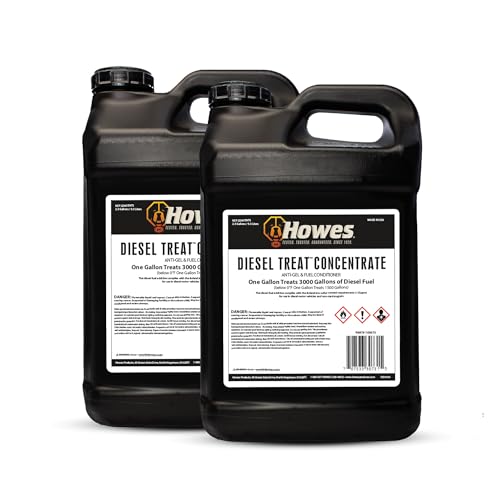
This is the bulk concentrate option, with two 2.5-gallon bottles rather than multiple small bottles. Howes says its wax-crystal modifier changes the size and shape of crystals forming in cold fuel; the formula is also described as removing water without alcohol or harmful solvents and helping prolong filter life. The large containers fit buyers treating substantial fuel volumes. The tradeoff is handling: at 320 ounces per bottle, this format is less convenient when you need a small amount or have limited storage space. Follow the product’s own mixing directions.
Bottom line: Pick the concentrate when container volume matters more than compact handling.
Howes Diesel Defender 64-Ounce

Diesel Defender is the distinct alternative here: its feature set centers on injector cleaning and added lubricity, not the Diesel Treat anti-gel role. Howes says it uses IDX4 detergent to target carbon deposits and is designed to clean the fuel system within three treatments when used as directed. The maker also cites HFRR wear-scar results that it says exceed specified US and European diesel-fuel limits. Choose it for the cleaning focus; it is not the closest choice for someone specifically seeking Diesel Treat cold-weather protection.
Bottom line: Choose this related product for injector cleaning rather than the Diesel Treat anti-gel format.
How diesel anti-gel additives work
Diesel anti-gel additives address wax crystals that form as fuel cools, but they do not replace winter-blended fuel. The fuel’s cloud point is the temperature at which wax first becomes visible; its cold-filter-plugging point (CFPP) is a separate measure of low-temperature operability. Actual thresholds vary by fuel blend and region, so use the fuel supplier’s seasonal guidance rather than assuming one temperature fits every tank. Treat the fuel before it cools enough to cloud: once fuel has gelled, an additive may not restore flow quickly. Keep the filter and lines warm or move equipment to a warmer location if fuel has already stopped flowing, and follow the chosen product’s label for dose and compatibility.
Choosing a Diesel Treat container size
Choose a container based on how much fuel you expect to treat and how accurately you can measure a dose. Six 32-ounce bottles are easier to handle individually than two 320-ounce containers, while the concentrate format holds substantially more per bottle. Do not compare bottle volume alone with coverage: treatment rate determines how much fuel a container can condition, and the specifications here do not supply a shared rate for a direct coverage calculation. Read the label before pouring, measure for the fuel volume in the tank, and avoid estimating by eye. For occasional treatment of a single vehicle, smaller containers may be simpler; for repeated treatment of bulk fuel, larger containers reduce package handling.
Anti-gel, lubricity additive, and injector cleaner differences
These additive roles overlap but are not interchangeable. Anti-gel products target cold-weather wax behavior; lubricity additives address fuel-system wear, a concern with ultra-low-sulfur diesel (ULSD); detergent cleaners target deposits in injectors and other fuel-system components. The product features describe Diesel Treat as an anti-gel with added lubricity and detergent, while Diesel Defender emphasizes injector cleaning and lubricity. HFRR is a standardized lab method for comparing fuel lubricity through wear-scar measurement; it does not by itself describe a vehicle’s real-world service life. Choose by the problem you are addressing, and do not assume an injector cleaner is a cold-weather anti-gel.
A simple need-to-choice guide helps separate the roles.
| Need | Product type | Key consideration |
|---|---|---|
| Cold-weather wax management | Anti-gel treatment | Add before fuel clouds |
| Injector deposit cleaning | Detergent cleaner | Use the specified treatment cycle |
| More convenient handling | Smaller containers | Measure the correct dose |
Safe dosing and common mistakes
Measure every diesel additive for the volume of fuel being treated, using the label’s dose rather than a guessed capful. Over- or under-dosing can fail to match the intended treatment, and products may differ in concentration even when both target the same issue. Do not mix additives unless their labels permit it; incompatible or redundant treatments can complicate diagnosis and may not improve fuel performance. Store containers closed and away from children, heat, and ignition sources, and clean spills promptly because diesel additives are chemical products. If equipment is already stalled in cold weather, do not keep cranking it; restore fuel flow safely and address the filter or line temperature before restarting.
Frequently Asked Questions
When should I add diesel anti-gel to fuel?
Add anti-gel before the fuel cools to its cloud point, when wax crystals begin to form. The applicable temperature varies with the fuel blend, so treat ahead of the forecast cold rather than waiting for a filter restriction.
Can anti-gel fix diesel fuel that has already gelled?
An anti-gel additive may not quickly reliquefy fuel that has already gelled. Warm the fuel system and filter safely, and use the product label for any recovery directions.
What does a diesel lubricity additive do?
A lubricity additive is intended to reduce wear in fuel-system components such as pumps and injectors. HFRR wear-scar testing compares fuel lubricity in a lab, but it is not a direct prediction of engine life.
How do I calculate the amount of diesel additive to use?
Use the treatment rate on the product label and the fuel volume in the tank or storage container. Measure the dose rather than estimating, since formulas and concentrations can differ.
Can I combine diesel anti-gel and injector cleaner?
Do not combine diesel additives unless both product labels allow it. Add one product at a time according to its directions so the fuel treatment remains clear and correctly dosed.