
Best Garage Floor Car Stops: 4 Types Compared

For most garages, F COME Two-Bump Parking Mats is the practical choice because its two tire bumps signal when to slow down and when to stop. Choose Guardian 6-Foot Rubber Parking Stop instead if you want a long curb to define a parking space, or Pyle 2-Pack Rubber Wheel Stops if you prefer separate compact blocks.
Garage floor car stops are wheel-contact guides that help mark a repeatable stopping position; measure available floor space and check whether adhesive or screw mounting suits your surface before choosing.
We earn a commission if you buy through links on this page. As an Amazon Associate I earn from qualifying purchases. Products are compared on manufacturer specifications, not hands-on testing.
- Best overall: F COME Two-Bump Parking Mats – Two raised bumps provide an early cue and a final stop in a compact 23.6-by-15.7-inch mat.
- Best for long parking bays: Guardian 6-Foot Rubber Parking Stop – The 72-inch rubber curb spans a longer section of the parking space and has pre-drilled mounting holes.
- Best for separate blocks: Pyle 2-Pack Rubber Wheel Stops – The two 21.7-inch rubber stops can be positioned individually in front of the tires.
- Best for compact two-wheel guidance: YONSHENG Two-Piece Parking Mats – Two 23.6-by-15.7-inch mats provide a broad footprint and are described as movable.
| Product | Best for | Style | Size | Mounting | Shop |
|---|---|---|---|---|---|
| F COME Two-Bump Parking Mats | Two-stage tire cue | Two-bump mat | 23.6 × 15.7 × 2.8 in | Adhesive; screw holes | Check Price on Amazon |
| Guardian 6-Foot Rubber Parking Stop | Long parking spaces | Continuous curb | 72 × 6 × 4 in | Portable; pre-drilled holes | Check Price on Amazon |
| Pyle 2-Pack Rubber Wheel Stops | Separate wheel blocks | Two individual stops | 21.7 × 5.9 × 3.5 in | — | Check Price on Amazon |
| YONSHENG Two-Piece Parking Mats | Relocatable floor guides | Two-piece mat | 23.6 × 15.7 × 2.8 in | Movable; mounting method unclear | Check Price on Amazon |
Garage Floor Car Stops Compared
Match the stop’s shape and footprint to your garage layout, then consider how you want to secure it.
F COME Two-Bump Parking Mats

Unlike a single raised block, these mats use two tire bumps: the first signals that the tire is on the mat, and the second marks the stopping point. Each mat measures 23.6 by 15.7 by 2.8 inches, and the pair is made from rubber with reflective strips. Adhesive stickers are supplied, and the mats also have holes for screw mounting. That gives a garage owner a choice of attachment approach, but adhesive performance depends on a clean, compatible floor surface; screw mounting requires suitable floor material and hardware.
Bottom line: Choose these if a two-stage stopping cue matters more than a narrow, single-piece stop.
Guardian 6-Foot Rubber Parking Stop

The 72-inch length makes this a continuous curb rather than a pair of tire-specific blocks or mats. It is made from 100% recycled rubber, with reflective yellow stripes, and its 6-inch width and 4-inch height define a broad stopping line. Pre-drilled 1/2-inch holes allow mounting, while the stop can also be used portably; mounting hardware is sold separately. The longer footprint suits a defined parking bay, but it takes more floor space than compact mats, so measure the stall and intended tire position first.
Bottom line: Pick this for a long, defined parking line and a choice between portable use and mounting.
Pyle 2-Pack Rubber Wheel Stops
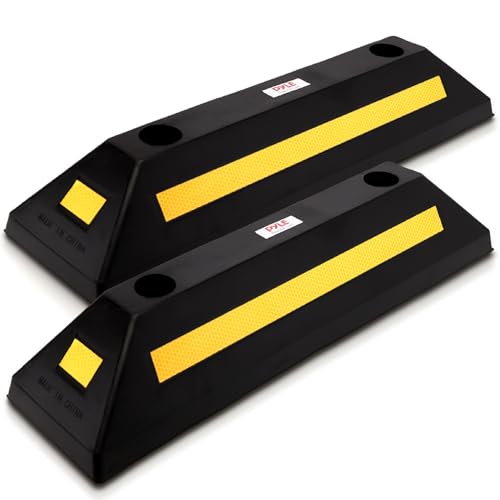
These two separate blocks offer a more compact alternative to a continuous curb, with each stop measuring 21.7 by 5.9 by 3.5 inches. The stops use high-density rubber and have a bright yellow reflective safety strip, making them suited to drivers who want a visible tire target without covering a wide section of floor. The maker says each stopper supports up to 33,000 pounds; that capacity is not a substitute for checking that the block’s placement and vehicle approach suit the garage.
Bottom line: Choose these if separate rubber blocks with reflective strips suit your parking layout.
YONSHENG Two-Piece Parking Mats

These two broad mats share a compact 23.6-by-15.7-inch footprint, but their product features emphasize portability and relocation rather than adhesive attachment. Each is 2.8 inches high and made from rubber; the maker describes the material as resistant to UV light, water, oil, and extreme temperatures. The maker also gives a maximum load capacity of 44,000 pounds. That figure does not establish that the mats are anchored, so they may be a less suitable choice when a fixed position is essential; check how they will stay aligned on your particular floor.
Bottom line: Pick these if you want two compact mats that can be moved or relocated.
How to Choose Garage Floor Car Stops
Choose by stopping shape first: a two-bump mat gives a staged cue, separate blocks mark individual tire positions, and a long curb defines more of the parking bay. Measure the garage depth from the closed door to the nearest wall or stored item, then leave room for the vehicle’s front or rear overhang. A tire stop is a positioning aid, not a substitute for the parking brake or transmission in Park. On a sloped floor, don’t treat a stop as a restraint for an unattended vehicle. For shared or dim garages, reflective markings can make the stopping point easier to see, but visibility does not make a stop safe to drive over at speed.
Garage Floor Stop Sizes and Placement
Place a stop where the tire meets it at the desired final position, not where the bumper appears to line up from the driver’s seat. Tire diameter, wheelbase, and front or rear overhang all change how far the bumper sits beyond the contact point, so test placement with the vehicle stationary before permanent attachment. A useful decision rule is to leave at least 12 inches between the stopped vehicle and a wall or stored object when the space permits; add more if the vehicle has a long overhang. Check that the garage door clears the stop and that a walking path remains unobstructed. Recheck the position after changing vehicles or tire size.
Rubber Mats, Wheel Blocks, and Long Curbs
Rubber car stops come in several shapes, and the shape affects how they guide a tire. A single block catches one tire at a time; a mat can provide a broader platform, while a long curb creates a line across more of the stall. Compare the footprint against the path of both tires rather than assuming a wider stop is always better. Concrete wheel stops are another common style, but they are heavier and harder to reposition than rubber. The table compares the formats in this selection by practical use, not by load rating.
| Format | Useful when | Trade-off |
|---|---|---|
| Two-bump mat | You want an early cue and a final stop | Broad floor footprint |
| Separate blocks | You want to position tire stops independently | Placement must align with tire paths |
| Long curb | You want to define a longer parking line | Uses more floor length |
Mounting and Floor Surface Checks
Mounting matters most when a stop must remain in the same position after repeated tire contact. Adhesive-backed products depend on a floor that is clean, dry, and compatible with the adhesive; dust, oil, moisture, or flaking coatings can weaken the bond. Screw-mounted stops require suitable fasteners and a floor material that can hold them, and drilling concrete calls for a masonry bit and eye protection. Before drilling, check for embedded utilities and confirm the stop’s hole pattern. Portable stops avoid drilling but can shift, especially on smooth floors, so inspect their position regularly. Keep stops clear of floor drains and door tracks.
Frequently Asked Questions
How far should a garage car stop sit from a wall?
Leave at least 12 inches between the parked vehicle and the wall when the garage allows it. Measure the vehicle’s overhang beyond the tire, then position the stop and confirm clearance with the vehicle stationary.
Can a rubber wheel stop keep a car from rolling?
A wheel stop is a parking-position guide, not a replacement for the parking brake or transmission in Park. On a slope, use the vehicle’s normal parking safeguards and do not rely on the stop to restrain an unattended car.
Will adhesive parking mats stick to painted concrete?
Adhesive may bond poorly if painted concrete is dusty, oily, damp, or peeling. Check the adhesive’s compatibility with the coating and prepare a clean, dry surface before attaching a mat.
How do I position stops for a different car?
Reposition the stop whenever wheelbase, tire diameter, or bumper overhang changes. Start with at least 12 inches of clearance to walls or stored items when possible, then verify the door and walking path remain clear.