
Canister for 5 Lbs of Flour: 5 Options Compared

For most people, ComSaf 5.5-Qt Flour Container Set is the best fit because its 5.5-quart canister is designed to hold 5 pounds of flour. Choose PrepSolutions Flour Keeper 3.8-Qt if you want a built-in leveler, or consider ComSaf 4-Qt Glass Jar Set if a 4.4-pound capacity is enough.
A flour canister is a pantry container meant to keep flour dry and accessible; if you need room for a full 5-pound bag, choose a model explicitly sized for that amount rather than judging by its outside dimensions.
We earn a commission if you buy through links on this page. As an Amazon Associate I earn from qualifying purchases. Products are compared on manufacturer specifications, not hands-on testing.
- Best overall: ComSaf 5.5-Qt Flour Container Set – Its 5.5-quart flour container is designed to hold 5 pounds.
- Best for measuring: PrepSolutions Flour Keeper 3.8-Qt – It has a built-in leveler and a 5-pound capacity.
- Best for glass storage: ComSaf 4-Qt Glass Jar Set – The wide-mouth glass jar holds about 4.4 pounds of flour.
| Product | Best for | Capacity (qt) | Material | Closure | Shop |
|---|---|---|---|---|---|
| ComSaf 5.5-Qt Flour Container Set | Full-bag storage | 5.5 qt; fits 5 lb flour | Plastic | Side-locking lid | Check Price on Amazon |
| PrepSolutions Flour Keeper 3.8-Qt | Built-in leveling | 3.8 qt (about 15.2 cups) | BPA-free material | Airtight seal | Check Price on Amazon |
| ComSaf 4-Qt Glass Jar Set | Glass storage | 4 qt per jar (about 16 cups) | Borosilicate glass | Bamboo lid; silicone seal | Check Price on Amazon |
| Rubbermaid Brilliance 16-Cup Container | Stackable pantry storage | 4 qt (16 cups) | BPA-free plastic | Snap-tight lid | Check Price on Amazon |
| Oggi 8-Inch Stainless Steel Canister | Clamp-lid storage | — | Stainless steel; clear lid | Clamp lid; silicone seal | Check Price on Amazon |
Canisters for 5 Lbs of Flour
Compare stated capacity, container material, and closure style to find the right match for your flour storage needs.
ComSaf 5.5-Qt Flour Container Set
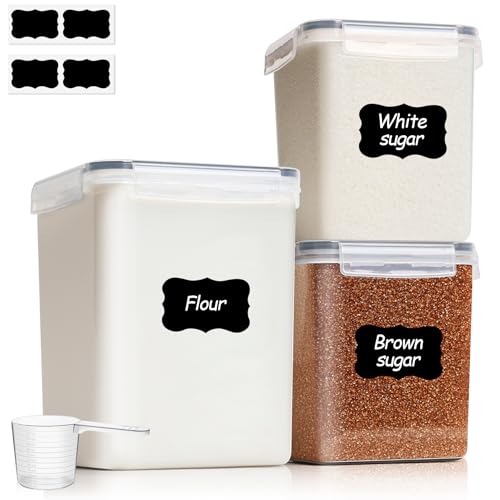
ComSaf 5.5-Qt Flour Container Set stands out by pairing a 5.5-quart flour canister sized for 5 pounds with two smaller sugar containers. The plastic set also includes labels and a 120 mL measuring cup, giving bakers a way to organize several dry ingredients together. Its side-locking lid is intended to block moisture; the maker notes that the clips may feel firm at first and recommends pressing the lid down while locking both sides. This set suits a pantry where flour and sugar need separate labeled containers. It is a three-container set, so it takes more shelf space than a single canister.
Bottom line: Choose this set if you want a flour container sized for 5 pounds plus separate sugar storage.
PrepSolutions Flour Keeper 3.8-Qt

PrepSolutions Flour Keeper 3.8-Qt combines a 5-pound capacity with a built-in leveler, unlike the other single-container options here. The 3.8-quart keeper measures 8 inches tall, 7 inches long, and 6 inches wide, which may help when planning pantry shelf space. Its airtight seal and BPA-free construction are intended for flour, sugar, and other dry goods. It suits someone who measures flour often and wants the leveling tool integrated into storage. The leveler is the distinct convenience, but this option does not offer the larger volume of the 5.5-quart flour canister.
Bottom line: Pick this canister if an integrated leveler matters as much as holding a 5-pound bag.
ComSaf 4-Qt Glass Jar Set
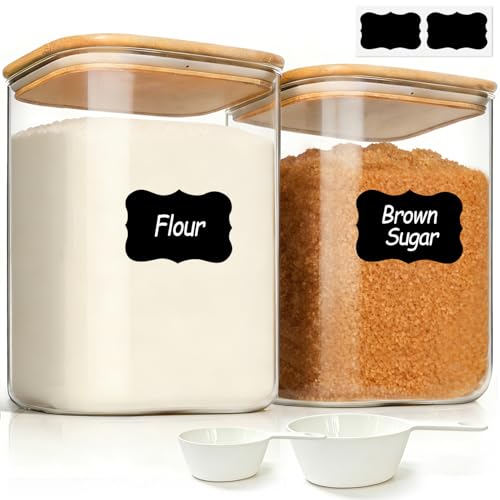
ComSaf 4-Qt Glass Jar Set is the glass alternative, with a 4-quart jar that holds about 4.4 pounds of flour rather than a full 5-pound bag. Its 5.9-inch-wide opening allows hand access for scooping and cleaning, and the borosilicate glass jar is dishwasher safe. The bamboo lid has a silicone seal and should be hand washed for long-term care. This set suits a buyer who prefers glass and can store a partial bag or divide flour between jars. Because the per-jar capacity falls short of 5 pounds, it is not the right choice when the entire bag must fit in one container.
Bottom line: Choose this set for wide-mouth glass storage when 4.4 pounds per jar is enough.
Rubbermaid Brilliance 16-Cup Container

Rubbermaid Brilliance 16-Cup Container emphasizes compact, stackable storage rather than a 5-pound flour capacity. The 16-cup container is made from BPA-free plastic, with snap-tight lids and clear sides and lids for seeing what is inside. It is also freezer-safe and top-rack dishwasher-safe, and the maker says the material resists stains and odors. This option suits buyers organizing smaller quantities of flour alongside other pantry ingredients. Since the volume is 16 cups and the capacity is not in pounds, do not assume a full 5-pound flour bag will fit; choose a container with an explicit 5-pound capacity if that is essential.
Bottom line: Pick it for stackable, visible pantry storage when you do not need a confirmed full-bag fit.
Oggi 8-Inch Stainless Steel Canister
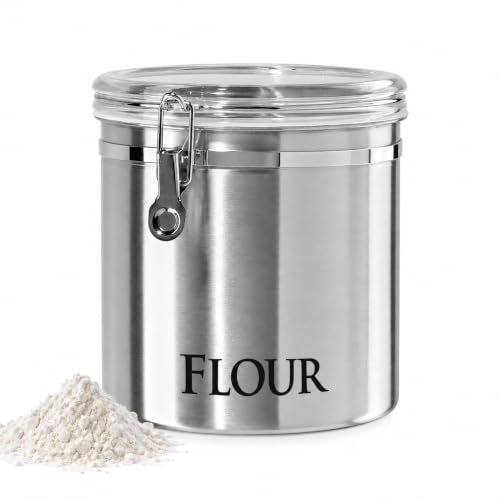
Oggi 8-Inch Stainless Steel Canister differs with a stainless-steel body and a clear clamp lid, so the contents remain visible while the canister is closed. Its silicone seal is intended to keep stored food fresh and dry, and the wide mouth is designed to make filling and emptying easier. The canister measures 7.5 inches high and 7.75 inches across. It suits buyers who want a clamp closure for general dry goods, but its capacity is not expressed as a flour weight or volume here. Confirm the capacity before choosing it for a full 5-pound bag; the outside dimensions alone do not establish how much flour fits.
Bottom line: Choose it for a clamp-lid canister only after confirming it holds the amount of flour you need.
How to Choose a Flour Canister by Capacity
For a full 5-pound bag, choose a container with an explicit 5-pound capacity or roughly 5 quarts of usable volume. All-purpose flour weighs about 4 to 4.5 ounces per cup, so 5 pounds takes around 18 to 20 cups; the exact amount changes with flour type, settling, and how it is scooped. A loose-fill method needs more space than a packed measurement. A practical decision rule is to select a canister rated for at least 5 pounds if you want to pour in a whole bag without transferring leftovers. A 4-quart jar rated for 4.4 pounds may work for partial-bag storage, but it leaves some flour outside the container.
Opening Size and Pantry Fit
A wide opening makes scooping and cleaning easier, while the canister’s footprint determines whether it fits your shelf. A 5- to 6-inch mouth is generally convenient for a measuring cup or hand access; narrower openings can be less practical for scooping. Measure shelf height and depth before selecting a tall or wide container, and leave clearance to lift off lids. Flour containers can be awkward to handle when full, so a shelf near waist height is easier to reach than an overhead shelf. Compare inside capacity rather than relying on outside dimensions: walls, lids, and corners take up space, and equal exterior measurements do not guarantee equal flour volume.
Flour Container Materials and Closures
Plastic containers are lighter to lift, while glass makes the contents visible and can be dishwasher-safe when the maker allows it. Stainless steel blocks light but needs a window or label if you want to identify the contents without opening it. Airtight seals help limit moisture and pantry odors, but a lid that is hard to close properly can defeat that benefit. Locking clips and clamp lids need an even seal around the rim; check that flour is not caught along the edge before closing. For flour that is used daily, favor an opening wide enough for your scoop and a lid that can be opened and resealed without shifting the container.
Storing Flour Safely and Keeping It Fresh
Keep flour in a cool, dry cupboard away from the stove, dishwasher, and direct sunlight; heat and moisture can shorten its usable quality. Many pantry staples are best used within about 6 to 8 months, while whole-wheat flour’s oils tend to turn stale sooner; freezing can extend storage, but flour should be sealed against odors and condensation. Let frozen flour return to room temperature while still sealed before opening, so moisture does not collect on it. Wash and dry a canister fully before refilling, and avoid topping up old flour with a fresh bag; emptying and cleaning first reduces stale residue and makes it easier to notice pests.
Frequently Asked Questions
How many cups of flour fit in a 5-pound bag?
Five pounds of all-purpose flour is roughly 18 to 20 cups, depending on how it is scooped and settled. A canister near 5 quarts gives more practical room than one sized to the exact packed volume.
Can a 16-cup container hold 5 pounds of flour?
A 16-cup container is generally short of the roughly 18 to 20 cups needed for 5 pounds of all-purpose flour. Flour type and packing affect the volume, so choose a container explicitly rated for 5 pounds if the whole bag must fit.
Should flour be stored in an airtight container?
An airtight seal helps limit moisture and odors in pantry storage. Keep the container in a cool, dry cabinet and make sure flour on the rim does not prevent the lid from sealing.
How wide should a flour canister opening be?
An opening around 5 to 6 inches is generally convenient for a measuring cup and hand access. A wider mouth also makes washing easier, but measure pantry shelf clearance before selecting a wide or tall container.
Can flour be stored in the freezer?
Yes, flour can be frozen in a sealed, moisture-resistant container. Let it warm to room temperature while still sealed before opening to reduce condensation on the flour.