
UK Plug Fast Chargers: Multi-Port Options Compared

CARZONJX 55W Type G Charger suits most travelers who want a Type G fast charger, because its 55W total output is the highest among the dedicated UK-style blocks here. Choose MINIX P1 66W GaN Charger if you need a charger that also supports laptop charging and includes foldable plugs with UK and EU converters.
UK plug chargers deliver power through USB ports; they do not necessarily convert mains voltage for appliances.
We earn a commission if you buy through links on this page. As an Amazon Associate I earn from qualifying purchases. Products are compared on manufacturer specifications, not hands-on testing.
- Best overall: CARZONJX 55W Type G Charger – Its Type G plug and stated 55W total output make it the strongest fit for multi-device travel charging.
- Best for laptops: MINIX P1 66W GaN Charger – The 66W GaN charger supports PD and QC and has two USB-C ports plus a USB-A port.
- Best for a compact block: YORANIX 40W Type G Charger – This Type G charger provides 40W total output and a 20W USB-C port.
| Product | Best for | Total output | USB ports | Plug setup | Shop |
|---|---|---|---|---|---|
| CARZONJX 55W Type G Charger | Type G travel | 55W | USB-A, USB-C | Type G | Check Price on Amazon |
| MINIX P1 66W GaN Charger | Laptop travel | 66W | 2 USB-C, 1 USB-A | Foldable plug; UK/EU converters | Check Price on Amazon |
| YORANIX 40W Type G Charger | Phone charging | 40W | USB-A, USB-C | Type G | Check Price on Amazon |
UK Plug Fast Chargers Compared
Compare the total output, port mix and plug design against the devices you plan to charge.
CARZONJX 55W Type G Charger

For a dedicated Type G wall charger, this model offers the highest total output among the UK-style blocks here: up to 55W. Its USB-C port is rated at 20W, and its USB-A port at 5V/3.1A; the maker says it supports Power Delivery and Quick Charge 3.0. That mix suits travelers charging phones and other USB devices from a UK-style outlet.
The limitation is that the maker identifies only USB-A and USB-C outputs despite calling the charger four-port. Confirm the physical port count if you need several devices connected at once.
Bottom line: Pick this if you want a dedicated Type G charger and 55W total output.
MINIX P1 66W GaN Charger
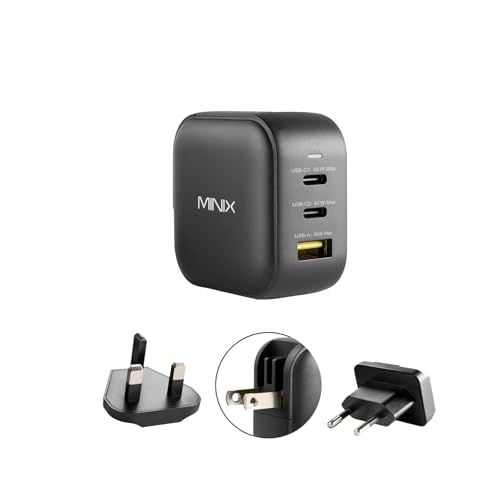
Unlike the dedicated Type G blocks, this 66W GaN charger combines two USB-C ports and one USB-A port with foldable plugs and UK/EU pin converters. The maker says it supports PD and QC, works with 100–240V input, and includes over-current, over-voltage, over-temperature and short-circuit protection. It is the clearest fit here for travelers who want to charge a laptop alongside smaller USB devices.
Its plug arrangement is less direct than a single Type G block because the UK pins come as converters. Check that the adapter configuration suits the outlets and packing setup on your trip.
Bottom line: Choose this for laptop-capable charging and a foldable, converter-based travel setup.
YORANIX 40W Type G Charger

This dedicated Type G block is the lower-output option, with up to 40W total and a 20W USB-C port. Its USB-A output is rated at 5V/3.1A, and the maker says it supports Power Delivery and Quick Charge 3.0. The smaller stated total makes it a sensible match for phone-focused travel when a 66W laptop-oriented charger is more capability than needed.
The port details identify one USB-A and one USB-C port, although the product name calls it four-port. Buyers who need several simultaneous connections should confirm the actual port layout before ordering.
Bottom line: Pick this for a Type G phone charger when 40W total output is enough.
How to choose a UK plug fast charger
Choose by the highest power draw of the device you expect to charge, then check how the charger divides power across connected ports. A phone may need less than a laptop, and a charger’s total wattage is not necessarily available from every port at once. USB-C Power Delivery is common for newer phones and laptops; Quick Charge is another charging protocol, but device and charger support must match. A USB-C cable also needs an adequate rating for higher-power charging.
For phone-only trips, a 20W USB-C port may be sufficient for many phones; for a laptop, compare its required USB-C input with the charger’s total output and port-sharing rules. If you need three connections at once, choose a charger that explicitly identifies three ports rather than relying on a four-port product name that conflicts with its port description.
UK Type G plug and voltage basics
A UK Type G outlet uses a three rectangular-pin plug, and UK household mains is nominally 230V at 50Hz. A plug adapter changes the physical connection, not the voltage: check the input label on each appliance, and use a separate voltage converter if a device does not accept the local supply. Most modern phone and laptop chargers accept a broad input range, but confirm the device label rather than assuming.
Travel chargers with removable pin converters need the correct converter seated securely before use. Do not force a plug that does not fit, and avoid using damaged adapters or chargers. If your trip includes destinations beyond the UK, verify the outlet type and local voltage for each location rather than assuming the UK converter covers every country.
USB-C ports, wattage and shared charging
USB-C describes the connector, not a guaranteed charging speed. Power Delivery negotiates voltage and current between compatible charger and device; the device draws only what it supports. Quick Charge compatibility likewise depends on both ends of the connection. A 66W total rating does not mean each port supplies 66W, particularly when several ports are in use.
For a clear decision, add the charging needs of devices you expect to use simultaneously and compare that sum with the total output. If two devices must charge at once, look for explicit per-port or combined-output figures. The 20W USB-C outputs on the Type G blocks are most relevant to phone charging; laptop users should compare their computer’s required input against the charger’s available USB-C output.
| Charging need | What to prioritize |
|---|---|
| One phone | Compatible USB-C PD or QC port |
| Phone plus accessories | Enough simultaneous ports and combined output |
| Laptop plus phone | USB-C laptop support and adequate total wattage |
Common travel charger mistakes
The most common mistake is treating a plug adapter as a voltage converter. Check the appliance input range before connecting it to a 230V UK outlet; a charger marked 100–240V can accept that range, while a device with a narrower input may need conversion. Another mistake is assuming a USB-C socket guarantees fast charging: the charger, cable and device all need compatible charging capabilities.
Also account for shared output when several devices are connected, because total wattage can be split among ports. For trips with limited outlet access, choose a charger whose actual port count is clear and sufficient. Keep chargers dry, uncovered and ventilated during use, and discontinue use if a plug, cable or housing is damaged or unusually hot.
Frequently Asked Questions
Does a UK plug charger convert voltage?
No, a UK plug charger or adapter does not by itself convert mains voltage. UK mains is nominally 230V at 50Hz, so check the connected device’s input label for compatibility.
Will any USB-C cable fast charge a phone?
No, fast charging depends on the phone, charger and cable supporting a compatible charging mode. For USB-C Power Delivery, use a cable rated for the power level the charger and device require.
Can a 66W charger charge a laptop?
It can charge a laptop only if the laptop accepts USB-C charging and the available charger output meets its needs. Multi-port charging may divide the 66W total, so check combined output when charging another device at the same time.
How many devices can I charge at once?
The usable device count depends on the charger’s actual port count and how its total output is shared. Confirm both before a trip, especially when the product’s port count conflicts with the port names provided.
Can I use a UK charger in Ireland?
A Type G plug fits standard outlets in Ireland, which also uses Type G. Check the device’s input range for the local mains supply, and confirm the charger’s voltage compatibility.