
Mini Sanders for Wood: 4 Detail Tools Compared

For most small wood projects, SKIL SR232301 Detail Sander is the strongest fit because its interchangeable detail attachments handle corners, edges and contours, with a vacuum port for dust collection. Choose SHALL Mini Pen Sander for pen-style precision, TOVPADE 54-Piece Micro Sander Kit for manual control, or HYCHIKA 14,000 OPM Detail Sander if you want included sheets in three grits.
We earn a commission if you buy through links on this page. As an Amazon Associate I earn from qualifying purchases. Products are compared on manufacturer specifications, not hands-on testing.
- Best overall: SKIL SR232301 Detail Sander – Three tool-free detail attachments and a vacuum port make it adaptable across edges, corners and contours.
- Best for included grits: HYCHIKA 14,000 OPM Detail Sander – It includes 12 sheets across P80, P120 and P240 grits.
- Best for tiny surfaces: SHALL Mini Pen Sander – Its pen shape, four speed settings and eight sanding heads suit small, tight areas.
- Best for hand control: TOVPADE 54-Piece Micro Sander Kit – The compact block comes with 54 sheets spanning nine grits from 80 to 800.
| Product | Best for | Sanding motion or speed | Dust setup | Included accessories | Shop |
|---|---|---|---|---|---|
| SKIL SR232301 Detail Sander | Versatile detail work | 13,500 OPM; 1.2 amps | Micro-filter box; 1-1/4-inch vacuum port | 3 attachments; 12 sheets | Check Price on Amazon |
| HYCHIKA 14,000 OPM Detail Sander | Three-grit starter set | Up to 14,000 OPM; 1.6 amps | Dust bag; six-hole collection | 12 sheets: P80, P120, P240 | Check Price on Amazon |
| SHALL Mini Pen Sander | Tiny precision areas | 5,000–10,000 SPM, 4 speeds | — | 8 heads; 18 sheets | Check Price on Amazon |
| TOVPADE 54-Piece Micro Sander Kit | Manual finishing control | Manual sanding block | — | 54 sheets; 9 grits, 80–800 | Check Price on Amazon |
Mini Sanders for Wood
Match the tool’s shape, sanding action and included abrasives to the size and finish of your woodworking task.
SKIL SR232301 Detail Sander
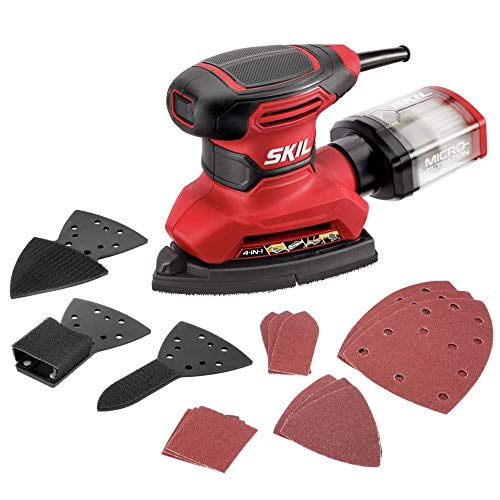
SKIL SR232301 stands out for its three changeable detail attachments, which extend a compact electric sander’s reach across flat areas, corners, edges and contours. The maker says its 1.2-amp motor runs at 13,500 orbits per minute. A micro-filter dust box and 1-1/4-inch vacuum port provide two dust-collection options; hook-and-loop backing makes sheet changes straightforward. Its 2.6-pound weight may matter during long sessions or overhead work. Choose this model if one electric tool needs to cover several small wood shapes, but plan to connect a suitable vacuum or empty the dust box during sanding.
Bottom line: Pick this for interchangeable shapes and a choice of dust collection.
HYCHIKA 14,000 OPM Detail Sander

HYCHIKA pairs its detail sander with 12 sheets in three distinct grits, giving woodworkers coarse, medium and finer starting options in one package. The maker says the 1.6-amp motor reaches 14,000 orbits per minute. Its six-hole collection pattern feeds a removable dust bag, and hook-and-loop backing secures the 140-by-90-millimeter sheets. At 2.2 pounds, this is a compact electric option for small home projects. The included range ends at P240, so anyone aiming for a very fine bare-wood finish will need finer abrasive sheets suited to the pad.
Bottom line: Choose this if you want coarse-to-finer sheets included with an electric detail sander.
SHALL Mini Pen Sander

SHALL’s pen-shaped reciprocating sander differs from the wider pad sanders here: its narrow body and eight sanding-head shapes target tiny surfaces and tight corners. The maker says its four adjustable settings span 5,000 to 10,000 strokes per minute. It also includes 18 sanding sheets, and the slender grip is intended for close control on small finishing, craft or 3D-print tasks. Its small contact area is a limitation on broader wood panels, where coverage will be slow; it suits detail work rather than replacing a full-size sander. Select a head shape that reaches the work without rounding a crisp edge.
Bottom line: Pick this for precision sanding on small parts and narrow corners.
TOVPADE 54-Piece Micro Sander Kit
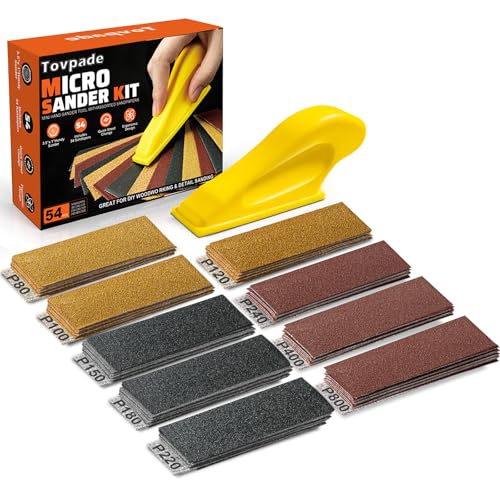
TOVPADE is the manual option in this group, using a 3.54-by-1.18-inch block instead of a motor to give direct hand control in grooves, corners and small furniture areas. The kit includes 54 hook-and-loop sheets across nine grits from 80 through 800, with color coding to distinguish coarse, medium and fine groups. No motor or dust-collection system is part of this tool, so sanding is slower and dust needs separate control. It suits workers who want gradual hand finishing and close feedback on delicate wood; choose an electric model for faster stock removal.
Bottom line: Choose this for measured hand sanding and a broad grit range.
Choosing a Mini Sander for Wood
Choose by the area you need to sand: a detail pad covers small flats, a pen-style reciprocating head reaches narrow shapes, and a hand block gives direct pressure control. For removing material, start around 80 to 120 grit; for smoothing between finish coats, use finer abrasives, often 220 grit or higher, as the finish manufacturer directs. A practical rule: if the work face is narrower than the sander’s pad, use a pen-shaped head or hand block to avoid scuffing adjacent edges. Electric sanders remove material quickly, so keep the pad moving and use light pressure; dwelling in one place can leave dips or visible swirls. Use dust collection and eye protection during sanding.
Matching Grit to Wood Sanding
Start with the finest grit that removes the marks or unevenness you can actually see; coarser abrasives cut faster but leave deeper scratches. For bare wood, a common sequence is 80 or 100 grit for shaping, 120 or 150 to refine, then 180 or 220 before many clear finishes. Skip a grit only when the previous scratches are already gone, because a finer sheet may polish over rather than remove deep marks. Between coats, use a fine abrasive such as 220 or 320 only when the finish instructions permit it. Sand with the grain on the final pass, especially by hand, to reduce cross-grain scratches that show under stain.
Use the chart as a starting point, not a fixed recipe; wood species, existing damage and the coating system change the useful stopping point.
| Need | Starting choice | Typical grit range |
|---|---|---|
| Remove rough spots | Electric detail sander | 80–120 |
| Refine bare wood | Detail sander or block | 150–220 |
| Reach grooves or tiny parts | Pen sander or hand block | 120–220 |
| Lightly smooth a cured coat | Hand block | 220–320 |
Controlling Dust and Protecting Wood
Wood sanding creates fine airborne dust, so connect a vacuum where the tool supports one, or use the dust-collection method provided, and wear a properly fitted particulate respirator and eye protection. Dust collection reduces debris at the source but does not make respiratory protection unnecessary, particularly with prolonged sanding or poor ventilation. For stain or clear finish, remove sanding dust before coating; trapped particles can roughen the surface or affect appearance. Avoid pressing hard to speed up electric sanding: added pressure can slow the pad, overheat the abrasive and leave uneven marks. Soft woods also dent more readily than hardwoods, so test the pressure and grit on an inconspicuous area first.
Choosing Between Electric and Manual Mini Sanders
Electric mini sanders suit repeated work because their powered motion removes material without requiring the same hand strokes as a block, while manual blocks give finer pressure feedback on fragile edges and small touch-ups. A reciprocating pen sander’s narrow heads can fit places a wider detail pad cannot, but its tiny contact area is inefficient on broad surfaces. Match hook-and-loop sheets to the tool’s pad shape and hole pattern when dust extraction depends on aligned openings. Do not force an oversized sheet onto a small pad: loose edges can catch, tear or abrade neighboring surfaces. For a single furniture corner, a manual block may be enough; for multiple parts, powered sanding can reduce effort.
Frequently Asked Questions
What grit should I start with on unfinished wood?
Start with 80 to 120 grit when the wood has roughness or visible defects, then move to 150 or 180 to refine it. If the surface is already smooth, begin finer to avoid unnecessary scratches.
Can I use a mini sander to remove paint from wood?
A mini sander can remove paint from small areas, but old coatings may contain hazardous materials, especially in older buildings. Do not dry-sand suspect paint; identify the coating and use appropriate containment and protective measures first.
Should I sand wood with or against the grain?
Make the final sanding pass with the grain, especially before staining, because cross-grain scratches can remain visible through the finish. Powered detail sanders use orbital motion, so inspect the surface in angled light and finish by hand with the grain if needed.
How do I keep a mini sander from leaving swirl marks?
Use a clean abrasive, light pressure and keep the sander moving evenly across the surface. Step through grits gradually; jumping from coarse paper to fine paper can leave scratches the finer sheet cannot remove quickly.
Do I need a respirator when sanding wood indoors?
Yes, use a properly fitted particulate respirator and eye protection, even when a sander has a dust bag or vacuum port. Ventilate the area and collect dust at the tool, since fine wood dust can remain airborne.