
Brake Booster Push Rod Adjustment Tool Guide

For most buyers, N48 Magnetic CNC Aluminum Gauge is the clearest match because it is a magnetic CNC aluminum gauge made to compare master-cylinder bore depth with booster push rod length. Choose Ryxtirx Adjustable Push Rod Gauge instead if you need an explicit compatibility note for adjustable rods; confirm your booster has an adjustable push rod before ordering.
A brake booster push rod adjustment tool compares the booster rod projection with the master cylinder’s piston-bore depth. Incorrect clearance can cause excessive pedal travel or brake drag, so use the vehicle’s service procedure and verify the measurement before assembly.
We earn a commission if you buy through links on this page. As an Amazon Associate I earn from qualifying purchases. Products are compared on manufacturer specifications, not hands-on testing.
- Best overall: N48 Magnetic CNC Aluminum Gauge – Its magnetic CNC aluminum gauge is specifically intended to measure master-cylinder bore depth for push rod adjustment.
- Best for compatibility checks: Ryxtirx Adjustable Push Rod Gauge – It explicitly says it works with adjustable push rods and cautions that fixed-rod systems may not be compatible.
- Best for compact dimensions: Magnetic Aluminum Gauge, 3.46 x 2.64 in. – Its 3.46-by-2.64-inch size gives a defined footprint for storage and setup.
| Product | Best for | Material | Size | Positioning | Shop |
|---|---|---|---|---|---|
| N48 Magnetic CNC Aluminum Gauge | Magnetic measuring | CNC aluminum | — | N48 magnets | Check Price on Amazon |
| Magnetic Aluminum Gauge, 3.46 x 2.64 in. | Defined footprint | Aluminum | 3.46 x 2.64 x 0.46 in. | Magnetic contacts | Check Price on Amazon |
| Ryxtirx Adjustable Push Rod Gauge | Adjustable rods | CNC aluminum | 3.42 x 2.62 x 0.6 in. | Built-in magnets | Check Price on Amazon |
| YGDMD Magnetic Aluminum Gauge | Basic measurement | Aluminum | 3.46 x 2.64 x 0.46 in. | Magnetic core | Check Price on Amazon |
| GZZTORES Adjustable-Pin Tool | Adjustable pins | — | — | — | Check Price on Amazon |
Brake Booster Push Rod Adjustment Tools
Compare the gauges by their material, footprint and positioning features, then check your booster configuration before choosing.
N48 Magnetic CNC Aluminum Gauge
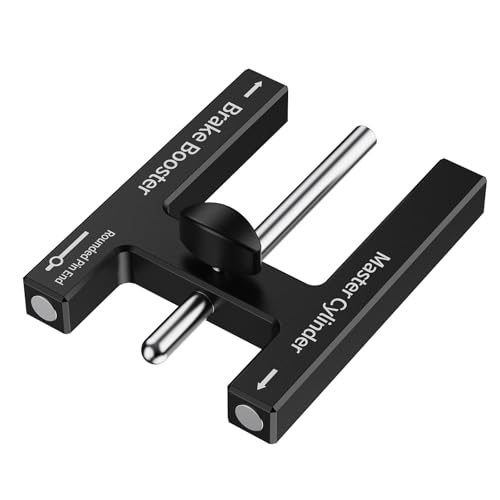
N48 Magnetic CNC Aluminum Gauge is the only tool here whose name specifies N48 magnets, alongside CNC aluminum construction. Its purpose is to measure master-cylinder piston-bore depth so the booster push rod can be adjusted against that measurement. That makes it a fit for repairers who want magnetic contact while positioning the gauge.
Bottom line: Choose this if magnetic positioning and CNC aluminum construction are your priorities.
Magnetic Aluminum Gauge, 3.46 x 2.64 in.

Magnetic Aluminum Gauge, 3.46 x 2.64 in. has a defined 3.46-by-2.64-by-0.46-inch footprint and aluminum construction, distinguishing it from the tools without a size. Magnetic contacts at both ends are intended to hold it against the master cylinder and booster during measurement. This suits a buyer comparing workspace and storage needs before choosing a gauge. The measurements do not establish whether it fits a particular booster face or flange, so check those dimensions against the tool before use.
Bottom line: Pick this if you want a tool size and magnetic contacts.
Ryxtirx Adjustable Push Rod Gauge

Ryxtirx Adjustable Push Rod Gauge stands out for naming its fit limitation: it is intended for boosters with adjustable push rods and is not compatible with every vehicle or fixed-rod system. Its CNC aluminum gauge uses built-in magnets, and its dimensions are 3.42 by 2.62 by 0.6 inches. It is suited to buyers who can first confirm an adjustable rod and compare the mounting surfaces. The compatibility note is important: do not assume a vehicle make listed in the product name guarantees fit for every model or configuration.
Bottom line: Choose this when you have confirmed an adjustable push rod and compatible surfaces.
YGDMD Magnetic Aluminum Gauge

YGDMD Magnetic Aluminum Gauge combines aluminum construction, a magnetic core at both ends and a size of 3.46 by 2.64 by 0.46 inches. It is designed to measure the master-cylinder piston-hole depth for adjusting a power-brake push rod. This is a straightforward option for a buyer who wants those measurements and magnetic alignment in one tool. The specifications do not identify a particular booster fit or adjustable-rod requirement, so verify your setup rather than treating the tool as universal.
Bottom line: Pick this if its dimensions and magnetic alignment suit your setup.
GZZTORES Adjustable-Pin Tool

GZZTORES Adjustable-Pin Tool emphasizes adjustable pins and broad compatibility with power-braking systems, setting it apart from gauges with dimensions or magnetic contacts. The specifications describe turning the tool for adjustment and identify cars, SUVs and trucks as intended applications. It may suit a buyer whose booster has an adjustable pin and who does not need published dimensions to narrow the choice.
Bottom line: Choose this if you need an adjustable-pin tool and can confirm its fit first.
How to choose a brake booster push rod gauge
Choose a gauge that can compare the booster push rod projection with the master-cylinder piston-bore depth, not a generic brake pedal tool. The goal is to establish the clearance called for by the vehicle’s service procedure; there is no single adjustment value that applies to every booster and master cylinder. Magnetic contact can steady a gauge on compatible metal faces, but it cannot confirm fit by itself. If your booster has a fixed rod, do not assume an adjustable-rod tool will work. Check the rod type and the master-cylinder flange opening before buying, especially when the product explicitly limits compatibility. A mismatched tool or an incorrect gap can leave excess pedal travel or cause brake drag after assembly.
How to measure and set push rod clearance
Measure the master-cylinder bore depth and booster push rod projection using the gauge and procedure intended for the vehicle, then compare the results with the service specification. The required clearance is vehicle-specific; do not substitute a generic number for the manufacturer’s adjustment value. Keep the mating faces clean and square while measuring, since debris or a tilted gauge changes the reference. Before installation, confirm that the rod can be adjusted and locked as designed. After assembly, check for free pedal movement and brake release; a rod set too long can hold the master-cylinder piston off its return position, while excessive clearance can increase pedal travel. If the measurement or lock method is unclear, pause and use a qualified brake technician.
Brake adjustment tool fit and safety
Fit depends on the booster face, master-cylinder flange, opening width and whether the push rod is adjustable. A product’s vehicle-make wording alone does not establish fit for every year, model or brake configuration. Compare tool dimensions with the available working space; the compact examples here measure roughly 3.4 inches long, but dimensions do not guarantee the gauge will sit on your mounting surfaces. Brake systems carry safety-critical loads, and an incorrect adjustment can affect pedal response or prevent full brake release. Do not drive if the brakes drag, the pedal behaves abnormally or the master cylinder does not return normally after installation. Confirm exact clearance and adjustment steps in the vehicle-specific service procedure.
Frequently Asked Questions
What does a brake booster push rod gauge measure?
It compares the booster push rod projection with the master-cylinder piston-bore depth. The correct clearance is vehicle-specific, so use the service procedure for the exact brake setup.
Can I use this tool with a fixed push rod?
Not every gauge fits a fixed-rod system; one of the compared tools explicitly limits use to adjustable push rods. Confirm rod style and gauge compatibility before ordering.
What happens if the booster push rod is too long?
A rod set too long can keep the master-cylinder piston from returning fully and may cause brake drag. Recheck the specified clearance before driving after brake work.
Should the master cylinder be pushed against the booster?
Do not use the mounting bolts to force a master cylinder into position against a misadjusted rod. Confirm the clearance and follow the vehicle-specific installation procedure before tightening or driving.