
Best Lubricant for Window Track: 4 Options Compared

3-IN-ONE RVcare Window & Track Dry Lube suits most people because it is made specifically for window and track lubrication and dries to a clear film intended not to attract dirt. Choose a different option if you want a multi-purpose spray, a bundle with other RV maintenance products, or grease for compatible parts.
We earn a commission if you buy through links on this page. As an Amazon Associate I earn from qualifying purchases. Products are compared on manufacturer specifications, not hands-on testing.
- Best overall: 3-IN-ONE RVcare Window & Track Dry Lube – Its dry formula is designed specifically for window and track use.
- Best for auto tracks: WD-40 Specialist Silicone Lubricant – The silicone spray is intended for window tracks, guide rails, and other equipment.
- Best for RV upkeep: 3-IN-ONE RVcare Trio Assortment – The bundle includes window-and-track lube alongside slide-out lube and seal conditioner.
- Best for grease application: KEZE Silicone Grease with PTFE – The PTFE silicone grease is a tube-applied option for compatible plastic, rubber, and metal parts.
| Product | Best for | Format | Size | Formula | Shop |
|---|---|---|---|---|---|
| 3-IN-ONE RVcare Window & Track Dry Lube | RV window tracks | Spray | 10 oz | Dry lubricant | Check Price on Amazon |
| WD-40 Specialist Silicone Lubricant | Auto window tracks | Spray | 13.3 oz | Silicone | Check Price on Amazon |
| 3-IN-ONE RVcare Trio Assortment | RV maintenance bundle | 3-piece bundle | 3-pack | Window lube, slide-out lube, seal conditioner | Check Price on Amazon |
| KEZE Silicone Grease with PTFE | Grease application | Tube grease | 1 oz | Silicone with PTFE | Check Price on Amazon |
Window Track Lubricants
Match the lubricant format to the track material and how precisely you need to apply it.
3-IN-ONE RVcare Window & Track Dry Lube
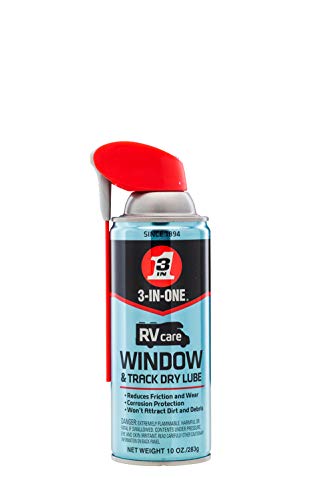
Unlike a general-purpose lubricant, this spray is made specifically for RV windows and tracks. The maker says its quick-drying film reduces friction without attracting dirt and offers corrosion protection. Its two-way nozzle switches between a stream and a wider spray, which helps when treating a narrow channel or a broader track. It is intended for most materials, including vinyl and plastic, but not clear polycarbonate or polystyrene. Choose another product if you need grease or a lubricant for those excluded plastics.
Bottom line: Pick this for RV window tracks when a dry spray and focused application matter.
WD-40 Specialist Silicone Lubricant

This silicone spray covers more than window tracks: the maker identifies guide rails, pulleys, valves, hinges, locks, and equipment as uses. It is designed for metal, rubber, vinyl, plastic, and other non-metal surfaces, and the maker says it dries to a clear finish without sticky residue or attracting dirt. That broad use makes it a practical choice for automotive or equipment tracks as well as household windows. It is a spray rather than a grease, so buyers seeking a paste for a small part should choose a tube format instead.
Bottom line: Choose this for silicone spray that can serve tracks and other moving equipment.
3-IN-ONE RVcare Trio Assortment

This is the only choice here that pairs window-and-track lubricant with two other RV maintenance products. The bundle contains slide-out lube and rubber seal conditioner as well; the maker says the window product dries quickly to a clear film that does not attract dirt and debris. Its two-way Smart Straw allows either a narrow stream or wider spray. The tradeoff is that it is a three-product assortment, so it is less focused if you only need a single window-track lubricant.
Bottom line: Pick the assortment when you also need slide-out lube and seal conditioner.
KEZE Silicone Grease with PTFE

Unlike the aerosol choices, this product is a tube of silicone grease with PTFE for applying lubricant directly to a small area. The maker describes it for plastic-to-plastic, plastic-to-metal, rubber-to-metal, vinyl, and other material combinations, including sliding-door and window-track parts. Its temperature range is -40°F to 428°F. Grease can hold debris more readily than a dry film in an exposed, dusty track, so this format is a better fit when the part and its maker call for grease.
Bottom line: Choose the tube when compatible parts call for grease rather than a dry spray.
How to Choose a Window Track Lubricant
For an exposed window channel that collects dust, start with a dry silicone spray rather than a heavy grease. A clean, low-residue film is less likely to hold loose grit against the moving surfaces. Match the product to the track material: window assemblies can combine metal, vinyl, plastic, and rubber, and compatibility can differ by part. If you cannot identify the material, verify compatibility with the window or vehicle maker before applying lubricant. Apply a small amount first and move the window through its travel to distribute it; excess lubricant can spread onto glass, trim, or nearby surfaces. A tube grease can make sense for a specific small mechanism that calls for grease, but it is usually less suitable for an open, dusty channel.
How to Prepare Window Tracks
Remove loose dirt before lubricating; adding lubricant over grit can turn debris into an abrasive layer. Vacuum the channel with a narrow attachment or lift dust with a soft brush, then wipe reachable surfaces with a clean cloth. For stubborn grime, use a cleaner compatible with the window material and let the track dry before applying lubricant. Keep the application controlled: spray onto a cloth for a short section or use a narrow stream, then wipe away excess. Open and close the window several times to spread the film and check for remaining resistance. If a window still binds after the track is clean and lubricated, inspect for a bent channel, damaged rollers, or misalignment rather than repeatedly adding product.
Spray or Grease for Window Tracks
Spray and grease serve different application needs: sprays cover longer channels, while grease can be placed on a small compatible component. The table compares formats by what they suit, not by a claim that one formula works for every window.
| Format | Useful when | Watch for |
|---|---|---|
| Dry silicone spray | Open tracks exposed to dust | Overspray on glass or trim |
| Silicone grease with PTFE | Small parts that call for grease | Residue can collect grit in exposed channels |
Choose by the part’s material and location. A covered roller or small sliding component may need a different lubricant than an open window track. Avoid assuming that any lubricant labeled silicone is interchangeable: spray and grease have different consistencies and application behavior. Use only a product compatible with the materials it will contact, especially where rubber seals or plastic parts are involved.
Common Window Track Lubrication Mistakes
Applying lubricant before cleaning is a common mistake because grit can remain trapped between moving surfaces. Another is using more product to compensate for a mechanical problem: bent tracks, worn rollers, and misaligned sashes need inspection, not a thicker coating. Keep spray away from glass, painted trim, and surfaces where residue would be difficult to remove; a cloth or narrow nozzle gives better control. Do not use a product on a plastic or seal material unless it is compatible with that material. After application, wipe away visible excess and cycle the window; persistent sticking or uneven movement is a reason to inspect the hardware.
Frequently Asked Questions
How often should window tracks be lubricated?
Clean and inspect window tracks about once a year, then lubricate when movement becomes rough or noisy. Dusty conditions may call for more frequent cleaning because grit can build up before the lubricant itself wears away.
Can silicone spray damage vinyl window tracks?
Some silicone sprays are designed for vinyl, but compatibility depends on the product and the exact part. Check the product’s material guidance before application, and avoid using it on excluded plastics such as clear polycarbonate or polystyrene when the maker names those exclusions.
Should window tracks be cleaned before lubricating?
Yes; remove loose dust and grit first with a soft brush or vacuum attachment. Lubricant applied over debris can hold grit against the channel and contribute to rough movement.
Why does a window still stick after lubrication?
A window that still binds may have a dirty or damaged roller, a bent track, or a misaligned sash. Inspect the hardware after cleaning; adding more lubricant will not correct a mechanical obstruction.