
RJ45 Pass-Through Crimpers: 5 Models Compared

For most buyers, Klein Tools VDV226-110 is the best starting point because it combines cutting, stripping and crimping and supports several modular connector positions. Choose Cable Matters All-In-One Cat 8 Tool if you need support for shielded connectors across Cat5 through Cat8, or Solsop Pass-Through RJ45 Kit if a tester and connector accessories matter more than a compact tool.
We earn a commission if you buy through links on this page. As an Amazon Associate I earn from qualifying purchases. Products are compared on manufacturer specifications, not hands-on testing.
- Best overall: Klein Tools VDV226-110 – Combines cutting, stripping and crimping and supports 4-, 6- and 8-position connectors.
- Best for shielded plugs: Cable Matters All-In-One Cat 8 Tool – Supports shielded Cat5 through Cat8 connectors.
- Best for a starter kit: Solsop Pass-Through RJ45 Kit – Includes a cable tester, 50 Cat6 pass-through connectors and 50 boots.
| Product | Best for | Supported connectors | Functions | Tool length | Shop |
|---|---|---|---|---|---|
| Klein Tools VDV226-110 | Broad modular fit | 4-, 6- and 8-position | Cut, strip, crimp | 6.1 in. | Check Price on Amazon |
| Cable Matters All-In-One Cat 8 Tool | Shielded connectors | Shielded Cat5, Cat6, Cat6A, Cat7, Cat8 | Cut, strip, crimp | 5.2 in. | Check Price on Amazon |
| Solsop Pass-Through RJ45 Kit | Included accessories | Cat5–Cat7; shielded/unshielded | Cut, strip, crimp; tester | 11 in. | Check Price on Amazon |
| Klein Tools VDV226-005 | Compact Klein plugs | Klein RJ45 pass-through; CAT5e/CAT6 | Crimp, trim | 5.3 in. | Check Price on Amazon |
| Mini RJ45 Pass-Through Crimper | One-hand handling | Pass-through Cat5e, Cat6, Cat6A; 26–23 AWG | Cut, strip, crimp | 5.2 in. | Check Price on Amazon |
RJ45 pass-through crimpers
Compare connector compatibility and tool format before choosing a crimper for your cable work.
Klein Tools VDV226-110

Unlike the compact Klein model, this tool supports 4-, 6- and 8-position modular connectors, including standard RJ11/RJ12 and Klein Tools RJ45 pass-through plugs. It combines a wire stripper, cutter and crimper for paired-conductor STP/UTP data cable, and its flush-trim design cuts conductors at the connector end face. That makes it a fit for jobs mixing voice and data terminations. The key limitation is connector specificity: the RJ45 pass-through compatibility described is for Klein Tools plugs, so buyers using another plug system should confirm fit before ordering.
Bottom line: Choose it for mixed modular work when its RJ45 pass-through plug compatibility matches your connectors.
Cable Matters All-In-One Cat 8 Tool
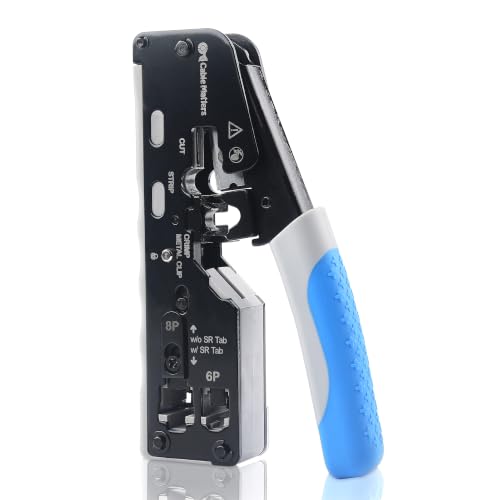
For shielded pass-through connectors, this is the broadest Cat-rated match among the tools here: compatibility spans Cat5, Cat6, Cat6A, Cat7 and Cat8, plus RJ11, RJ12 and RJ45. The all-in-one body cuts, strips and crimps, making it useful when building patch cables to custom lengths from bulk cable. The maker describes the tool as a shielded crimper; that is the distinction to weigh against the broader position support of Klein Tools VDV226-110. Its connector range is specifically shielded, so buyers working with unshielded pass-through plugs should verify that the plugs are compatible before choosing it.
Bottom line: Pick it when your pass-through plugs are shielded and you need wide Cat-category coverage.
Solsop Pass-Through RJ45 Kit

Unlike the standalone crimpers, this kit adds a cable tester, 50 Cat6 pass-through connectors and 50 connector boots. The crimper is described for Cat5 through Cat7 cable and RJ11/RJ12 standard plugs as well as pass-through RJ45 connectors, including shielded and unshielded modular plugs with dovetail clips. The included tester is specified for cables up to 300 meters and takes a 9V battery, which is not included. The kit is a less compact choice at 11 inches long, so it may be cumbersome for buyers who prioritize a small tool over bundled testing and accessories.
Bottom line: Choose this kit if you want a tester and a batch of connectors and boots alongside the crimper.
Klein Tools VDV226-005

At 5.3 inches long, this is the compact option for Klein Tools RJ45 pass-through connectors, with an on-tool wiring guide to help reduce wiring errors. It crimps and trims round STP/UTP paired-conductor cable and supports CAT5e and CAT6 applications. Compared with Klein Tools VDV226-110, it is focused on RJ45 pass-through work rather than supporting 4-, 6- and 8-position modular connectors. It is explicitly not for standard, non-pass-through connectors, so buyers who need ordinary RJ45 plug crimping or broader connector flexibility should choose a different tool.
Bottom line: Pick it for compact CAT5e/CAT6 work using Klein Tools pass-through plugs only.
Mini RJ45 Pass-Through Crimper

This mini-format crimper is specified for pass-through Cat5e, Cat6 and Cat6A RJ45 connectors and 26–23 AWG cable. Its cutting, stripping and crimping functions are combined in one tool, and the maker highlights a replacement-blade mounting notch intended to keep the blade seated during use. Unlike Solsop Pass-Through RJ45 Kit, it does not come with a tester or connector bundle in the product name or fields. The range is narrower than tools covering additional Cat categories, so buyers who use Cat7 or Cat8 connectors should verify compatibility before choosing it.
Bottom line: Choose it for a small-format tool when your work stays within its Cat5e–Cat6A range.
How to choose an RJ45 pass-through crimper
Start by matching the plug type, cable category and shielding, not just the RJ45 shape. RJ45 usually refers to an 8-position modular connection; pass-through plugs let conductors extend through the plug face so they can be trimmed after insertion. A crimper must trim those protruding ends cleanly, and its die must match the connector family. For mixed voice and data jobs, look for 4-, 6- and 8-position support; for shielded Ethernet, confirm shielded-plug compatibility specifically. If you terminate both shielded and unshielded cable, choose only a tool whose fit covers both. A practical rule: if your plugs are not the exact pass-through type specified for a tool, do not assume a standard RJ45 die will work.
Pass-through plug fit and wiring
Pass-through construction simplifies conductor alignment, but it does not correct a wiring-order mistake. For common Ethernet straight-through cables, use T568B at both ends or T568A at both ends; mixing the two produces a crossover arrangement. Keep the twisted pairs close to the plug and untwist only enough to arrange conductors, typically no more than about 0.5 inch. Trim the conductors flush with the plug face so exposed copper does not extend beyond the connector. Shielded plugs also require matching shielded cable and compatible hardware; a shielded crimper alone does not establish that every plug type fits. After crimping, test continuity and pair order before installing a cable in a network.
Choosing cable category and gauge
Match the connector category to the cable category and the network requirements; a higher category plug cannot upgrade lower-category cable. Cat5e and Cat6 are common for gigabit Ethernet runs, while Cat6A is commonly selected for 10-gigabit links up to 100 meters when the full channel is Cat6A-rated. Ethernet balanced cabling channels are generally limited to 100 meters, including patch cords. Conductor gauge matters because plugs are built for particular solid or stranded conductors and wire diameters; the mini crimper here gives a 26–23 AWG range, while the other tools have different stated compatibility. Check plug-and-cable fit before terminating, especially when switching between solid in-wall cable and stranded patch cable.
Testing and common termination mistakes
A cable tester can catch opens, shorts, reversals and split pairs that a visual check may miss. Basic continuity testers do not certify bandwidth or prove a run meets a Cat performance class, so they are useful for wiring faults rather than full qualification. The most common mistakes are choosing the wrong plug for solid or stranded cable, untwisting pairs too far, swapping pair order, and leaving uneven conductor lengths at the plug face. For permanent in-wall runs, use solid-conductor cable with jacks or plugs designed for it; stranded conductors are generally intended for flexible patch leads. Keep data cabling separated from power wiring as required by local electrical rules, and never crimp a plug while the cable is connected to powered equipment.
Frequently Asked Questions
How far should Ethernet pairs be untwisted?
Keep untwisting to about 0.5 inch or less at the termination. Longer untwisted sections can increase crosstalk and make the cable less reliable at its rated category.
Can a pass-through crimper work with standard RJ45 plugs?
Not necessarily; a tool designed for pass-through plugs may use a trimming blade and die suited to that connector style. Use standard plugs only when the tool explicitly supports them, and remember that one included tool here explicitly excludes non-pass-through connectors.
Should both Ethernet cable ends use T568A or T568B?
For a typical straight-through patch cable, terminate both ends to the same scheme, either T568A or T568B. Using one scheme at each end creates a crossover wiring pattern.
How long can a copper Ethernet cable run be?
A standard Ethernet channel is generally limited to 100 meters, including patch leads. Permanent horizontal cabling is commonly limited to 90 meters, leaving up to 10 meters for patch cords.
Does a cable tester certify Cat6 performance?
A basic wire-map tester checks continuity and wiring faults but does not certify Cat6 bandwidth performance. Certification requires a cable certifier that measures channel performance against the applicable category limits.