
Pressure Cookers Made in Germany: Compare 4 Models

For a pressure cooker made in Germany, start with the Fissler Vitaquick Premium 4.5 L: it explicitly states German manufacture and offers two cooking levels. The Silit Sicomatic T-Plus is a smaller German-made option with three settings and a ceramic cooking surface.
Choose another model if you need a larger pot or a pressure skillet; check the country-of-origin marking before ordering any model whose German manufacture is not established here.
We earn a commission if you buy through links on this page. As an Amazon Associate I earn from qualifying purchases. Products are compared on manufacturer specifications, not hands-on testing.
- Best overall: Fissler Vitaquick Premium 4.5 L – Its 4.5-liter capacity, two cooking levels and stated German manufacture match the search closely.
- Best for compact cooking: Silit Sicomatic T-Plus 2.5 L – The 2.5-liter pot is made in Germany and has three cooking settings.
- Best for larger batches: Fissler Vitaquick Premium 8.5 qt – The 8.5-quart capacity suits larger batches, though German manufacture is not established.
- Best for skillet cooking: Fissler Vitavit Premium 1.9 qt Skillet – The 1.9-quart pressure skillet adds a browning-friendly base and four settings.
| Product | Best for | Capacity | Material | Origin | Shop |
|---|---|---|---|---|---|
| Fissler Vitaquick Premium 4.5 L | Everyday stovetop meals | 4.8 qt | Stainless steel | Made in Germany | Check Price on Amazon |
| Silit Sicomatic T-Plus 2.5 L | Compact portions | 2.6 qt | Silargan ceramic | Made in Germany | Check Price on Amazon |
| Fissler Vitaquick Premium 8.5 qt | Large batches | 8.5 qt | Stainless steel | — | Check Price on Amazon |
| Fissler Vitavit Premium 1.9 qt Skillet | Small skillet meals | 1.9 qt | Stainless steel | — | Check Price on Amazon |
Pressure cookers made in Germany and alternatives
Compare capacity, cooking controls and origin before choosing a pot for your usual batch size.
Fissler Vitaquick Premium 4.5 L

The 4.5-liter capacity makes this a larger everyday option than the compact Silit, while its two cooking levels provide a choice between gentle and faster cooking. Fissler says the pot is manufactured in Rhineland-Palatinate and uses up to 90% recycled stainless steel. The super-thermal base is compatible with all cooktop types, including induction, and the locking indicator changes from red to green with a click when closed securely. Choose it for flexible stovetop cooking; the two settings offer fewer fixed choices than the Silit’s three settings.
Bottom line: Choose this if you want a German-made stainless-steel cooker with two pressure levels and roomier capacity.
Silit Sicomatic T-Plus 2.5 L

The Silit’s 2.5-liter capacity is the compact choice among the German-made cookers here, and its three fixed settings cover gentle, quick and steam cooking. The Silargan functional ceramic surface has a 30-year warranty when used as intended; the maker also gives a 10-year spare-parts delivery warranty. An interior scale helps measure amounts, while its removable lid handle is designed to simplify cleaning. This model suits smaller batches and buyers who value ceramic construction. Its smaller capacity is less suited to large soups or family-sized batches.
Bottom line: Pick this for smaller portions and three preset cooking choices in a German-made cooker.
Fissler Vitaquick Premium 8.5 qt

The 8.5-quart size sets this cooker apart for larger batches; it is substantially bigger than the 4.5-liter Fissler and 2.5-liter Silit. It comes with a steamer insert and tripod, and its two pressure settings are intended for foods ranging from vegetables and fish to beans and stews. Fissler says it can cook up to 70% faster and use up to 50% less energy than a standard cooking pot, with results varying. The German manufacturing origin is not established for this model here, so verify its country-of-origin marking if that is essential.
Bottom line: Choose this for larger stovetop batches if German manufacture is not a requirement.
Fissler Vitavit Premium 1.9 qt Skillet
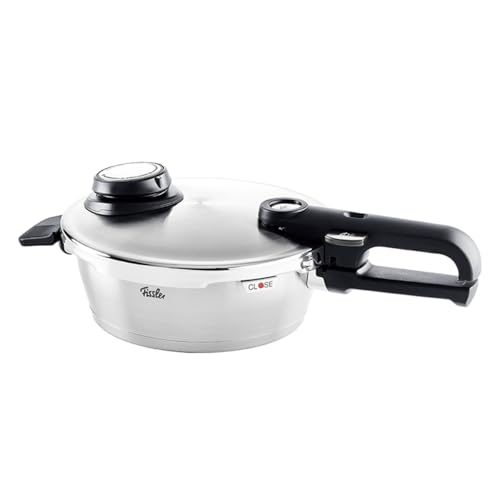
The 1.9-quart pressure skillet is the smallest option here and differs from the deeper cooker formats by offering a base intended for browning. It has four adjustable settings, induction compatibility and a pressure-release feature at the indicator; the locking indicator clicks from red to green when correctly sealed. Fissler says its pressure cooking can reduce cooking time by 70% and preserve up to 90% of vitamins such as vitamin C. This suits small portions and browning-oriented cooking, but its limited capacity is not a fit for large batches. German manufacture is not established for this model.
Bottom line: Pick this for small skillet-style meals and browning capability, not German-origin assurance.
How to choose a German-made pressure cooker
Choose by capacity first, then confirm the origin and cooktop fit. A 2.5-liter pot suits smaller batches, while 4.5 liters offers more room for soups, beans or shared meals; an 8.5-quart pot serves larger batches but takes more storage space. Stovetop pressure cookers use sealed steam to raise pressure and cooking temperature above an uncovered pot, shortening cooking time. Two pressure levels give a simple gentle-versus-faster choice; three fixed settings can offer a dedicated steam option. For induction, look for an explicit compatibility claim rather than assuming any stainless-steel pot works. Country of manufacture is separate from brand nationality, so use an explicit origin claim when German manufacture is a requirement.
Pressure cooker capacity and batch size
Match capacity to the amount you cook at once, while leaving room for steam. A pressure cooker should not be filled beyond two-thirds capacity for most foods; foamy foods such as beans, grains and rice generally need a half-full maximum. That headroom helps prevent food from obstructing the pressure valve. The included capacities span 1.9 to 8.5 quarts, so the smallest skillet is for modest portions and the largest pot fits bigger batches. A useful rule is to choose a larger cooker if your typical batch approaches half the pot’s volume, especially for foods that foam. Never fill to the rim or treat stated capacity as usable cooking volume.
Pressure settings and safe release
Use the cooker’s pressure indicators and release controls as designed, and keep hands and face away from escaping steam. Steam can cause serious burns; natural pressure release allows pressure to fall gradually, while quick release vents steam rapidly and may be unsuitable for foamy foods. The Silit offers three fixed settings, while the Fissler Vitaquick models list two cooking levels; the small skillet has four adjustable settings. These controls are not interchangeable, so use recipes intended for stovetop pressure cookers and adjust for the particular setting. Before opening, confirm the pressure indicator has dropped and the lid releases without force. Never force open a pressurized cooker.
Stovetop pressure cookers compared
Stainless steel and ceramic-surfaced cookers differ in surface material and care considerations. Stainless steel is the construction in the Fissler models with material specified here; the Silit uses Silargan functional ceramic. Capacity and controls may matter more than surface choice if you are planning meals for different group sizes. Origin is another independent decision: the first two models explicitly identify German manufacture, while the other two do not establish that in the available product facts. If an origin requirement is strict, confirm the marking before purchase. This table distinguishes the format choices without treating brand nationality as proof of manufacturing location.
| Need | Model type | Decision point |
|---|---|---|
| Small batches | Compact pressure cooker | Use half-full limit for foaming foods |
| More pressure choices | Three-setting cooker | Check the recipe’s pressure level |
| Large batches | Large stovetop cooker | Reserve storage and counter space |
| Browning plus pressure cooking | Pressure skillet | Capacity is limited |
Frequently Asked Questions
How much should I fill a pressure cooker?
Keep most foods below two-thirds full, and limit beans, grains, rice and other foaming foods to half full. Leave headroom so food and foam cannot obstruct the valve.
Can a stovetop pressure cooker work on induction?
Only when the cooker is compatible with induction; a stainless-steel label alone does not guarantee that. The Fissler Vitaquick 4.5-liter model and the 1.9-quart skillet explicitly state induction compatibility.
Why does a pressure cooker need a minimum liquid amount?
A pressure cooker needs liquid to produce steam and build pressure; cooking without enough liquid can prevent proper pressurization and damage the pot. Use the recipe’s amount and do not exceed the cooker’s fill limit.
How do I know when a pressure cooker is safe to open?
Wait until the pressure indicator has dropped and the lid releases without force. Escaping steam can burn, so keep your face and hands clear of the release path.
How often should a pressure cooker seal be replaced?
Replace a gasket when it is cracked, stretched, stiff or no longer seals, rather than relying on a universal calendar interval. Inspect the gasket and valve before each use because wear and cleaning frequency affect their condition.