
Games Like Bop It: 5 Fast-Paced Alternatives Compared

For a close match to Bop It’s fast voice-command play, choose Hasbro Bop It Extreme: its four modes include a head-to-head option for two players. Choose Hasbro Simon Micro Series or Moose Games Flipslide instead if you want pattern memory or a color-matching puzzle rather than reacting to spoken commands.
We earn a commission if you buy through links on this page. As an Amazon Associate I earn from qualifying purchases. Products are compared on manufacturer specifications, not hands-on testing.
- Best overall: Hasbro Bop It Extreme – Four modes include one-on-one challenges alongside solo and group play.
- Best for memory play: Hasbro Simon Micro Series – Players repeat a growing sequence of colored lights.
- Best for puzzle play: Moose Games Flipslide – Four modes center on flipping and sliding colored blocks to match lights.
| Product | Best for | Play modes | Main action | Height | Shop |
|---|---|---|---|---|---|
| Hasbro Bop It Extreme | Head-to-head play | 4 | Voice-command actions | 9.49 in | Check Price on Amazon |
| Hasbro Bop It | Classic commands | Solo, pass-it, multiplayer | Voice-command actions | 10.5 in | Check Price on Amazon |
| World’s Smallest Bop It Extreme | Compact command play | Multiple modes | Voice-command actions | 3.35 in | Check Price on Amazon |
| Hasbro Simon Micro Series | Visual memory | Multiple levels | Repeat light sequence | 8.27 in | Check Price on Amazon |
| Moose Games Flipslide | Color puzzle rounds | 4 | Flip and slide blocks | 1.93 in | Check Price on Amazon |
Games Like Bop It
These handheld games differ most in whether they use voice commands, visual memory, or color-matching moves.
Hasbro Bop It Extreme

Hasbro Bop It Extreme is the closest fit for players who want Bop It-style commands plus a direct two-player challenge. Its four modes are Solo, Pass It, Party, and One-on-One, and the controls include a knob, wheel, and lever for actions such as bop, twist, pull, spin, and flick. That range makes it suitable for both a solo reflex round and a party game. The tradeoff is its 9.49-inch height, which makes it less compact than the miniature alternative.
Bottom line: Pick this for familiar command reactions with a built-in head-to-head mode.
Hasbro Bop It
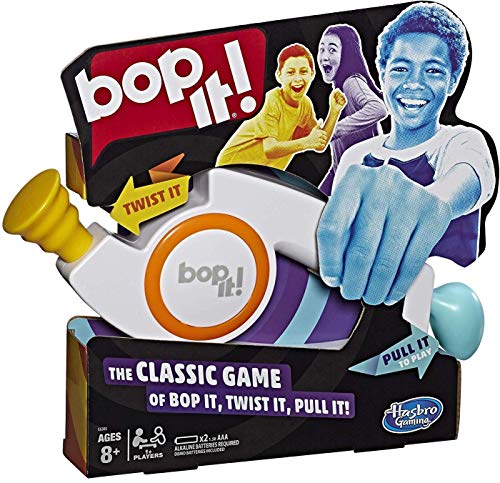
Hasbro Bop It keeps the familiar three-action format: players listen for Bop It, Twist It, or Pull It and respond quickly as the commands arrive in random order. Solo and pass-it modes support personal-score attempts or group turns, while a multiplayer face-off adds competition. It suits buyers seeking a simpler command set than the Extreme version. The dimensions make this unit 10.5 inches tall, so it is not the smallest option for a travel bag.
Bottom line: Choose this for straightforward Bop It commands and solo or pass-it play.
World’s Smallest Bop It Extreme

World’s Smallest Bop It Extreme shrinks the Extreme-style command game to a 3.35-inch-tall unit, making it the compact choice among these voice-command options. Its actions include bop, twist, pull, spin, and flick, and the game supports solo play or passing it among friends. It is intended for ages 6 and up, unlike the other Bop It products here, which are aimed at older children. The miniature format may suit travel, but players who prefer a larger grip should consider a full-size unit.
Bottom line: Pick this when a miniature Bop It-style game matters more than a larger grip.
Hasbro Simon Micro Series

Hasbro Simon Micro Series replaces spoken action commands with a color-sequence memory challenge: watch the lights, then press the colored buttons in the same order. The compact Simon unit supports solo high-score play and party turns, with higher levels adding difficulty. It is a better fit for players who enjoy remembering patterns than for anyone seeking physical Bop It gestures. At 8.27 inches tall, it is smaller in height than the full-size Bop It units, though its sequence-based play is a distinct kind of challenge.
Bottom line: Choose this for a light-and-color memory challenge instead of voice commands.
Moose Games Flipslide
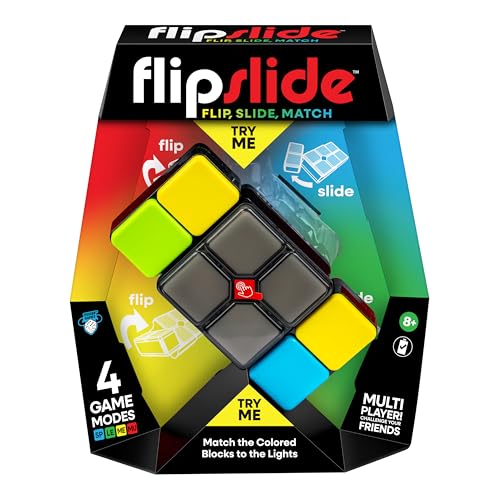
Moose Games Flipslide turns the fast-paced challenge into a color-matching puzzle: flip and slide blocks to match the lights. Its four modes—Speed, Multiplayer, Level, and Memory—offer several ways to play alone or with others, and batteries are included. This is the pick for buyers who want puzzle moves rather than spoken commands or button-sequence recall. Its height is 1.93 inches, but the overall dimensions are 2.99 by 5.98 by 1.93 inches, so compare the full footprint when packing it for travel.
Bottom line: Pick this for quick color-matching puzzle rounds and multiple play modes.
How to Choose a Bop It Alternative
Choose by the response the game asks for: spoken commands, remembered light patterns, or color matching. Voice-command games most closely reproduce Bop It’s listen-and-react rhythm; Simon-style play tests short-term sequence memory, while a flip-and-slide puzzle adds hand movement and visual matching. For group play, look for an explicit pass-it, party, multiplayer, or head-to-head mode rather than assuming solo play automatically supports turns. If compactness matters, compare the complete dimensions, not just height: one listed unit is 2.99 by 5.98 by 1.93 inches. For a child under age 8, favor a product whose age range includes them, such as the miniature option rated for ages 6 and up.
Voice Commands Versus Memory Games
Voice-command games reward quick recognition and motor response, while sequence games require players to retain and repeat a visual pattern. Simon-style electronic games typically begin with a short sequence and add steps as the player succeeds; the growing sequence is the core difficulty, not reaction to a changing instruction. Handheld color puzzles use a different skill again: matching visual cues while manipulating tiles or sliders. A useful decision rule is to choose a command game if players enjoy reacting immediately to spoken cues; choose a pattern game if they prefer pausing to recall an order. These categories may all be electronic handheld games, but their play styles are not interchangeable.
| Play style | Player response | Choose when |
|---|---|---|
| Voice command | Perform the called action | Fast reactions are the draw |
| Light sequence | Repeat the color order | Memory is the challenge |
| Color puzzle | Flip or slide to match | Color matching is preferred |
Size and Age Fit for Handheld Games
Handheld game dimensions affect grip and portability, but height alone does not tell you how easy a unit is to hold. A miniature game at 3.35 inches tall takes less room than a unit over 9 inches tall, while width and depth determine whether it fits a pocket or small pouch. Check the package age guidance as well as size: these options span ages 6+ and 8+, and age guidance is not a substitute for adult judgment about a child’s coordination. Electronic games also need power, so check whether batteries are included before planning a trip; the Flipslide package includes batteries. For play near younger children, keep small handheld units and batteries out of reach when not in use.
Group Play and Common Buying Mistakes
Group modes differ: pass-it play hands one unit around, while a one-on-one mode lets two players compete directly. Party modes can add whole-body participation, so leave clear space around players and keep the game away from stairs, furniture corners, and breakable objects. A common mistake is choosing by the word “multiplayer” alone; confirm whether the format is turn-taking, simultaneous competition, or simply sharing a solo challenge. Another is assuming a compact version has the same grip or controls as a full-size unit. Match the game’s mode to the group and compare the actual dimensions before deciding.
Frequently Asked Questions
What skills do Bop It-style games use?
Voice-command games combine listening, quick decisions, and coordinated movement. Memory games instead ask players to remember a sequence, while color puzzles add visual matching and hand manipulation.
Are electronic reaction games suitable for a six-year-old?
Some are labeled for ages 6 and up, while several options here are aimed at ages 8 and up. Choose a game whose age guidance includes the child, and supervise play if small parts or batteries could be accessible.
How much space should players leave for a party game?
Leave at least an arm’s length around each player and clear nearby hard or breakable objects before starting. Whole-body party play needs more room than a seated button game, so avoid tight spaces and stairs.
Do handheld electronic games need batteries?
Most portable electronic games use batteries, but package contents vary. The Flipslide includes batteries; check the package before travel so a game is not unusable when needed.
What is the difference between pass-it and head-to-head modes?
Pass-it mode typically moves a single game unit from one player to the next after a turn. Head-to-head play is a direct competition between players, and some units are designed for two opponents to hold the unit at the same time.