
Voldyne 5000 Volumetric Exerciser: Alternatives Compared

The named Voldyne 5000 is not among these options; 5-Liter Ball-Flow Spirometer is the closest match because it is a measured incentive spirometer with 5 liters of capacity. Choose One-Ball Breathing Exerciser or White One-Ball Breathing Trainer for a simpler one-ball trainer, or Blue 3-Ball Non-Measuring Trainer and Transparent 3-Ball Lung Trainer for three-ball visual feedback rather than a measured 5-liter device.
We earn a commission if you buy through links on this page. As an Amazon Associate I earn from qualifying purchases. Products are compared on manufacturer specifications, not hands-on testing.
- Best overall: 5-Liter Ball-Flow Spirometer – Its 5-liter maximum capacity and volume markings most closely match the Voldyne 5000 search.
- Best for three-ball feedback: Blue 3-Ball Non-Measuring Trainer – It uses three balls and lists a 1600 cc/sec size.
- Best for simple feedback: One-Ball Breathing Exerciser – Its one-ball design offers a straightforward visual breathing cue.
| Product | Best for | Capacity or measure | Ball design | Flow guidance | Shop |
|---|---|---|---|---|---|
| 5-Liter Ball-Flow Spirometer | Measured breathing | 5 L maximum | Ball flow indicator | Yes | Check Price on Amazon |
| One-Ball Breathing Exerciser | Simple visual cue | No volume scale | One ball | No | Check Price on Amazon |
| White One-Ball Breathing Trainer | White single-ball | No volume scale | One ball | No | Check Price on Amazon |
| Blue 3-Ball Non-Measuring Trainer | Three-ball feedback | No volume scale | Three balls | 1600 cc/sec | Check Price on Amazon |
| Transparent 3-Ball Lung Trainer | Transparent finish | No volume scale | Three balls | — | Check Price on Amazon |
Voldyne 5000 Volumetric Exerciser Alternatives
These options range from a measured 5-liter spirometer to simple visual trainers, so choose by whether volume measurement matters.
5-Liter Ball-Flow Spirometer

The measured design is what separates this option from the simple visual trainers: it has a 5-liter maximum volume, volume markings, and a flow-rate indicator. The maker says the indicator guides inhale speed, with the middle position as the target. That combination makes it the closest fit here for someone seeking a Voldyne-style volumetric exerciser.
Bottom line: Choose this if you want volume markings up to 5 liters and guided inhale pace.
One-Ball Breathing Exerciser

A single rising ball distinguishes this trainer from the measured 5-liter option and the three-ball models. Its markings provide a visual cue for inhale height, but the product’s own description says there are no numbers, so it is not a volumetric substitute for a Voldyne 5000. This suits buyers who want a basic visual routine rather than capacity tracking.
Bottom line: Pick this for a simple ball-height cue, not measured volume.
White One-Ball Breathing Trainer

The white color is the only distinguishing detail supplied for this version; its core design matches the other one-ball trainer. It provides visual rise feedback instead of volume readings, which makes it a different kind of tool from a volumetric spirometer. Choose it when a one-ball format is the priority and the white finish is useful for identification.
Bottom line: Choose this for a white one-ball visual trainer rather than a volume scale.
Blue 3-Ball Non-Measuring Trainer

The blue, three-ball design and 1600 cc/sec size separate this non-measuring trainer from the other options. Its three lightweight balls rise during inhalation, but it does not provide the 5-liter capacity scale associated with the Voldyne 5000. The maker says it is intended for gentle breathing practice and includes a flexible tube; the measurements also give a 5.5-inch height, 6.7-inch length, and 2-inch width. This is a fit for visual ball movement, not tracking inhaled volume.
Bottom line: Pick this if you want three-ball movement and do not need volume measurement.
Transparent 3-Ball Lung Trainer
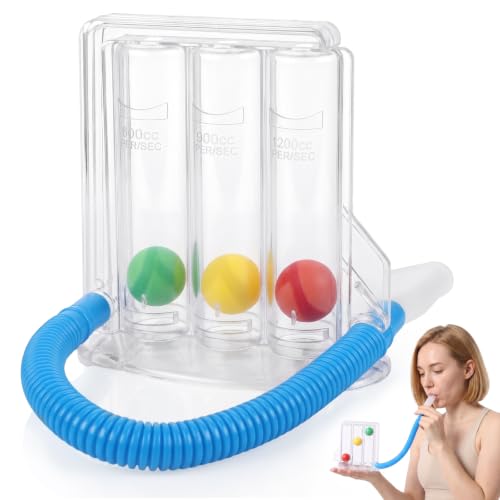
The transparent finish sets this three-ball trainer apart from the blue version, while its visual feedback remains distinct from a measured spirometer. The maker says the lightweight balls rise during inhalation and describes the device as a low-resistance option for routine practice. It is intended for visual height cues, not a marked volume target, so it will not provide the same capacity tracking as a Voldyne 5000-style model. This is the relevant choice when three-ball feedback and a transparent color matter more than measurement.
Bottom line: Choose this for a transparent three-ball visual trainer without volume tracking.
How volumetric incentive spirometers work
A volumetric incentive spirometer makes inhalation visible through a piston, marker, or ball that moves as air is drawn in; the measured target is usually volume, while a flow indicator helps pace the breath. A slow, steady inhale is the goal rather than a sharp gasp, because rapid inhalation can raise the flow cue without sustaining a deep breath. Capacity is not a personal target by itself: follow the breathing goal set for your situation, and stop if the exercise causes pain, dizziness, or unusual shortness of breath. A three-ball device generally shows motion or flow bands, not the same volume measurement as a 5-liter scale.
Choosing a measured model or visual trainer
Choose a model with volume markings when tracking an inhaled-volume goal matters; choose a ball-only trainer when a simple visual cue is sufficient. A 5-liter maximum describes the instrument’s scale, not a recommended breath or a promise that every user can reach that amount. Flow indicators and volume readings answer different questions: one guides inhale pace, while the other shows volume. Use this quick comparison to identify which feedback type fits the intended routine.
| Need | Useful feature | Available match |
|---|---|---|
| Track volume | Marked capacity scale | 5-Liter Ball-Flow Spirometer |
| See ball movement | One or three visual balls | One-Ball Breathing Exerciser, White One-Ball Breathing Trainer, Blue 3-Ball Non-Measuring Trainer, or Transparent 3-Ball Lung Trainer |
If a clinician has prescribed a specific target, prioritize the prescribed scale and technique rather than selecting by maximum capacity alone.
Using an incentive spirometer safely
Sit upright, seal your lips around the mouthpiece, and inhale slowly enough to keep the flow cue controlled; after a deep breath, hold it briefly if your care team has instructed you to do so. Many postoperative care plans use repeated sets while awake, but the number of breaths and target volume should come from the clinician rather than a generic device label. Keep the mouthpiece clean and do not share it, because it contacts saliva. Stop and seek clinical guidance for worsening breathing symptoms, chest pain, or lightheadedness; spirometry is a breathing exercise aid, not emergency treatment.
Matching the device to the prescribed goal
A prescribed volume target calls for a device with an actual volume scale, while a ball-only model cannot confirm a liter value. Confirm that the device’s measurement range includes the target assigned by the care team before ordering; a maximum of 5 liters does not make every intermediate scale mark suitable for every patient. If the goal is paced inhalation, a flow indicator can be useful, but it should not be confused with volume. For routine recovery, also confirm the expected mouthpiece and tubing setup with the clinician if a specific configuration has been requested.
Frequently Asked Questions
What does 5000 mean on a Voldyne 5000?
The name refers to a volumetric spirometer with a capacity scale reaching 5,000 milliliters, or 5 liters. That is the scale’s upper range, not a target every user should attempt.
Is a 5-liter spirometer the same as a three-ball trainer?
No. A 5-liter spirometer provides volume markings, while a three-ball trainer shows ball movement as a visual breathing cue. Choose volume markings when a measured target is needed.
How slowly should I inhale through an incentive spirometer?
Inhale gradually rather than sharply, aiming to keep any flow indicator controlled while drawing a deep breath. If a clinician has set a pace or target, use that instruction instead of a generic setting.
Should I use an incentive spirometer if breathing feels worse?
No; stop the exercise and get medical guidance for worsening shortness of breath, chest pain, or lightheadedness. An incentive spirometer is not a substitute for urgent care.