
Wood Grain Paint Roller Sets Compared by Tool Mix

Wood Grain Tool Set, 11-Piece is the most versatile choice because its 11-piece set combines a 7-inch roller, a rocker, four graining tools and five brushes. Choose a different set if you want a smaller group of tools or a handheld design rather than a kit with painting brushes.
Wood grain paint rollers and graining tools create decorative patterns in a wet paint layer; the final effect depends on paint consistency, timing and how you move the tool.
We earn a commission if you buy through links on this page. As an Amazon Associate I earn from qualifying purchases. Products are compared on manufacturer specifications, not hands-on testing.
- Best overall: Wood Grain Tool Set, 11-Piece – It pairs a 7-inch roller and rocker with four graining tools and five brushes.
- Best for a six-piece set: Wood Graining Tool Set, 6-Piece – The set is presented as six pieces and includes a 7-inch roller.
- Best for color-coded tools: Wood Grain Painting Tool Set, 7-Piece – Its set uses red, blue and yellow tools and describes a basecoat-then-topcoat process.
- Best for compact grip: LUTQ Wood Grain Tool, Pack of 4 – The product emphasizes handheld operation and gives dimensions of 6.5 by 5.8 inches.
| Product | Best for | Included tools | Roller size | Dimensions | Shop |
|---|---|---|---|---|---|
| Wood Grain Tool Set, 11-Piece | Full tool variety | 7-inch roller, rocker, 4 graining tools | 7 inches | 12.25 × 7.05 × 3.15 inches | Check Price on Amazon |
| Wood Graining Tool Set, 6-Piece | Six-piece set | 6-piece set; individual tool mix not broken | 7 inches | 12.2 × 7 × 1.8 inches | Check Price on Amazon |
| Wood Grain Painting Tool Set, 7-Piece | Color-coded tools | 7-piece set; red, blue and yellow | — | 12 × 7 × 1.8 inches | Check Price on Amazon |
| LUTQ Wood Grain Tool, Pack of 4 | Handheld operation | Pack of 4 | — | 6.5 × 5.8 × 1.5 inches | Check Price on Amazon |
Wood Grain Paint Roller Sets
Compare the included tools and measurements to choose a set suited to your project and preferred patterning approach.
Wood Grain Tool Set, 11-Piece

Unlike the smaller sets, this 11-piece kit includes five brushes alongside its patterning tools: a 7-inch roller, a 4-inch rocker and four rubber graining tools in 3-, 4-, 5- and 6-inch sizes. That range suits projects where you want to switch between broader strokes and narrower details without assembling separate brush sizes. The maker says the rubber tools have good elasticity and are wear-resistant; the brushes have synthetic filaments and wood handles. The tradeoff is a larger collection to manage, which may be unnecessary for a single small surface.
Bottom line: Choose this set if you want brushes and several graining-tool widths in one kit.
Wood Graining Tool Set, 6-Piece
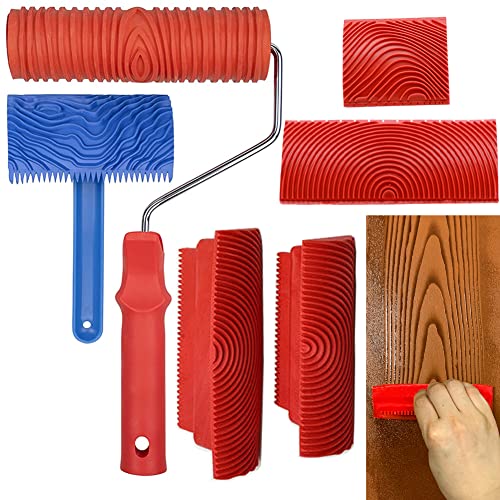
This set is described as six pieces and centers on a 7-inch wood grain roller, while the 11-piece option spells out a wider mix of sizes and brushes. Its features describe rubber tools with handles, plus a style without a handle that offers a larger gripping area. The maker says the rubber is elastic and resistant to wear.
Bottom line: Pick this if a six-piece grouping and 7-inch roller fit your project.
Wood Grain Painting Tool Set, 7-Piece

Color is the clearest point of distinction here: the set is identified in red, blue and yellow, whereas the other options foreground a larger brush collection, handle design or handheld operation. Its maker describes a sequence of brushing on a base color, letting it dry, then applying a surface color while wet and sliding the tool through it. The maker says the technique is suitable for textured and water-based paint.
Bottom line: Choose this if the described two-color process and color-coded set suit your work.
LUTQ Wood Grain Tool, Pack of 4

This pack emphasizes handheld operation and an ergonomic grip, rather than a specified roller width or a brush assortment. Its dimensions are 6.5 inches long by 5.8 inches wide by 1.5 inches high, and its weight is 0.45 pounds. The maker says its rubber tool is intended for creating wood grain effects on varied surfaces. It may suit someone prioritizing a compact hand-held format, but the maker does not identify a roller size or itemize the four pieces, so verify those points if the surface area or tool variety is decisive.
Bottom line: Pick this for a compact pack when handheld operation matters more than stated roller width.
How to choose a wood grain paint roller
Choose by tool width and included accessories, then match the patterning approach to the area you need to cover. A 7-inch roller appears in two of these sets; narrower tools can help with detail work, while a rocker is a separate patterning shape. Wider tools cover more surface per pass, but need enough clear space to move evenly. For a single small accent, a compact set may be easier to handle; for several surfaces or varied detail, a kit with multiple widths and brushes can reduce tool changes. Compare what is actually itemized: a piece count alone does not show the size or purpose of every piece. If a specific width matters, confirm it before ordering.
How wood grain paint tools create a pattern
Wood grain tools shape a contrasting wet paint layer into lines and curves that resemble grain; movement and timing influence the result. A typical decorative approach uses a dried basecoat, then a second color while wet, as described for one set here. Test the paint and motion on a scrap board or hidden area before applying the pattern across a wall or furniture face. Short, controlled passes are easier to adjust than long strokes across an entire surface. Keep the tool angle and travel direction consistent where you want the grain to look continuous, and clean paint from the tool before it dries. Paint compatibility and drying time depend on the product label and room conditions.
Which wood grain tool set fits your project
Match the set to the surfaces and details you plan to pattern rather than choosing on piece count alone. A roller is suited to longer runs, while smaller hand tools can add narrower marks; a rocker creates a different motion and pattern. The 11-piece kit includes four stated tool widths and five brushes, while other sets emphasize a six- or seven-piece grouping or handheld operation. Use this comparison as a starting point, then check that any needed sizes and components are included.
| Project need | Useful set feature |
|---|---|
| Broad decorative runs | Stated 7-inch roller |
| Several pattern widths | Multiple graining tools, such as 3-, 4-, 5- and 6-inch sizes |
| Brushes for prep or edging | Set that explicitly includes brushes |
| Compact hand use | Handheld design and stated dimensions |
Paint preparation and safe use
Prepare the surface and paint before making a decorative pass: a clean, sound surface and a compatible basecoat help the top layer move predictably. Follow the paint label for application, drying and ventilation; water-based paint is not automatically odor-free, and ventilation is still sensible. Work in a well-ventilated area, protect floors and nearby surfaces, and keep paint tools away from children and pets. Do not assume the same wet time works for every paint: temperature, humidity, film thickness and formulation change how quickly a coat sets. Try a small test area first, especially if the surface is valuable or difficult to repaint.
Frequently Asked Questions
Can a wood grain roller be used on furniture?
Yes, wood grain painting tools can be used on furniture when the paint and surface preparation are compatible. Test the pattern on an inconspicuous area first, since the surface finish and paint drying rate affect the result.
Should the basecoat dry before graining?
For the two-color sequence described by one set, the basecoat dries before the surface color goes on wet. The workable time for that wet layer depends on the paint label and room conditions, so practice on scrap first.
What roller width works for wood graining?
Choose a width that fits the panel or wall area, and verify a required size before ordering.
How do I make wood grain lines look continuous?
Use a consistent direction and overlapping, controlled passes on a test surface before working on the finished area. Paint tack and tool movement can interrupt a pattern, so work in sections that remain workable rather than letting the topcoat set.
Is ventilation needed when using decorative paint?
Yes, ventilate the room and follow the paint label even when using water-based paint. Keep children and pets out of the work area until the paint is dry as directed.