
Pink Rock Climbing Shoes: 5 Models Compared by Fit

For most adult beginners, Ocun Striker QC, Rose Mesa is the strongest match because its neutral profile and relaxed heel are intended for comfortable indoor climbing and bouldering. Choose ZHENSI Dual-Strap, Pink or MASZRE Kids, Black/Pink for a child-sized option, or omcam Women’s, Pink and omcam Low-Volume, Pink if you want a pink synthetic shoe with hook-and-loop straps and a narrow, low-volume fit.
We earn a commission if you buy through links on this page. As an Amazon Associate I earn from qualifying purchases. Products are compared on manufacturer specifications, not hands-on testing.
- Best overall: Ocun Striker QC, Rose Mesa – A neutral, slightly asymmetrical shape and relaxed heel suit easy to moderate routes and all-day wear.
- Best for young beginners: ZHENSI Dual-Strap, Pink – An entry-level indoor shoe with an elastic midsole and dual straps.
- Best for kids’ bouldering: MASZRE Kids, Black/Pink – A kids’ shoe with dual Velcro straps and reinforced toe area.
- Best for narrow feet: omcam Women’s, Pink – A women’s indoor shoe with a narrow last and low-volume heel.
| Product | Best for | Fit profile | Closure | Intended use | Shop |
|---|---|---|---|---|---|
| Ocun Striker QC, Rose Mesa | All-day comfort | Neutral, relaxed heel | Hook-and-loop | Indoor, bouldering, multipitch | Check Price on Amazon |
| ZHENSI Dual-Strap, Pink | Young beginners | Low, symmetrical arch | Dual strap | Indoor climbing | Check Price on Amazon |
| MASZRE Kids, Black/Pink | Kids’ bouldering | Supportive fit | Dual Velcro | Indoor climbing, bouldering | Check Price on Amazon |
| omcam Women’s, Pink | Narrow feet | Narrow last, low-volume heel | Hook-and-loop | Indoor climbing | Check Price on Amazon |
| omcam Low-Volume, Pink | Low-volume fit | Narrow last, low-volume heel | Hook-and-loop | Indoor climbing | Check Price on Amazon |
Pink Rock Climbing Shoes
Compare each shoe’s fit and intended use before choosing a size for your climbing sessions.
Ocun Striker QC, Rose Mesa

Unlike the more gym-focused beginner shoes here, the Striker QC is designed for easy to moderate routes as well as indoor climbing, bouldering and multipitch use. Its neutral profile, slightly asymmetrical shape and relaxed heel leave room for toes to sit flatter, which can suit newer climbers or recreational climbers prioritizing comfort over an aggressively downturned fit. Ocun says most climbers find the shoe fits at street-shoe size or within a half size. The tradeoff is that the relaxed shape is not aimed at climbers seeking a tight, highly downturned shoe for steep or technical climbing.
Bottom line: Choose it for comfortable sessions across indoor climbing, bouldering and multipitch routes.
ZHENSI Dual-Strap, Pink
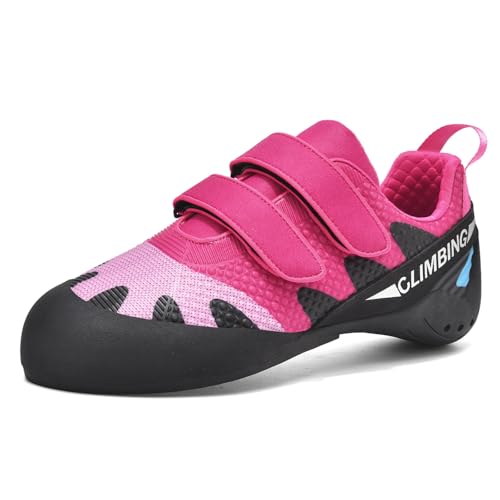
The ZHENSI is aimed specifically at indoor climbing and entry-level use, with a low, symmetrical arch and elastic midsole. Its dual straps allow adjustment, while the maker describes its fit as snug at the heel with moderate stiffness. The sizing guidance recommends children and beginners go up one size, a notable contrast with the snug, gap-free fit usually sought in climbing shoes. Check how the toes sit while bent on a foothold: extra space that lets the foot slide can make precise placement harder. The pink color and children’s sizing make it a practical option for young climbers starting in a gym.
Bottom line: Pick it for a young beginner who needs a pink indoor shoe with adjustable straps.
MASZRE Kids, Black/Pink

For children who want a shoe specifically sized for smaller feet, MASZRE pairs a supportive fit with a reinforced toe and flexible midsole. The soft, breathable upper and two Velcro straps are intended to make on-and-off changes straightforward, while the outsole is rubber. Its use includes indoor climbing and bouldering, making it more focused on young climbers than adult-oriented all-round options. One limitation is its black-and-pink color rather than an all-pink finish; that distinction matters if matching a fully pink look is the priority.
Bottom line: Choose it for a child who wants an adjustable shoe for gym climbing and bouldering.
omcam Women’s, Pink

The women’s omcam stands out for its narrow last and low-volume heel, a fit detail that can matter more than the color if standard climbing shoes feel loose around the heel. Its synthetic upper is described as breathable and lightweight, and hook-and-loop straps make fit adjustments quick between attempts. The shoe is intended for beginner climbers and indoor rock climbing. A narrow last can pinch wider forefeet, so climbers with broad toes should prioritize width and comfort rather than assuming a snug heel means the whole shoe will fit well.
Bottom line: Pick it if you need a pink indoor shoe with a narrow last and lower-volume heel.
omcam Low-Volume, Pink

This omcam version shares the women’s model’s narrow last, low-volume heel and hook-and-loop closure, but its name identifies it as a men’s and women’s option. It is intended for indoor rock climbing and beginner use, with a synthetic upper and rubber outsole. The size is 6, so confirm that size against the fit you need rather than relying on the adult category label alone. As with other narrow-fit shoes, climbers with wider feet may find the forefoot constricting even if the heel feels secure.
Bottom line: Choose it for a pink, strap-adjustable option with a narrow, low-volume fit.
How to choose pink rock climbing shoes
Choose climbing shoes by fit and intended climbing, not color alone. Beginners often do well in a flatter, more relaxed shoe for comfort on easy routes and longer sessions; a downturned shape is designed for steep terrain and demanding footholds. Most climbing shoes should fit snugly without painful pressure or empty space at the toes. When your toes bend on a foothold, gaps can let your foot slide, so try the fit in a climbing stance rather than standing only on flat ground.
Closure changes convenience more than the basic fit: hook-and-loop straps are quick to loosen between climbs, while laces offer more adjustment along the upper. A measurable rule is to favor a neutral or relaxed profile if you expect long sessions on easy routes; prioritize a tighter performance fit only when the climbing calls for it and the shoe remains tolerable.
Climbing shoe fit and sizing
A climbing shoe should hold the heel and forefoot without gaps when the toes curl, but painful toe compression is not a useful fit target for a beginner. Street-shoe size is a starting point rather than a universal conversion: the Striker QC guidance says most climbers fit at street-shoe size or within a half size, while the ZHENSI guidance recommends children and beginners go up one size.
Foot shape matters alongside length. A narrow last can reduce excess space for a narrow foot, but may squeeze a wider forefoot; a relaxed heel and neutral toe position favor comfort over a highly aggressive fit. Try both feet, since one may be longer, and test standing on a small foothold. If toes slide or the heel lifts noticeably, reassess the size or shape.
Pink climbing shoe types compared
Adult all-round shoes, beginner gym shoes and kids’ climbing shoes address different fit needs. Neutral shoes are generally more comfortable for longer, easier climbing, while specialized profiles trade comfort for precision on steeper terrain. Kids’ models focus on smaller feet and easy adjustment; adult categories should not be assumed to fit a child simply because a size appears small.
Use this guide to narrow the shoe type before settling on a size. The intended climbing setting is a useful first filter, while fit profile and closure help distinguish options within that group.
| Climbing need | Useful shoe trait | Fit check |
|---|---|---|
| Longer easy sessions | Neutral, relaxed profile | Toes feel held, not crushed |
| Young beginner | Kids’ sizing and adjustable straps | No heel lift or sliding toes |
| Narrow heel or forefoot | Low-volume heel or narrow last | Secure heel without pinching |
Climbing shoe safety and care
Rubber climbing outsoles rely on clean contact with holds; dust and chalk can reduce friction, so brush holds when permitted and wipe the sole if grit collects. A worn or damaged toe rand can affect how the shoe contacts footholds, so inspect the toe area and outsole before climbing, especially on frequently used shoes.
Climbing shoes are not protective work footwear, and a snug fit does not make them safe to walk long distances in. Remove them between attempts if sustained pressure causes pain or numbness. Keep shoes dry between sessions and away from direct high heat, which can damage adhesives and materials.
Frequently Asked Questions
Should climbing shoes fit smaller than street shoes?
Not always: the Striker QC guidance places most climbers at street-shoe size or within a half size. A snug fit should hold the foot without gaps, but painful compression is not a good target for beginners.
How snug should beginner climbing shoes feel?
Beginner shoes should hold the heel and forefoot without allowing the toes to slide when bent on a foothold. If the shoe causes pain or numbness during a short fit check, try another size or shape.
Why do climbing shoes have curved toes?
A downturned toe shape is intended to concentrate force for steep climbing and demanding footholds. A flatter, neutral profile is generally more comfortable for easy routes and longer sessions.
How often should climbing shoes be resoled?
Inspect the outsole and toe rand after every few sessions, especially if the toe rubber is thinning or separating. Resoling is commonly considered before wear reaches the rand, since damage there can require more extensive repair.
Can children wear adult climbing shoes?
Children can use an adult shoe only if the shape and size hold the heel and forefoot without sliding or painful squeezing. Kids’ models are made for smaller feet, and beginner sizing advice can differ; for example, ZHENSI advises children and beginners to go up one size.