
Dog Repellent for Lawns: 3 Options Compared by Form

For most lawn areas, Nature’s MACE Dog Repellent Granules, 2.5 lb is the clearest match because its granules cover up to 1,400 square feet and it gives a 1–2 week reapplication interval.
We earn a commission if you buy through links on this page. As an Amazon Associate I earn from qualifying purchases. Products are compared on manufacturer specifications, not hands-on testing.
- Best overall: Nature’s MACE Dog Repellent Granules, 2.5 lb – Granules cover up to 1,400 square feet, with reapplication every 1–2 weeks or after rain.
- Best for larger areas: Nature’s MACE Dog Repellent Granules, 6 lb – Its 6-pound granule package treats 3,500 square feet and calls for reapplication every two weeks or after rain.
| Product | Best for | Coverage | Reapplication | Shop |
|---|---|---|---|---|
| Nature’s MACE Dog Repellent Granules, 2.5 lb | Defined lawn areas | Up to 1,400 sq. ft. | Every 1–2 weeks or after rain | Check Price on Amazon |
| Nature’s MACE Dog Repellent Granules, 6 lb | Larger lawn areas | Up to 3,500 sq. ft. | Every two weeks or after rain | Check Price on Amazon |
| Bonide Go Away! Repellent Granules, 3 lb | Mixed animal deterrence | — | — | Check Price on Amazon |
Dog Repellent for Lawns
Compare how each repellent is applied and how much lawn or problem-area coverage the maker specifies.
Nature’s MACE Dog Repellent Granules, 2.5 lb

Nature’s MACE Dog Repellent Granules, 2.5 lb pairs a lawn-area limit with a granular format, making it easier to plan for a defined patch of turf. The 2.5-pound package covers up to 1,400 square feet, and the maker recommends more frequent application at first, followed by less frequent use as dogs avoid treated areas. Clear waste or markings before spreading granules evenly across lawns, gardens, or shrubs. This is a training aid based on scent aversion, not a physical barrier; buyers seeking protection without recurring application should consider another approach.
Bottom line: Choose this for a lawn patch you can measure and re-treat regularly.
Nature’s MACE Dog Repellent Granules, 6 lb

Nature’s MACE Dog Repellent Granules, 6 lb covers a larger stated area per package than the smaller granular option: up to 3,500 square feet from 6 pounds of granules. It is intended to discourage visits and digging in lawns, gardens, and flower beds through scent aversion. Clean dog waste from the target area before applying, then reapply every two weeks or after rain. The maker also suggests pairing it with its spray, but this package alone is granular. The main limitation is that rain can prompt an earlier repeat application, so it is less suited to buyers wanting a set-and-forget treatment.
Bottom line: Pick this when the lawn area is broad enough to use its coverage.
Bonide Go Away! Repellent Granules, 3 lb
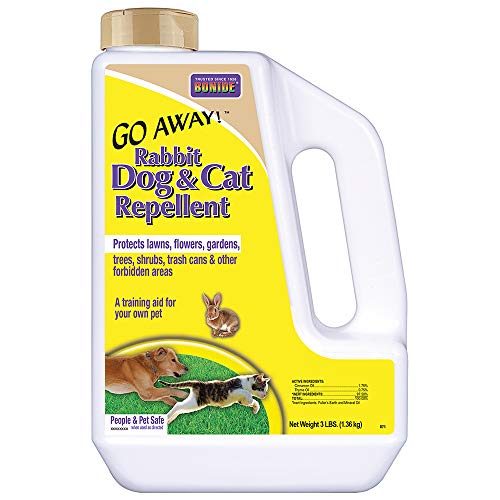
Unlike the dog-only options, Bonide Go Away! Repellent Granules, 3 lb is formulated for rabbits and cats as well as dogs, and its active oils are cinnamon and thyme. The 3-pound granules are intended for lawns, gardens, flower beds, trees, and shrubs, so it fits yards with several kinds of planting areas. The maker positions it as a training aid and says it may need other behavior-modification techniques for established habits.
Bottom line: Choose this if deterring rabbits and cats alongside dogs matters.
How to choose dog repellent for lawns
Choose by treatment area first: a granular repellent with a square-foot figure is easier to measure across turf than packs placed at individual trouble spots. Measure the lawn section you want to protect; for a 1,000-square-foot section, a package rated for up to 1,400 square feet gives a more useful planning basis than one with no area figure. Granules work by distributing scent over treated ground, while packs create scent near their placement. Neither is a fence or a guaranteed barrier, and scent-based deterrents generally work as one part of redirecting a dog’s behavior. Remove waste and existing markings before application because residual scent can keep attracting repeat visits.
| Need | Better fit | Reason |
|---|---|---|
| Measured lawn section | Granules | Two options give square-foot coverage |
| Several animal types | Multi-animal granules | Named for dogs, cats, and rabbits |
| One localized spot | Scent packs or balls | Placed around a problem area |
Granules versus scent packs on turf
Granules suit broad surface treatment, while scent packs are better suited to points where dogs repeatedly enter, dig, or urinate. Granules need an even spread; avoid concentrating them in one pile, since the intended effect depends on treating the target area. Pack products instead need placement near the behavior and eventual replacement as scent fades. Rain is a practical difference: one granular product calls for reapplication after rain, and the other gives the same rain-related direction. Before buying a pack-style product for a full lawn, confirm its coverage and replacement timing; a pack count alone does not establish square-foot treatment.
When to reapply lawn repellents
Granular products in this group use repeat schedules ranging from every 1–2 weeks to every two weeks, with rain prompting earlier treatment for both. The smaller Nature’s MACE option also says to apply more often at first and taper as dogs learn to avoid the area. Scent packs differ: one product is designed for 2–3 months, but another provides no replacement interval. Treat those periods as product-specific rather than universal, since rain, irrigation, and exposed placement can affect how long a scent remains detectable. Remove waste before each new application and keep a simple calendar so scheduled treatments are not mistaken for continuous protection.
Safe application around pets and children
Apply each repellent only as directed on its package and keep children and pets away from the treated area until application is complete. “Natural” or plant-based ingredients do not mean edible or harmless in every exposure; essential oils and scent ingredients can irritate skin or eyes, and granules or packs can be swallowed. Store the product sealed and out of reach, and wash hands after handling. Do not place packs where a child or pet can chew them, and avoid scattering granules on play surfaces or food-growing areas unless the package specifically permits that use. If a dog keeps returning despite treatment, use a physical boundary or supervision rather than increasing exposure beyond directions.
Frequently Asked Questions
How much dog repellent should I use on a lawn?
Measure the target section and use the product’s coverage rate rather than estimating by handfuls. One granular choice covers up to 1,400 square feet per 2.5-pound package, while another covers up to 3,500 square feet per 6-pound package.
Does rain wash lawn dog repellent away?
Rain can shorten the effective interval for granular repellents, and the two options with schedules call for reapplication after rain. Irrigation may also expose treated turf to water, so account for that when planning repeat applications.
Are dog repellent granules safe around pets?
Use granules only as directed and prevent pets from eating them or contacting concentrated product. “Pet safe when used as directed” is not permission to ingest the product; keep animals away during application and follow package precautions.
How often should I replace dog repellent packs?
One pack product is designed to last 2–3 months, while another pack-style product provides no interval here. Check the package before relying on packs for continuous protection, especially in rain-exposed lawn areas.
Will dog repellent stop a dog from digging?
Scent repellents can make a treated spot less appealing, but they are training aids rather than physical barriers. For a dog that repeatedly digs, pair scent treatment with supervision or a barrier and redirect digging to an allowed area.