
Best Fly Fishing Knot Tying Tools Compared by Use

HOOK-EZE Nail Knot Tool Combo is the best fit for most anglers because its combo centers on a nail knot tool and adds a hook cleaner, waterproof knot guide cards and a retractable zinger. Choose Fly Roost 2.0 Magnetic Fly Threader for holding tiny flies while threading tippet, or a hook-cover tool if safer handling is the priority.
Fly fishing knot tools assist with particular rigging steps; they do not replace choosing the right knot for the connection.
We earn a commission if you buy through links on this page. As an Amazon Associate I earn from qualifying purchases. Products are compared on manufacturer specifications, not hands-on testing.
- Best overall: HOOK-EZE Nail Knot Tool Combo – Pairs a nail knot tool with a hook cleaner, waterproof guide cards and a retractable zinger.
- Best for line control: Lake Products Three-in-One Knot Tool – Its spring-action tool has a precision-machined contact designed to grip line without damage.
- Best for tiny flies: Fly Roost 2.0 Magnetic Fly Threader – A magnetic holder steadies small flies, including size 22 gnats, while threading tippet.
- Best for hook safety: HOOK-EZE 2X Standard Knot Tool – Covers hooks from standard 4/0 down to size 28 and includes a line cutter.
| Product | Best for | Primary use | Hook coverage | Included extras | Shop |
|---|---|---|---|---|---|
| HOOK-EZE Nail Knot Tool Combo | Nail knot tying | Nail knots | — | Guide cards, cleaner, zinger | Check Price on Amazon |
| Lake Products Three-in-One Knot Tool | Line handling | General knot tying | — | Clip loop | Check Price on Amazon |
| Fly Roost 2.0 Magnetic Fly Threader | Tiny fly threading | Fly holding and threading | Size 22 gnats | — | Check Price on Amazon |
| HOOK-EZE 2X Standard Knot Tool | Hook protection | Hook covering and tackle tying | 4/0 to 28 | Line cutter | Check Price on Amazon |
| Hook Eze Knot Tool, 2-Pack | Two-tool setup | Hook covering and tackle tying | 4/0 to 28 | 2 tools, line cutters | Check Price on Amazon |
Fly Fishing Knot Tying Tools
Match the tool to the knot or handling step you want to make easier, then check that its hook range suits your flies.
HOOK-EZE Nail Knot Tool Combo
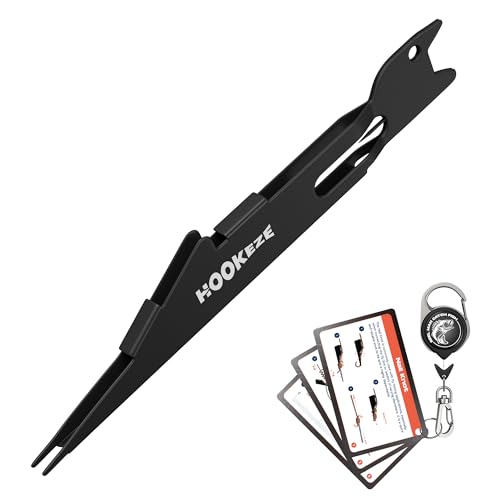
This combo is the clearest choice for anglers who want a dedicated nail knot aid plus a few rigging accessories. It includes a stainless steel nail knot tool with a built-in hook-eye cleaner, waterproof step-by-step knot guide cards and a retractable zinger. The guide cards can help when a knot needs a quick refresher on the water, while the zinger keeps the tool accessible. It suits anglers who value an all-in-one setup; the main limitation is that its specialty is nail knots, not holding tiny flies for threading tippet.
Bottom line: Pick this if a nail knot tool and on-water accessories are your priorities.
Lake Products Three-in-One Knot Tool

This tool stands apart for its spring-action mechanism and precision-machined contact, which is designed to grip line without damage. Its body is made from lightweight Acetel Delrin, and the stainless steel shaft, head and loop are specified as corrosion resistant. A loop lets you clip it to clothing. At 10 inches long, it is a larger-format choice than compact vest tools, so it may suit anglers who prefer a longer tool for handling line. The specifications do not identify its three knot functions, so confirm those functions match the knots you tie before choosing it.
Bottom line: Choose this if spring action and a longer line-handling tool matter most.
Fly Roost 2.0 Magnetic Fly Threader

Unlike knot tools centered on tying a line connection, this magnetic holder steadies a small fly while you thread tippet. It is intended for delicate patterns including size 22 gnats, where keeping the hook still can make the threading step more controlled. The cone-shaped barrel is also part of its threading design. This is a useful fit when the frustrating part is handling a tiny fly, but it is not described as a dedicated nail knot tool; anglers seeking help joining leader to fly line should choose a different type.
Bottom line: Pick this for stabilizing tiny flies during tippet threading, not for nail knots.
HOOK-EZE 2X Standard Knot Tool

This tool focuses on covering the hook point while tying tackle, rather than on one fly-line connection. Its range runs from standard 4/0 hooks down to size 28, and it includes a stainless steel trimmer for line up to 50 pounds. That range makes it relevant to anglers tying selected flies as well as other tackle, while the hook cover can help reduce accidental contact with the barb during rigging. It is a general fishing tool, so it may be less direct than a nail knot tool for anglers chiefly joining leader to fly line.
Bottom line: Choose this if shielding hook points while tying is your main concern.
Hook Eze Knot Tool, 2-Pack

This two-tool pack suits anglers who want a hook-covering tool in more than one tackle station or pack. Each tool is described as covering hooks from standard 4/0 down to size 28 and includes a trimmer for line up to 50 pounds; the pack contains two. That makes it a broader tackle-handling option for tying selected flies, swivels and other gear. It is not a dedicated fly-line nail knot system, so anglers focused specifically on that connection may prefer a tool built around nail knots.
Bottom line: Pick this if having two hook-covering tools is more useful than a dedicated nail knot aid.
Choose a tool by the knot connection
Start with the line connection you tie most: a nail knot joins a leader or backing to fly line, while a clinch knot commonly connects tippet to a fly. A surgeon’s knot is a common way to join two leader or tippet sections. These knots do different jobs, so a tool labeled for nail knots is not automatically the right aid for hook knots. Use a compact dedicated tool when one connection is the recurring challenge; choose a multi-purpose tool when hook handling or line cutting matters too. For the options here, the nail knot combo is the direct match for fly-line connections, while the magnetic holder addresses threading small flies rather than forming a line knot.
Match hook coverage to fly size
Hook sizing runs in reverse through most of the trout-fly range: a size 22 hook is much smaller than a size 4 hook, while 4/0 denotes a large hook. A tool range extending down to size 28 covers very small flies, but a cover-style device still needs to fit the hook shape and your tying task. The practical decision rule is to choose a tool whose range includes the smallest hook you regularly tie; when you use flies smaller than size 28, confirm fit before ordering. Tiny hooks are easy to bend or catch in fingers, so keep the point directed away from skin and avoid forcing a hook into a cover.
Know which knot belongs at each end
A fly-fishing leader tapers from the fly line toward the tippet, and knots connect sections with different diameters. Nail knots are typically used where a compact connection to fly line is needed; clinch or improved clinch knots are common at the fly, while a surgeon’s knot joins tippet to leader. A knot aid can guide wraps or hold line, but knot choice and snug, even tightening remain essential. Wetting nylon or fluorocarbon before drawing a knot tight reduces friction heat that can weaken the line. Pull-test each finished connection firmly before fishing, and retie after damage or a snag rather than relying on a tool to compensate for a poorly seated knot.
Use knot tools without creating hook hazards
Hook points can puncture fingers during tying, and barbed hooks are harder to remove than barbless hooks. A cover-style tool helps shield the point during handling, but it does not make an exposed hook safe; keep the point away from your hand and clothing. Line cutters also deserve care: cut away from skin and keep loose tag ends contained. For small flies, a steady holder can reduce fumbling, but avoid squeezing delicate hooks hard enough to deform them. Before packing a tool, check that its cutting edge is protected and that any clip or retracting attachment cannot snag loose line.
Frequently Asked Questions
What is the nail knot used for in fly fishing?
A nail knot commonly joins a leader or backing to a fly line. Its compact profile helps the connection pass through rod guides more readily than a bulky knot.
Which knot joins tippet to a fly?
A clinch knot or improved clinch knot is commonly used to attach tippet to a fly. Leave a short tag end and pull the knot snug before trimming it.
How often should I replace fly fishing tippet?
Replace tippet when it is abraded, kinked, weakened by a snag, or repeatedly retied until too short. Inspect the final few feet after fishing around rocks or woody cover.
Does hook size 28 mean a larger hook than size 4?
No; in the standard numbered hook sequence, size 28 is much smaller than size 4. Sizes become larger as the number gets smaller, until large hooks use aught sizes such as 4/0.
Should I wet a fishing knot before tightening it?
Yes, wet nylon or fluorocarbon line before drawing most knots tight to reduce friction heat. Pull the connection firmly afterward to check that it has seated securely.