
11 and 5 Plate Alkaline Water Machines Compared

For a home ionizer with 11 titanium plates, 11-Plate Home Ionizer is the closest match; its plate count is the clearest distinction from the 5-plate Curety 5-Plate Ionizer. Choose a different model if you need under-sink installation, more settings or a particular filter capacity.
Water ionizers use electrolysis to produce streams with different pH levels, while filtration depends on the filter and the incoming water.
We earn a commission if you buy through links on this page. As an Amazon Associate I earn from qualifying purchases. Products are compared on manufacturer specifications, not hands-on testing.
- Best overall: 11-Plate Home Ionizer – Its 11 titanium plates and pH range of 4–10.5 directly match the higher plate-count option.
- Best for 5 plates: Curety 5-Plate Ionizer – It has five titanium plates, seven water settings and an 8,000-liter filter capacity.
- Best for under-sink installation: AlkaViva Delphi H2 – Its under-sink format keeps the ionizer out of sight and offers 36 settings.
| Product | Best for | Titanium plates | pH range | Filter capacity | Shop |
|---|---|---|---|---|---|
| 11-Plate Home Ionizer | 11-plate countertop | 11 | 4–10.5 | 10,000 L | Check Price on Amazon |
| Curety 5-Plate Ionizer | 5-plate option | 5 | 4–10.5 | 8,000 L | Check Price on Amazon |
| AlkaViva Vesta H2 | automatic operation | — | 3.5–11 | — | Check Price on Amazon |
| Aqua Ionizer Deluxe 7.0 | seven settings | 7 | 4.5–11 | 4,000 L | Check Price on Amazon |
| AlkaViva Delphi H2 | under-sink setup | — | 3.5–11 | — | Check Price on Amazon |
11 and 5 Plate Alkaline Water Machines
Compare plate counts, pH ranges and filter capacities to narrow down the right ionizer format and settings.
11-Plate Home Ionizer
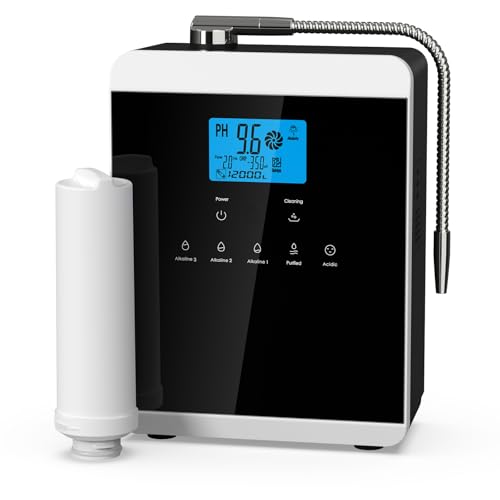
With 11 titanium plates, this home ionizer stands apart from the 5- and 7-plate options here. It offers six water settings, including purified water, strong alkaline water at pH 10.5, beauty water at pH 4–6 and strong acidic water at pH 3.5. The filter capacity is 10,000 liters. The maker says its ORP can reach −600 mV. At 13 inches tall, 9.6 inches long and 5.4 inches wide, it suits buyers with room for a countertop unit. Its six settings are fewer than the seven on some alternatives.
Bottom line: Choose this if the 11-plate configuration and 10,000-liter filter capacity are your priorities.
Curety 5-Plate Ionizer

Five titanium plates make this a direct alternative to the 11-plate machine, with two fewer plates and a lower filter capacity of 8,000 liters. It has seven water settings, auto-cleaning and voice features. The maker says its ORP can reach −500 mV. Its 5-plate setup may suit buyers who specifically want that configuration, but not shoppers seeking the highest plate count.
Bottom line: Pick this if you want five plates and seven settings and have room for its larger dimensions.
AlkaViva Vesta H2
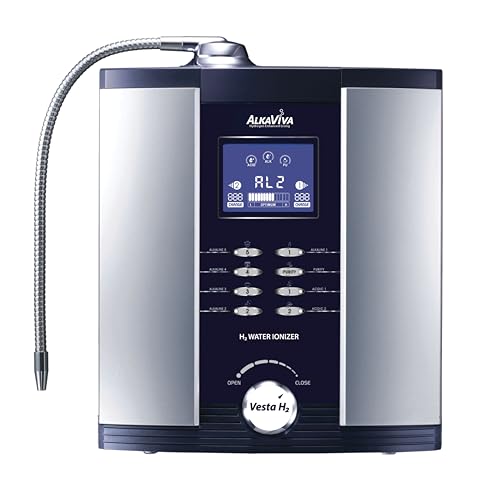
The Vesta H2 differs from the plate-count choices by emphasizing automatic operation and a pH range of 3.5–11. The maker describes it as self-cleaning and claims it reduces 249 tested contaminants by 99.9%; treat that as a maker claim rather than a substitute for checking which contaminants matter for your water. Its two-tone unit measures 14.5 inches high, 12.5 inches long and 5.5 inches wide. Buyers focused on a specific plate count should choose a model that names one; this option is better suited to those prioritizing automatic operation.
Bottom line: Choose this if automatic operation matters more to you than a plate count.
Aqua Ionizer Deluxe 7.0

The Deluxe 7.0 is the only model with seven electroplates and four continuously variable alkaline settings. It also has one purified-water setting, two acidic presets and a built-in carbon filter with a 4,000-liter capacity. The maker gives an ORP range of +600 to −750 mV and says the unit cleans itself after each use, with an automatic plate wash every 10.5 gallons. Its white housing measures 13 inches high, 5.25 inches long and 4.3 inches wide. Its filter capacity is lower than those of the two 5- and 11-plate choices.
Bottom line: Choose this if variable alkaline settings and a narrow countertop footprint matter most.
AlkaViva Delphi H2

The Delphi H2 is an under-sink hydrogen system, unlike the countertop ionizers in this comparison. It offers 36 settings and a pH range of 3.5–11. The maker says it is self-cleaning and claims it reduces 249 tested contaminants by 99.9%; confirm that claim against the contaminants you need addressed and the system’s applicable documentation. At 9.37 inches high, 5.5 inches long and 4.5 inches wide, the unit is designed for cabinet installation. Its under-sink format is the key reason to choose it, but it does not provide a plate count for a plate-based comparison.
Bottom line: Pick this if you need an under-sink system and want a wide range of settings.
How to choose an alkaline water ionizer
Start with the installation style, then compare plate count, settings and filter capacity. An ionizer uses electrodes to electrolyze flowing water; pH and oxidation-reduction potential (ORP) describe different properties, so a lower ORP number does not establish filtration performance. Filter capacity is a rated volume, not a guarantee of contaminant reduction for every water supply. Match the unit’s filter claims to the specific contaminants in your water, and check whether its filter replacement schedule is based on gallons, time or both. For a countertop unit, measure the available height, width and depth before deciding; dimensions can matter more than plate count when cabinet clearance is tight.
What plate count and pH range tell you
Plate count identifies the number of electrolysis plates, but it does not by itself establish the pH a machine will produce at a particular faucet. Water chemistry, flow rate and electrode condition can affect ionizer output. Compare the published pH range and settings alongside plate count rather than treating either number as a standalone performance measure. The EPA secondary drinking-water pH range is 6.5–8.5, a non-enforceable guideline for aesthetic effects; it is not a target that validates health claims about alkaline water. Use the product’s pH settings for their intended purpose, and do not assume that water made at an extreme pH is suitable for drinking.
Countertop and under-sink ionizers compared
Countertop machines sit beside the faucet and are simpler to inspect, while under-sink systems conserve counter space but need cabinet room and a compatible installation. Use this table to match the format to your kitchen before comparing settings.
| Need | Format to consider | Check before choosing |
|---|---|---|
| Visible, accessible unit | Countertop | Counter and cabinet clearance |
| Clear counter space | Under-sink | Cabinet dimensions and connection setup |
| Specific electrode count | Model with plate count | Count, pH range and filter capacity |
Regardless of format, filtration and ionization are separate functions. If contaminant reduction is the goal, identify the contaminant first and verify that the filter is suited to it.
How to compare filter capacity and maintenance
Filter capacity is commonly expressed as the volume a cartridge is intended to process, but actual replacement timing can depend on source-water quality and household use. Compare capacities in the same unit, then check whether the manufacturer also gives a time limit or a filter-change indicator. A larger capacity alone does not prove that a filter removes a particular substance; contaminant-specific claims and the relevant test basis matter. Ionizer maintenance may also include cleaning or descaling electrodes, especially where mineral-rich water leaves deposits. Follow the unit’s maintenance schedule and use only compatible replacement filters so the filtration and electrode systems continue to work as intended.
Frequently Asked Questions
Does more plates mean higher pH water?
No; plate count alone does not determine the pH at the tap. Water chemistry, flow and machine settings also affect the result.
What does ORP mean on a water ionizer?
ORP is oxidation-reduction potential, measured in millivolts, and it is distinct from pH. Compare ORP figures only under comparable test conditions, since water chemistry and measurement conditions affect readings.
How often should an ionizer filter be changed?
Use the cartridge’s capacity and any time-based limit, whichever comes first. High sediment or contaminant loads can use up a filter sooner than volume alone suggests.
Can alkaline water machines remove contaminants?
Only the filter can reduce contaminants, and the substances removed depend on the filter. Check for a contaminant-specific reduction claim rather than assuming electrolysis is purification.
Is acidic water from an ionizer safe to drink?
Do not assume that water at an acidic setting is intended for drinking; machines may assign different uses to different settings. Check the specific unit’s intended-use guidance before consuming water outside its drinking-water setting.