
Patches for Inner Tubes: 3 Repair Kits Compared

Slime Tube Rubber Patch Kit suits most buyers seeking patches for inner tubes because its kit includes rubber patches, a metal scuffer and rubber cement. Choose 24-Piece Vulcanizing Patch Kit for more patch sizes, or PAX Oval Inner Tube Patches if you need oval patches for slits and already have rubber cement.
Inner tube patches seal punctures in a removable inflatable tube; they are not the same as plugs used on many tubeless tires.
We earn a commission if you buy through links on this page. As an Amazon Associate I earn from qualifying purchases. Products are compared on manufacturer specifications, not hands-on testing.
- Best overall: Slime Tube Rubber Patch Kit – Includes five rubber patches, a metal scuffer and a tube of rubber cement.
- Best for patch variety: 24-Piece Vulcanizing Patch Kit – Provides 24 vulcanizing patches in three sizes, plus metal files and sandpaper.
- Best for slits: PAX Oval Inner Tube Patches – Its 96 oval patches measure about 0.94 by 1.38 inches and require separate rubber cement.
| Product | Best for | Patch count | Patch shape or size | Glue included | Shop |
|---|---|---|---|---|---|
| Slime Tube Rubber Patch Kit | Basic tube repair | 5 | Includes two 1-inch diameter patches | Yes | Check Price on Amazon |
| 24-Piece Vulcanizing Patch Kit | Multiple patch sizes | 24 | Three sizes: 1.18–2.15 in | No | Check Price on Amazon |
| PAX Oval Inner Tube Patches | Slits and cuts | 96 | Oval, 0.94 × 1.38 in | No | Check Price on Amazon |
Patches for Inner Tubes Compared
Choose by the shape and count you need, and whether you already have rubber cement.
Slime Tube Rubber Patch Kit

This kit combines rubber patches with the scuffer and cement needed for a conventional repair, unlike patch-only sets that require separate adhesive. It contains five patches, one metal scuffer and one tube of rubber cement; two patches are 1 inch in diameter. The kit is intended for tubes used on bicycles, ATVs, mowers and wheelbarrows, as well as other inflatables. It suits riders or homeowners who want a small, self-contained repair set. Its limitation is the five-patch count, which is less useful for frequent repairs than a bulk pack.
Bottom line: Pick this if you want a compact set with cement and surface-prep tool included.
24-Piece Vulcanizing Patch Kit

Three patch sizes distinguish this set from the smaller single-size options, giving you more choice when matching a patch to a puncture. It includes 24 vulcanizing patches, four metal files and four pieces of sandpaper in a portable storage box. The kit is aimed at bicycle, motorcycle, BMX and ATV tube repairs. It suits riders who want several abrasives and a range of patch sizes together.
Bottom line: Choose this for a broader patch-size selection and multiple surface-prep tools.
PAX Oval Inner Tube Patches
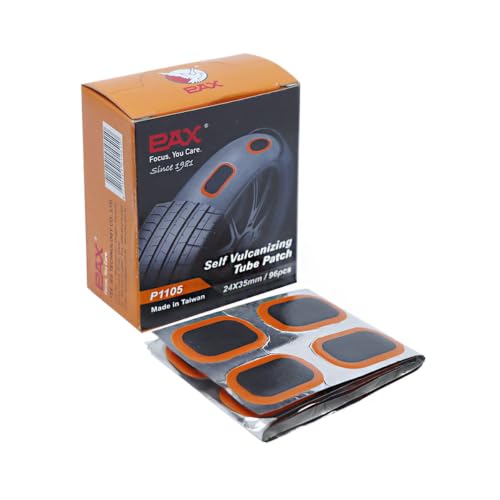
Oval patches sized for elongated damage set this apart from standard round patches. The pack contains 96 natural-rubber patches, each measuring 24 by 35 mm, or about 0.94 by 1.38 inches. The maker describes them as suited to slits, cuts and paired punctures; they can be used on tubes for bicycles, motorcycles, dirt bikes, ATVs, wheelbarrows and mowers. This is a fit for bulk repair supplies or damage that runs in a line. The tradeoff is that rubber cement or vulcanizing glue must be purchased separately.
Bottom line: Choose these when oval coverage fits the damage and you have compatible cement.
How to choose patches for inner tubes
Choose a patch by matching its shape and size to the damage, then check whether the kit includes adhesive and an abrasive tool. A round patch is convenient for a small puncture; an oval patch can cover a longer slit or two closely spaced holes. Patch kits vary from a few repairs to bulk packs, so consider how often you expect to use them. If the damage extends beyond the patch or lies at a seam, replacing the tube is the safer choice rather than relying on a patch to bridge an irregular area. For a roadside kit, prioritize a case and the tools needed to expose and prepare the tube.
How to prepare a tube for a patch
Preparation matters because a patch bonds to clean, abraded rubber rather than dirt or a glossy surface. Remove the tube, inflate it slightly, and locate the leak; a little water can reveal bubbles around a puncture. Dry the area and roughen a patch-sized area with the kit’s scuffer or abrasive, taking care not to thin or cut through the tube. With cement-based patches, spread a thin layer and wait until it turns tacky before pressing the patch firmly into place. Self-adhesive patches use a different method, so do not add cement unless the patch maker calls for it. Check the repaired tube for leaks before reinstalling.
Patch types and what they suit
Round or standard patches are a practical match for isolated pinholes, while an oval patch gives more coverage along a narrow cut. Self-adhesive patches avoid a separate cement tube, whereas vulcanizing patches rely on compatible adhesive and careful surface preparation. A simple match-up helps avoid choosing by patch count alone.
| Damage or need | Patch choice | Key condition |
|---|---|---|
| Small isolated puncture | Round patch | Patch covers the prepared area fully |
| Long slit or paired holes | Oval patch | Shape spans the damaged line |
| Repair without separate cement | Self-adhesive patch | Follow its wait time before inflating |
| Bulk repair supply | Multi-count patch pack | Confirm adhesive is available |
Any patch should sit on intact tube rubber with room around the puncture; a high count does not compensate for a patch that is too small.
When to replace an inner tube instead
Replace the tube rather than patching when damage is too large for a patch to cover fully, reaches a seam, or the tube has multiple repairs clustered together. A tire casing can also cause repeat flats: remove the sharp object and inspect the inside of the tire before installing a repaired or new tube. Do not inflate a tube beyond the pressure range printed on the tire, and do not treat a tube patch as a repair to a damaged tire casing. For bicycles, check that the tire bead is seated evenly before riding; an improperly seated tire can fail even when the tube itself holds air.
Frequently Asked Questions
Can I use inner tube patches on tubeless tires?
Usually, these patches are for removable inner tubes, not for sealing a tubeless tire from the inside or outside. Tubeless punctures typically use a plug or an internal repair method made for that tire system.
How long should rubber cement dry before patching?
Wait until a thin cement layer turns tacky rather than pressing the patch into wet adhesive. The exact time depends on the adhesive and conditions, so use its directions for timing.
Can a patched bicycle tube be inflated right away?
Allow the patch to bond before inflating; self-adhesive patches may specify a wait of 15–20 minutes. Check the repaired area for escaping air before fitting the tube back into the tire.
When is an inner tube too damaged to patch?
Replace a tube if the puncture is too large for the patch to cover fully, reaches a seam, or sits among several nearby repairs. Also inspect the tire for the object that caused the puncture so it does not damage the replacement.
Do oval patches work for round punctures?
An oval patch can cover a round puncture if it fully covers the prepared area and fits the tube’s curve. Round patches are generally easier to align over a single small hole.