
Fish Tank Magnet Cleaner: 4 Models Compared by Fit

For fish tank magnet cleaners, start with tank wall thickness: Aqueon Medium Magnetic Cleaner is a flexible pick for glass or acrylic and has a curved pad for flat and curved surfaces. Choose a different option if your tank requires a specific thickness range or a floating scrubber with blades.
A magnetic aquarium cleaner moves an inner pad from outside the tank, so you can scrub algae without putting your hand in the water.
We earn a commission if you buy through links on this page. As an Amazon Associate I earn from qualifying purchases. Products are compared on manufacturer specifications, not hands-on testing.
- Best overall: Aqueon Medium Magnetic Cleaner – Works on glass or acrylic and has a curved pad for flat and curved surfaces.
- Best for thicker glass: AQQA M Magnetic Cleaner – The M size is matched to tank walls from 0.2 to 0.4 inch thick.
- Best for small glass tanks: fishkeeper Small Magnetic Cleaner – Fits glass from 1/8 to 1/4 inch thick and includes two detachable scrapers.
| Product | Best for | Tank material | Wall thickness range | Cleaning design | Shop |
|---|---|---|---|---|---|
| Aqueon Medium Magnetic Cleaner | Glass or acrylic | Glass or acrylic | — | Curved pad | Check Price on Amazon |
| AQQA M Magnetic Cleaner | Defined thickness fit | Glass or acrylic | 0.2–0.4 in | Double-sided, 2 blades | Check Price on Amazon |
| fishkeeper Small Magnetic Cleaner | Thin glass tanks | Glass | 0.12–0.25 in | Double-sided, detachable scrapers | Check Price on Amazon |
| DaToo Nano Mini Scrubber | Nano aquariums | Aquarium glass | — | Soft pad and abrasive pad | Check Price on Amazon |
Fish Tank Magnet Cleaners Compared
Match each cleaner’s pad style and tank compatibility to your aquarium before choosing.
Aqueon Medium Magnetic Cleaner
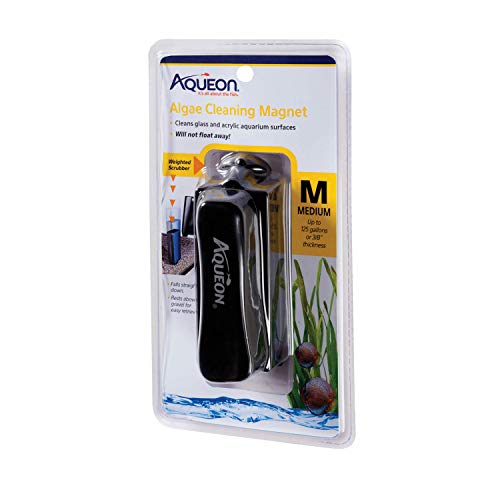
Unlike the other options, Aqueon Medium Magnetic Cleaner explicitly supports both glass and acrylic and has a curved pad for flat and curved surfaces. Its medium size measures 4.5 inches long by 9 inches wide and 2.5 inches high, and the weighted design is intended to keep it from floating away. The magnet separates from the inner cleaner if detached, allowing it to fall straight down for retrieval. Choose it if material versatility matters; the tradeoff is that no aquarium-wall thickness range is given, so confirm compatibility for unusually thick walls before buying.
Bottom line: Choose this if you need a cleaner for either glass or acrylic.
AQQA M Magnetic Cleaner

AQQA M Magnetic Cleaner is the choice with an explicit thickness window for its M size: 0.2 to 0.4 inch. The maker says magnet strength depends on wall thickness, and this model pairs a double-sided cleaning brush with two blades and a self-floating scrubber design. Its range is useful when the tank wall measurement is known, rather than guessing at magnet strength. The limitation is that the M size is not intended for walls outside its interval; measure the tank wall and select another size if it falls beyond that range.
Bottom line: Pick this when your tank wall measures 0.2 to 0.4 inch.
fishkeeper Small Magnetic Cleaner

fishkeeper Small Magnetic Cleaner differs by targeting a relatively thin glass range: 0.12 to 0.25 inch, also given as 1/8 to 1/4 inch. It has a double-sided scrubber, felt outer pad, and two detachable scrapers; the maker says its magnetic grip is designed to stay attached during cleaning. The small body measures 4.3 inches long, 3.5 inches wide, and 2.5 inches high. This is a focused fit rather than a general-purpose choice, so it matters most for glass tanks within that thickness interval.
Bottom line: Choose this for glass tanks measuring 1/8 to 1/4 inch thick.
DaToo Nano Mini Scrubber

DaToo Nano Mini Scrubber is the mini option, with a soft nonwoven pad on one side and an abrasive-fiber pad on the other. Its N38 neodymium-iron-boron magnet is described by the maker as super strong, while the compact Nano size is intended for small aquariums. The two surface types offer a choice between gentler wiping and more abrasive scrubbing.
Bottom line: Pick this for a small aquarium where a compact scrubber matters most.
How to choose a fish tank magnet cleaner
Match the cleaner’s magnetic range to the aquarium wall before comparing pads or blades. Aquarium glass thickness varies widely, and a magnet that is too weak can separate during use while excessive force can make repositioning difficult. Measure the wall at an accessible edge with a ruler or caliper, then select a model whose range contains that measurement. As a practical rule, when the wall is 0.4 inch thick or less, a cleaner explicitly rated through that thickness is a clearer fit than one without a range. Glass and acrylic are not interchangeable assumptions: acrylic can scratch, so use only a pad the manufacturer identifies as suitable for that material. Also keep the inner pad free of trapped grit, which can scratch either surface.
Glass thickness and aquarium cleaner fit
Thickness fit determines whether the two halves of a magnetic cleaner stay coupled across the aquarium wall. For reference, 1/8 inch equals 0.125 inch and 1/4 inch equals 0.25 inch, so a 0.12–0.25-inch range roughly spans those common fractions. A 0.2–0.4-inch interval overlaps the upper part of that range but is not equivalent to it. Measure the tank itself rather than relying on a nominal aquarium size, because tank volume does not reveal panel thickness. This table gives a direct measurement-to-choice starting point; if a wall falls outside a model’s range, choose a different rated size rather than forcing the magnet to hold.
| Measured wall | Starting choice |
|---|---|
| 0.12–0.25 in, glass | fishkeeper Small Magnetic Cleaner |
| 0.2–0.4 in | AQQA M Magnetic Cleaner M |
| Glass or acrylic, unspecified thickness | Aqueon Medium Magnetic Cleaner, after confirming fit |
| Nano tank, thickness unknown | DaToo Nano Mini Scrubber, after confirming fit |
Scrubber pads, blades, and algae removal
Pad material and scraper edges serve different cleaning jobs. Soft fabric or felt pads are suited to routine wiping, while abrasive fibers, hooks, or blades can tackle more persistent growth but call for controlled pressure. Aquarium algae can include soft green films and harder crusts; a magnetic pad may not remove every type equally, so avoid pressing harder when residue resists. For acrylic, use a surface-safe pad because metal blades and embedded grit can leave permanent scratches. Rinse or inspect the cleaning face before each pass, particularly after the cleaner has been dropped near substrate, where sand grains can lodge in the pad. A blade-equipped tool is most useful when the aquarium surface and blade type are explicitly compatible.
Frequently Asked Questions
How do you measure aquarium glass thickness?
Measure a tank panel edge with a ruler or caliper and record the result in inches. A measurement of 1/4 inch is 0.25 inch, which can be compared directly with a cleaner’s range.
Can a magnetic cleaner scratch an aquarium?
Yes, trapped sand or gravel can scratch glass, and acrylic is especially vulnerable to scratches from abrasive pads or blades. Rinse the cleaning face and use only a pad or blade approved for the tank material.
How often should aquarium glass be cleaned?
Clean when algae or film begins to obscure the view; growth rate depends on light, nutrients, and maintenance. Short, frequent wipes are generally easier than scraping a thick buildup in one pass.
Are magnetic cleaners safe for acrylic aquariums?
Only use a cleaner explicitly identified as suitable for acrylic, because acrylic scratches more readily than glass. Even on compatible models, check the pad for grit before moving it across the panel.