
Best Small Dog Window Perch: 3 Options Compared

Kepptory Window Perch with Retractable Stairs is the best small dog window perch for most homes because it combines a cushioned window seat, retractable stairs, and drawers in a 53.5-by-18.9-inch footprint. Choose a different setup if you need a lower perch, a small floor footprint, or a mount that hooks directly to a windowsill.
A dog window perch is an elevated resting spot positioned by a window; access steps and mounting style determine whether it suits a small dog and your room.
We earn a commission if you buy through links on this page. As an Amazon Associate I earn from qualifying purchases. Products are compared on manufacturer specifications, not hands-on testing.
- Best overall: Kepptory Window Perch with Retractable Stairs – Combines a cushioned window seat, retractable stairs, and storage in a 53.5-by-18.9-inch footprint.
- Best for compact floor space: MABOZOO 3-Tier Window Perch – Its 15.5-by-15.5-inch base and 18-inch height take less floor area.
- Best for a lower climb: HOMBYS Foam Window Perch, 15.7-Inch – The 15.7-inch perch includes five steps with anti-slip texture.
| Product | Best for | Height | Length × width | Shop |
|---|---|---|---|---|
| Kepptory Window Perch with Retractable Stairs | Most small dogs | 30 in | 53.5 × 18.9 in | Check Price on Amazon |
| MABOZOO 3-Tier Window Perch | Compact rooms | 18 in | 15.5 × 15.5 in | Check Price on Amazon |
| HOMBYS Foam Window Perch, 15.7-Inch | Lower access | 15.7 in | 17 × 17 in | Check Price on Amazon |
Small Dog Window Perches
Compare the perch height, footprint, and access style against your dog’s needs and the space beside your window.
Kepptory Window Perch with Retractable Stairs

Kepptory Window Perch with Retractable Stairs stands out for combining a window-facing cushioned seat with retractable stairs and storage drawers. The 30-inch height creates a high viewing spot, while the 53.5-by-18.9-inch overall footprint needs a long, narrow stretch of floor. The maker says the perch supports up to 110 pounds, so capacity alone is unlikely to be the limiting factor for a small dog. Consider it when your dog can use steps and the room has enough length; the high seat and long footprint matter if you need a low-access perch or have limited floor space.
Bottom line: Pick this if you want stairs and storage together and have room for its long footprint.
MABOZOO 3-Tier Window Perch

MABOZOO 3-Tier Window Perch has the smallest floor footprint among these floor-standing choices, measuring 15.5 inches square and 18 inches high. Its three-tier design combines stairs, a top bed, storage, and a sisal scratcher, which may suit a small dog that benefits from an intermediate platform. The maker gives a 25-pound weight limit, so weigh your dog and include any uncertainty before choosing it. This is the more compact option for a tight corner, but its capacity is lower than the 110-pound maximum claimed for Kepptory Window Perch with Retractable Stairs.
Bottom line: Choose this when floor space is tight and your dog weighs no more than 25 pounds.
HOMBYS Foam Window Perch, 15.7-Inch
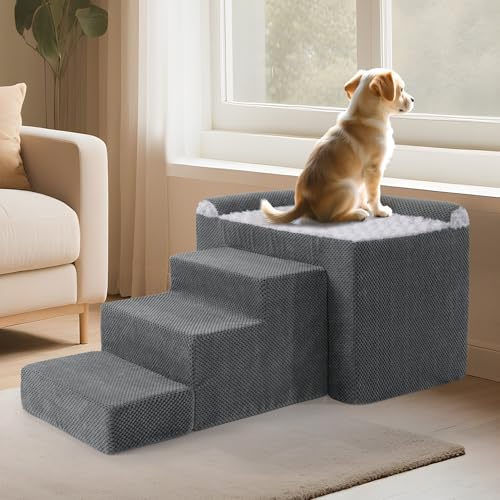
HOMBYS Foam Window Perch, 15.7-Inch keeps the perch lower than the 18- and 30-inch options and uses five steps with anti-slip texture. Its 17-by-17-inch footprint is more compact than the two Kepptory models, while still requiring floor space for the stairs. The maker describes a reinforced metal frame and 40D memory foam; those construction and cushioning features distinguish it from the drawer-equipped platforms. The measurements do not give a weight capacity, so confirm that limit before ordering if your dog is near the product’s intended size range.
Bottom line: Pick this for a lower perch and gradual stair access, after confirming the weight limit.
How to choose a small dog window perch
Start with the perch height and the route your dog must climb. The floor-standing options here range from 15.7 to 30 inches high, and the included steps differ in count, surface, and footprint. A lower seat can reduce the climb, but still check whether the steps have a secure, nonslip surface and whether your dog can turn around on each tread. Measure the clear floor area first: a 53.5-inch-long design needs a very different space than a 15.5-inch-square base. Match any weight limit to your dog’s current weight; do not infer capacity from the product’s own weight. For a dog that cannot use stairs reliably, prioritize a lower perch or another safe resting location.
Measure the window and floor space
Measure the open floor area between the window and nearby furniture, then compare it with the perch’s full length and width rather than just its top bed. The floor-standing choices span 15.5 to 53.5 inches in length and 15.5 to 18.9 inches in width, while the sill-mounted cat perch has a 24-by-15-inch bed and needs a compatible ledge. Confirm the window trim and nearby opening path leave no awkward gap for a small dog to fall into.
Stairs, platforms, and hook-on mounts compared
Floor-standing stairs and hook-on hammocks solve different access problems. Stairs put the climb on the floor and can include intermediate platforms; a hook-on perch saves floor area but relies on the windowsill’s shape and fit. Use this comparison to match the design to your room and dog.
| Design | Space requirement | Check before choosing |
|---|---|---|
| Multi-tier floor perch | Clear floor for the base and steps | Overall footprint and dog weight limit |
| Lower foam perch with steps | Floor space in front of the window | Step access and stated capacity |
| Hook-on windowsill bed | Compatible sill instead of a floor base | Slot depth, sill depth, and dog fit |
For an older or short-legged dog, a lower perch with gradual steps may be easier to approach than a 30-inch platform, but the dog’s mobility matters more than the label. Avoid placing a raised bed where the dog can launch into a narrow space between furniture and glass.
Safe placement and upkeep
Put a freestanding perch on a level floor and keep the stair path clear; a raised bed can tip or become a fall hazard if it wobbles or sits beside an open window. Keep windows closed or use a secure screen designed to resist pet pressure, since an ordinary insect screen is not a fall barrier. Inspect steps, fabric, fasteners, and any frame periodically for looseness, tears, or shifting, and stop use if the structure is unstable. Removable or washable cushions can make routine cleaning easier, but follow the maker’s care directions for the actual fabric. A dog should be able to get down without being trapped by a closed door or blocked stairs.
Frequently Asked Questions
How high should a small dog window perch be?
A useful perch height is the one your dog can reach through stable steps without jumping; these options range from 15.7 to 30 inches. For a dog with limited mobility, favor a lower seat and gradual steps over a higher platform.
How much weight capacity should a dog perch have?
Choose a perch whose limit exceeds your dog’s current weight, allowing margin rather than matching the limit exactly. One option here has a 25-pound limit and another claims support up to 110 pounds, so check the particular model’s rating.
Can a window perch sit in front of an open window?
Only if the window has a secure pet-resistant barrier; a standard insect screen is not designed to stop a falling dog. Keep the perch away from openings without that protection.
How do I know if a hook-on perch fits my windowsill?
Measure the sill depth and check its edge for the required mounting slot before choosing a hook-on design.
What is the safest way for a small dog to reach a high perch?
Use stable, clear steps rather than relying on a jump, and choose a lower perch if the dog cannot climb steadily. Keep the approach area unobstructed and stop use if stairs or the frame shift.