
Best Pool Vacuum for Algae: 3 Models Compared

For routine algae cleanup, choose Vucaki 5-in-1 Handheld Pool Vacuum for its 18.9 GPM suction and 14-inch wheel vacuum head, but algae usually needs brushing loose before vacuuming.
We earn a commission if you buy through links on this page. As an Amazon Associate I earn from qualifying purchases. Products are compared on manufacturer specifications, not hands-on testing.
- Best overall: Vucaki 5-in-1 Handheld Pool Vacuum – Its 18.9 GPM suction and 14-inch wheel head make it the strongest match for moving loosened algae and debris.
- Best for visible spot cleaning: JESIMAIK 18.5 GPM Handheld Vacuum – The dual head includes a transparent brush head for watching material lift during spot cleanup.
| Product | Best for | Maximum suction flow | Runtime | Pool fit | Shop |
|---|---|---|---|---|---|
| Vucaki 5-in-1 Handheld Pool Vacuum | Loosened algae | 18.9 GPM | 70 minutes | Inground and aboveground | Check Price on Amazon |
| JESIMAIK 18.5 GPM Handheld Vacuum | Visual spot cleaning | 18.5 GPM | 60 minutes | Aboveground and inground | Check Price on Amazon |
| Enhulk PC10 Handheld Pool Vacuum | Longer spot sessions | Up to 18.5 GPM | Up to 60 minutes | Pool, hot tub and spa | Check Price on Amazon |
Pool vacuums for algae
Compare these handheld cleaners by flow, runtime and the pool size or debris type they are intended to handle.
Vucaki 5-in-1 Handheld Pool Vacuum

For a wider cleaning pass, this cordless model pairs 18.9 GPM suction with a 14-inch wheel vacuum head and a 10.8-foot telescopic pole. The maker says it is intended for inground and aboveground pools and spas, and its five-in-one design is aimed at varied cleanup tasks. It suits owners who want to collect algae after brushing it off pool surfaces. The vacuum is still a debris collector, not an algae treatment; suspended or very fine algae may pass through or require a filter-based cleanup instead.
Bottom line: Choose this for loosened algae across a larger pool area.
JESIMAIK 18.5 GPM Handheld Vacuum
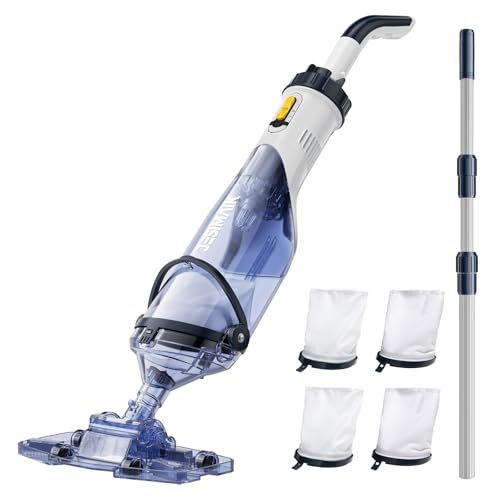
The transparent brush head distinguishes this cleaner for targeted work: it lets the operator see material being picked up, and a separate vacuum nozzle provides a suction option. JESIMAIK gives an 18.5 GPM flow rate and up to 60 minutes of runtime, with a 40W motor. The cordless pole setup is suitable for aboveground or inground pools, spas and hot tubs.
Bottom line: Pick this for close, visible spot cleanup after brushing.
Enhulk PC10 Handheld Pool Vacuum

The PC10 emphasizes charging convenience, with the maker giving a full recharge time of 1.5 hours and runtime up to 60 minutes. Its 20V, 40W motor has a maximum flow rate equivalent to 18.5 gallons per minute, and the product is intended for pool, hot tub and spa cleanup of debris and sand. That makes it a practical option for small areas of algae once growth has been brushed into loose material. The product is not identified as a fine-algae filter, so it may not collect algae suspended in cloudy water.
Bottom line: Choose this if a shorter recharge turnaround matters.
How to choose a pool vacuum for algae
A vacuum is most useful after algae has been brushed off the surface; suction collects loosened material but does not kill algae. For faster passes across a pool floor, compare the flow rates and head width, while a smaller brush head can be easier to maneuver around steps and corners. A flow rating in gallons per minute is not a fine-particle capture rating, so do not treat higher suction as proof that microscopic algae will be filtered. If the water is cloudy green or algae returns quickly, use an appropriate sanitation and filtration process rather than relying on a handheld cleaner alone.
For visible patches, brush the affected surface, then vacuum slowly enough to collect the loosened debris. If algae is suspended in the water, a pool filter or suitable waste-vacuum method may be needed.
Brush algae loose before vacuuming
Brushing first is the key step because algae can cling to pool walls, steps and the floor instead of entering a vacuum head. Use a brush compatible with the pool surface: nylon bristles are the usual choice for vinyl and fiberglass, while plaster can generally take a stiffer brush. Avoid aggressive brushing that could damage a liner or finish. Work from the walls toward the floor so the loosened material is easier to collect, and brush corners and behind ladders where circulation is weaker.
Vacuum slowly after brushing, especially where debris has settled. Follow up by checking the water’s sanitizer level and filtration, since physical collection does not replace water treatment.
When handheld suction is not enough
Handheld pool vacuums collect debris at the head, but algae that remains suspended or is too fine for the collection system can pass through. A typical sand filter traps particles roughly 20 to 40 microns, while cartridge filters can capture particles around 10 to 20 microns; the exact result depends on the filter and condition. For heavy algae, brushing, sanitizer correction, circulation and filtration work together. Vacuum settled dead algae to waste only if the pool system supports that setting, because sending a large load through a filter can clog it quickly.
Never mix pool chemicals or add them directly to a vacuum. Keep people out of the water during chemical treatment and use the product label for dosage and re-entry guidance.
Match the cleaner to pool size and cleanup
Choose by the amount of floor to cover and the type of debris you need to collect. A wider head can reduce the number of passes on an open pool floor, while a compact cleaner is easier to use in a spa or around steps. A useful rule is to reserve a light-duty cleaner for spot work and small pools; for broad algae cleanup in a full-size pool, use a pool-rated brush and filtration plan in addition to handheld suction.
The comparison below separates the fit from the role each cleaner is best suited to.
| Need | Useful feature | Limit to consider |
|---|---|---|
| Open pool floor | Wider head and higher flow | Loose algae must still be brushed free |
| Steps and patches | Compact brush head | More passes may be needed |
| Small spa or pool | Lightweight, short-pole cleaner | Not suited to broad heavy cleanup |
Frequently Asked Questions
Can a handheld pool vacuum remove green algae?
A handheld vacuum can collect algae that has settled or been brushed loose, but it does not kill algae. For cloudy green water, correct sanitation and filtration as well as brushing are necessary.
Should I brush algae before vacuuming the pool?
Yes, brush algae off walls and the floor before vacuuming so it can be collected as loose material. Use a surface-compatible brush; nylon bristles suit vinyl and fiberglass, while plaster can generally handle a stiffer brush.
Will a pool vacuum remove algae from cloudy water?
Not necessarily, because a handheld debris vacuum may not capture suspended microscopic algae. Typical sand filtration captures roughly 20 to 40 microns, and cartridge filtration around 10 to 20 microns, depending on the filter.
Can I vacuum dead algae through the pool filter?
You can vacuum settled dead algae through the filter if the pool system allows it, but a large load can clog the filter quickly. Use a waste setting only if your system has one and you can safely manage the water being discharged.
How slowly should I vacuum algae from a pool?
Move slowly enough that the vacuum collects the loosened material rather than stirring it back into the water. Brush walls toward the floor first, then make deliberate passes over the settled debris.