
Finger Protection for Cutting Knives: 4 Guards Compared

For simple finger protection while cutting with a knife, SLXDEX Adjustable Stainless Steel Finger Guards is the clearest fit because its open stainless steel ring adjusts to the finger. Choose a multi-piece set instead if you want additional holders or prep tools; shoppers seeking a wearable cut-resistant fabric sleeve should choose a different type.
We earn a commission if you buy through links on this page. As an Amazon Associate I earn from qualifying purchases. Products are compared on manufacturer specifications, not hands-on testing.
- Best overall: SLXDEX Adjustable Stainless Steel Finger Guards – An adjustable open-ring stainless steel guard suited to straightforward slicing and chopping.
- Best for varied tools: CHENGU 9-Piece Finger Guard Set – The nine-piece set includes two guard styles and an onion holder.
- Best for a full kit: Romooa 11-Piece Finger Guard Set – The 11-piece set combines guards, finger cots and several prep accessories.
| Product | Best for | Material | Count | Adjustability or included tools | Shop |
|---|---|---|---|---|---|
| SLXDEX Adjustable Stainless Steel Finger Guards | Simple knife prep | Stainless steel | 2 pieces | Open adjustable ring | Check Price on Amazon |
| CHENGU 9-Piece Finger Guard Set | Mixed prep tasks | Stainless steel guards | 9 pieces | Two guard styles, onion holder | Check Price on Amazon |
| 304 Stainless Steel Finger Guards, 2-Piece | Steel guard pair | 304 stainless steel | 2 pieces | Adjustable finger sleeve | Check Price on Amazon |
| Romooa 11-Piece Finger Guard Set | Accessory bundle | Stainless steel guards | 11 pieces | Guards, cots, holders, cutters | Check Price on Amazon |
Finger Protection for Cutting Knives
Compare guard styles and included accessories to choose a setup that fits your kitchen routine.
SLXDEX Adjustable Stainless Steel Finger Guards

The open-ring design distinguishes these guards from the sets that bundle extra prep tools. The pair is stainless steel, and each ring can be adjusted for a more comfortable fit; the size is 6.5 cm. The maker says the guards are intended to help protect fingers during chopping vegetables, fruit and meat. They suit cooks who want a basic wearable shield rather than a collection of accessories. The limitation is coverage: these are finger guards, not a glove or a complete hand barrier, so careful knife technique remains essential.
Bottom line: Pick this pair for adjustable, straightforward finger coverage during routine knife prep.
CHENGU 9-Piece Finger Guard Set
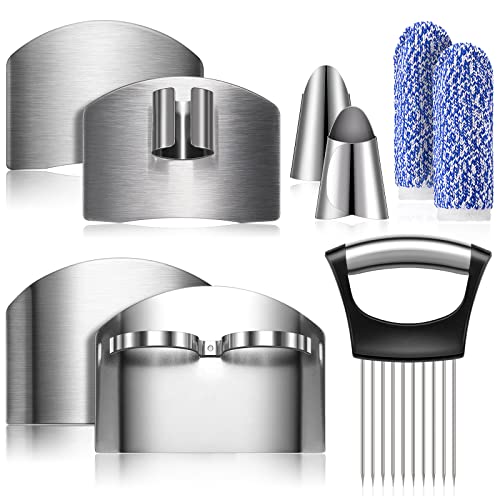
The CHENGU set stands out for including an onion holder alongside two guard styles. Its nine pieces include a two-finger protector measuring about 2.99 by 2.17 inches, a single-finger protector about 2.48 by 2.17 inches, and an onion holder about 5.51 by 3.66 inches. The maker says the set is intended to protect fingers while slicing and cutting. It suits a household that wants different guard formats for different prep tasks. Its tradeoff is that a multi-piece kit requires choosing the right piece and keeping the parts together.
Bottom line: Choose this set if you want alternate guard formats plus an onion holder.
304 Stainless Steel Finger Guards, 2-Piece
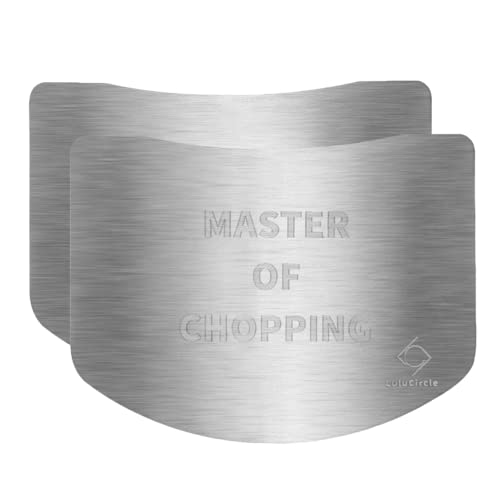
Grade 304 stainless steel is the defining material of this two-piece guard pair. The maker describes an adjustable finger-sleeve design intended to suit a wide range of finger sizes and use during slicing, dicing and chopping. This is a focused choice for cooks who want two steel guards without the additional tools in the larger kits. The specifications give overall dimensions of 4 by 3 by 2 inches, but not a specific adjustment range; buyers who need a precise fit should confirm that range before ordering. A guard does not replace controlled knife handling.
Bottom line: Pick this pair if 304 stainless steel is your priority and you do not need a tool bundle.
Romooa 11-Piece Finger Guard Set

The Romooa kit has the broadest mix of accessories among these options: 11 pieces include four stainless steel guards in two styles, two thumb guards, two finger cots, a crinkle cutter, an onion holder and a mandoline slicer. The maker says the guards are intended to keep fingers away from knives during slicing and dicing. This bundle suits cooks who want multiple styles of protection and prep accessories in one set. Its limitation is complexity: if you only need a single wearable guard, most of the included pieces may go unused.
Bottom line: Choose this set when you want multiple guard styles and prep accessories together.
How to choose a finger guard for knife work
Choose a guard by how it sits on the hand and how much of the finger it covers, not by piece count alone. A ring-style guard shields the front of a finger while leaving the hand otherwise uncovered; a finger cot covers the fingertip, while a glove covers more of the hand. The choices include stainless steel guards, an adjustable open ring, and kits with holders or other tools. A guard is a backup barrier, not permission to speed up: use a stable cutting board, curl the fingertips of the guiding hand, and keep the knife edge moving away from them. If the guard shifts, catches or blocks a comfortable grip, stop and reposition it before continuing.
Fit and coverage for cutting knives
Fit matters because a guard that rotates or slips can put the protected area out of position. Adjustable rings can accommodate some variation, but adjustment range and finger circumference are different measurements; compare the maker’s sizing against the finger you intend to protect. For a wearable item, check that it stays secure without pinching and that the knife hand can hold its handle normally. Steel guards are rigid shields rather than flexible gloves, so expect less coverage than a full cut-resistant glove. No finger guard makes contact with a blade safe, and a sharp knife can still cut exposed skin or penetrate a gap.
Finger guards, cots and kitchen sets compared
Finger guards and fabric cots solve related but different problems: guards create a barrier or guide fingers, while cots cover individual fingertips. Sets add convenience only when the included pieces match your actual prep work. A mandoline or slicer accessory also calls for its own safe handling; never assume a finger guard makes a blade tool risk-free. Use this comparison by task:
| Need | Useful format | Tradeoff |
|---|---|---|
| Basic knife slicing | Single or paired finger guards | Limited hand coverage |
| Several prep tasks | Kit with holder or slicer tools | More parts to manage |
| Tip coverage | Finger cot | Covers less than a glove |
Using and caring for a knife finger guard
Before each prep session, check that a guard is clean, correctly positioned and free of a bent edge or damaged fabric. Stainless steel can resist corrosion, but it still benefits from washing and thorough drying after food contact; follow the maker’s care directions for any bundled pieces. Keep the cutting board stable and use a slow, controlled motion, especially with round produce that can roll. Avoid trying to catch a falling knife, and keep fingers out of the blade’s path even when a guard is worn. If a fit or fastening changes during use, pause rather than continuing with a loose or misaligned protector.
Frequently Asked Questions
Does a finger guard make knife cutting completely safe?
No finger guard eliminates the risk of a cut. It provides a barrier only where it covers, so keep fingertips curled and control the knife even when wearing one.
Should I choose a steel guard or a finger cot?
A steel guard is a rigid shield, while a finger cot covers an individual fingertip with fabric. Choose based on coverage and fit; neither covers the whole hand like a glove.
How should a finger guard fit while chopping?
A guard should stay in position without pinching or interfering with your knife grip. Test the fit before cutting and stop if it rotates or slips.
Can I put a finger guard on a mandoline?
Use the mandoline’s compatible food holder or hand guard rather than assuming a finger ring is adequate. Mandoline blades can cut deeply, so keep hands away from the exposed edge.
How do I clean stainless steel finger guards?
Wash guards after food contact and dry them thoroughly to limit residue and moisture. Check the maker’s care directions, especially when a kit includes parts made from other materials.