
Best Walker for Short Seniors: 5 Models Compared

Medline Junior Folding Walker is the clearest fit for most short seniors because its handles adjust from 25 to 32.5 inches and its intended user range is 4 feet 6 inches to 5 feet 5 inches. Choose a different style if you need a seat for resting or a narrow frame for tight passages.
A walker supports balance while walking; frame style and handle fit determine how comfortably you can use it.
We earn a commission if you buy through links on this page. As an Amazon Associate I earn from qualifying purchases. Products are compared on manufacturer specifications, not hands-on testing.
- Best overall: Medline Junior Folding Walker – The junior frame’s 25–32.5-inch handle range and 4-foot-6-inch to 5-foot-5-inch user range directly address shorter users.
- Best with a seat: HOMLAND Adjustable Rollator – The rollator has a seat and adjustable handles from 33 to 40 inches, with the maker citing users from 4 feet 7 inches to 6 feet 6 inches.
- Best for tight spaces: Delog Narrow Folding Walker – The frame adjusts from 18 to 22 inches wide and has independently closing sides.
| Product | Best for | Handle height | Weight | Capacity | Shop |
|---|---|---|---|---|---|
| Medline Junior Folding Walker | Shorter users | 25–32.5 in | 7 lb | 400 lb | Check Price on Amazon |
| HOMLAND Adjustable Rollator | Seated walking | 33–40 in | 20.4 lb | 350 lb | Check Price on Amazon |
| Loyoda Folding Walker with Skis | Glide attachments | 31–38 in | 6.03 lb | 350 lb | Check Price on Amazon |
| Delog Narrow Folding Walker | Narrow passages | — | 6 lb | 350 lb | Check Price on Amazon |
| Drive Medical Two-Button Walker | Glide-cap surfaces | — | 7.5 lb | 350 lb | Check Price on Amazon |
Walkers for Short Seniors Compared
Match the handle range and frame style to the user’s height, balance, and walking routine.
Medline Junior Folding Walker

The junior frame gives shorter users the lowest handle range in this group: 25 to 32.5 inches, with a fit for adults and children from 4 feet 6 inches to 5 feet 5 inches. Its steel frame has side cross braces, 5-inch wheels, and folds flat with a two-button mechanism. At 7 pounds, it is easier to lift for storage than the heavier rollator here. This is a practical choice for someone who wants a basic wheeled frame rather than a seat. Its wheel-and-frame layout is not a substitute for a rollator’s built-in resting seat.
Bottom line: Pick this frame if its handle range fits and a seat is not needed.
HOMLAND Adjustable Rollator

The HOMLAND stands apart with a built-in seat and the widest user-height span: the maker says it accommodates people from 4 feet 7 inches to 6 feet 6 inches. Handle height adjusts from 33 to 40 inches, while the seat adjusts from 20 to 23 inches; the seat measures 16 by 12 inches and has 1.6 inches of padding. Its 8-inch wheels and 20.4-pound weight make it a larger, heavier choice than the folding frames. Choose it when a resting seat matters, but verify handle fit before buying because the handle range starts higher than the junior walker’s.
Bottom line: Choose this rollator if you need a seat and its handle range fits.
Loyoda Folding Walker with Skis

The Loyoda includes replaceable ski glides as well as 5-inch wheels, giving it a different foot setup from the junior walker’s wheeled frame. It has eight height adjustments from 31 to 38 inches, weighs 6.03 pounds, and supports up to 350 pounds. Those handle settings start higher than the Medline’s, so shorter users should compare the actual fit rather than assume the “standard” size will work. The range may suit some shorter adults, but the specifications do not give a user-height range. Verify the handle position before choosing it for a petite user.
Bottom line: Consider it if the 31-inch minimum handle height fits and ski glides are useful.
Delog Narrow Folding Walker

The Delog’s distinguishing feature is its adjustable frame width, which runs from 18 to 22 inches; each side can close independently using a trigger release. At 6 pounds, it is the lightest frame here, and its capacity is 350 pounds. Narrow width can help in tight indoor spaces, but width does not establish a short user’s handle fit. No handle-height range is available for comparison, so measure the user’s preferred handle position and confirm the frame can reach it before buying. This option suits someone whose main constraint is passage width, not necessarily a lower handle setting.
Bottom line: Choose it for adjustable width only after confirming a usable handle height.
Drive Medical Two-Button Walker
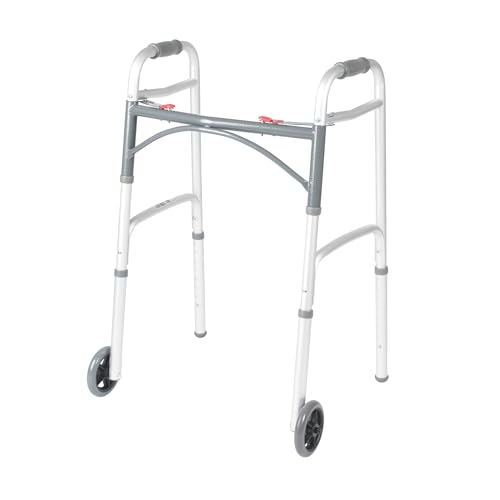
The Drive Medical combines front wheels with rear glide caps, a setup intended to roll forward while the rear legs glide across surfaces. Its aluminum frame weighs 7.5 pounds, supports up to 350 pounds, and uses dual push-button releases. Measure the needed handle height and confirm the adjustment range before choosing it. The frame may suit someone who wants front-wheel movement and rear glides, but it is less clearly targeted to petite users than the junior walker.
Bottom line: Pick it if front wheels and rear glides suit the user and height fit is confirmed.
How to choose a walker for a short senior
Choose by handle fit first, then decide whether the user needs a seat, wheels, or a narrower frame. Standing upright with arms relaxed, the handles should line up near the wrist crease; when gripping them, the elbows should bend slightly, roughly 15 to 30 degrees. A handle that is too high can raise the shoulders, while one that is too low encourages a stoop. Measure the user in walking shoes and compare the measurement with the adjustment range, not the walker’s overall height. If the range does not reach the wrist-level target, move to a model with a lower range rather than relying on a generic “small” label.
Rollator or folding walker for shorter adults
A folding walker and a rollator solve different mobility needs. A standard folding walker can be lifted or advanced step by step and is often chosen when the user needs a more deliberate, stationary frame for support. A rollator’s wheels keep moving more freely, and its seat can provide a resting place; safe use requires the user to control the brakes and keep the frame steady before sitting. Use a rollator only if the user can manage its braking system and walking pace. A walker with under 30 inches of handle range is a sensible starting point when the measured wrist height is below 33 inches; otherwise compare a higher range. Do not treat a seat as a substitute for stable transfer support.
Use this fit guide to narrow the style before comparing individual frame measurements.
| Need | Starting point | Fit check |
|---|---|---|
| Lower handle setting | Junior folding walker | Reach the wrist-level handle height |
| Resting seat | Rollator | Confirm brake control and seat height |
| Tight passage | Narrow folding frame | Measure doorway width and handle height |
Measure walker fit and use it safely
Measure handle height while the user stands naturally in the shoes they will wear for walking. The handle should be reachable without leaning or shrugging, and both sides should be set evenly before walking. Keep the walker close rather than reaching far ahead; long reaches shift weight outside the support frame. A wheeled walker should not be pulled up on to stand, and a rollator should have its brakes engaged before the user sits or stands. Clear loose rugs, cords, and clutter from the walking route, since small wheels can catch on abrupt edges. If balance, strength, or transfer ability is uncertain, ask a physical therapist or clinician to assess the fit and technique before regular use.
Frequently Asked Questions
How high should walker handles be for a short senior?
Walker handles should generally meet the wrist crease when the user stands upright with arms relaxed. A light elbow bend of roughly 15 to 30 degrees when gripping the handles helps avoid reaching or hunching.
Is a rollator safe for someone with poor balance?
A rollator is appropriate only if the user can control its brakes and keep the wheeled frame steady. Someone who cannot manage the brakes or tends to pull on the frame may need a more stable walker style assessed by a clinician.
How wide should a walker be for indoor doors?
Measure the narrowest doorway and hallway in the route, including trim and furniture pinch points. Leave clearance beyond the frame on both sides; a width-adjusting model can help, but should not be so narrow that the user’s hands or hips are crowded.
Can someone sit on a rollator seat while walking?
No; the user should stop, engage the brakes, and make sure the rollator is steady before sitting. The seat is for resting while stationary, not for riding or moving along while seated.
When should walker height be rechecked?
Recheck handle height after a change in walking shoes, posture, or mobility, and whenever the user begins leaning or shrugging. Even a small change in heel height can alter wrist-level alignment.