
Dr. Infrared Heaters: 5 Models Compared by Use

The DR-968 suits most people who want a portable room heater, with 1,500 watts and quartz-plus-PTC heat; choose another model for hardwired garage heating or outdoor mounting. Infrared heaters warm people and objects directly, while fan-assisted models also circulate heated air.
We earn a commission if you buy through links on this page. As an Amazon Associate I earn from qualifying purchases. Products are compared on manufacturer specifications, not hands-on testing.
- Best overall: Dr. Infrared DR-968 – Its 1,500-watt dual heating system combines infrared quartz with a low-noise blower for room heating.
- Best for garages: Dr. Heater DR-910M – It delivers 10,000 watts on a 240-volt hardwired connection and includes a cart.
- Best for outdoor mounting: Dr. Infrared 35-Inch Outdoor Heater – Its IP55 rating and included wall and ceiling brackets suit covered or exposed mounting locations.
| Product | Best for | Power | Power connection | Dimensions | Shop |
|---|---|---|---|---|---|
| Dr. Infrared DR-968 | Portable room heat | 1,500 W | — | 17 × 13 × 12.5 in. | Check Price on Amazon |
| Dr. Infrared DR-123 | Timed room heating | 1,500 W | — | 13.8 × 10.6 × 10.8 in. | Check Price on Amazon |
| Dr. Infrared DR-998 | Humidified room heat | 1,500 W | — | 16 × 16 × 11 in. | Check Price on Amazon |
| Dr. Heater DR-910M | Hardwired garage heat | 10,000 W | 240 V, hardwired | 33 × 21 × 24 in. | Check Price on Amazon |
| Dr. Infrared 35-Inch Outdoor Heater | Mounted patio heat | 900 / 1,200 / 1,500 W | 120 V plug-in | 35 × 8 × 4 in. | Check Price on Amazon |
Dr. Infrared Heaters Compared
Match the heater’s power and installation style to the room or area you need to warm.
Dr. Infrared DR-968

The DR-968 pairs a 1,500-watt infrared quartz element with PTC heating and a low-noise blower, making it a flexible choice for indoor room heating. Dr. Infrared says it can heat spaces up to 1,000 square feet and provide up to 5,200 BTU; room insulation, ceiling height, and outdoor temperatures affect what a heater can manage. At 17 × 13 × 12.5 inches and 19 pounds, it is smaller than the garage unit here, but it is not a hardwired heater for a large workshop. Its safety-feature description is incomplete, so check the unit’s manual for operating clearances.
Bottom line: Choose this for portable, fan-assisted warmth in a room.
Dr. Infrared DR-123

The DR-123 stands out for its programmable 12-hour timer and three operating modes, including Eco, High, and Low. Its digital thermostat spans 30°F to 99°F, and four caster wheels make repositioning easier than with a mounted heater. The maker describes its quartz-and-PTC dual system as delivering fast, widespread warmth; that combination can provide direct radiant heat while a fan moves warm air. The remote requires two AAA batteries, which are not included. This model suits someone who wants scheduling and mobility, but its indoor portable format is not a substitute for a hardwired shop heater or a purpose-rated outdoor unit.
Bottom line: Pick this for portable indoor use with a timer and thermostat.
Dr. Infrared DR-998

The DR-998 adds a cool-mist ultrasonic humidifier and oscillation to a 1,500-watt dual infrared-quartz and PTC heater. Those extras distinguish it from the simpler portable room models: humidification may be useful when indoor air feels dry, while oscillation helps distribute warm air across a wider area. The maker claims up to 60% more warmth than standard 1,500-watt heaters; treat that as a brand performance claim, not a guarantee for every room. At 16 × 16 × 11 inches, it has a broader footprint than the DR-123. Choose it for combined heating and humidifying, but not if you need a basic heater without water maintenance.
Bottom line: Choose this if you want a humidifier integrated with room heat.
Dr. Heater DR-910M
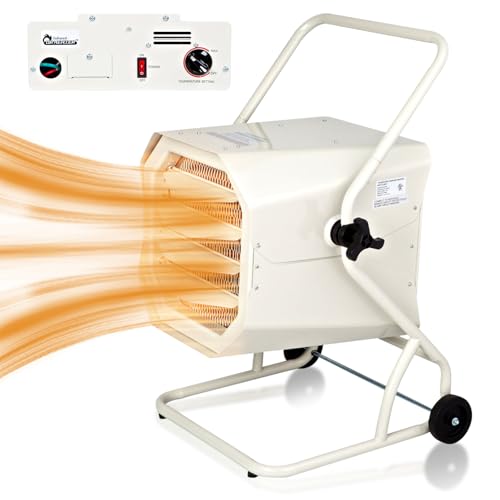
The DR-910M is the only 10,000-watt, 240-volt hardwired shop heater in this group, and it comes with a cart and five adjustable louvers. The thermostat adjusts from 37°F to 104°F. Its motor is fully enclosed, and the heater is UL/CUL listed. Installation requires 6 AWG copper wires; the unit has no power cord, so this is not a plug-in option. At 48 pounds and 33 × 21 × 24 inches, it is substantially larger than the portable indoor models. It suits a garage or shop with a suitable circuit and installation plan, not a standard household outlet.
Bottom line: Pick this for a properly wired garage or shop that needs high output.
Dr. Infrared 35-Inch Outdoor Heater

The 35-inch heater is the only model here designed for indoor and outdoor use, with an IP55 rating and included wall and ceiling brackets. It plugs into a standard 120-volt outlet and offers three power settings: 900, 1,200, and 1,500 watts. Its remote control and slim 35 × 8 × 4-inch shape support fixed placement, but it lacks a thermostat. Infrared heat works best when aimed at people or seating rather than being expected to warm all the air in an open patio. Choose this for targeted mounted heat; a portable fan-assisted unit is more adaptable for moving between rooms.
Bottom line: Choose this for targeted heat on a mounted patio or garage wall.
How to Choose a Dr. Infrared Heater
Start with the installation and power supply, then choose features for the space. Portable 1,500-watt heaters plug into a standard 120-volt outlet, while the DR-910M requires a 240-volt hardwired connection and 6 AWG copper wire. A 1,500-watt heater draws 12.5 amps at 120 volts, so avoid running it on a circuit already near its limit; household circuits are commonly 15 or 20 amps. Infrared heat warms objects and people directly, while PTC fan heat transfers warmth through moving air. For a drafty room, insulation and air leakage matter as much as the heater’s advertised coverage. Pick a wall- or ceiling-mounted infrared unit for fixed directional heat, not flexible room-to-room use.
Room Size and Heater Placement
Room area is only a rough guide because insulation, ceiling height, windows, and drafts change heating demand. A common planning estimate for a reasonably insulated room is about 10 watts per square foot; a 150-square-foot room would therefore call for roughly 1,500 watts, while a poorly insulated space may need more. Direct radiant heaters need a clear line of sight to the people or objects they are intended to warm. Keep portable heaters on a level, stable surface and maintain the clearance distances in the manual from curtains, furniture, bedding, and other combustibles. Never use an indoor-only portable heater outdoors or in a wet location. For outdoor comfort, aim a rated heater toward a seating area rather than trying to heat open air.
Portable, Hardwired, and Mounted Heater Types
Portable fan-assisted models suit room-to-room heating, hardwired shop heaters suit dedicated high-output installations, and mounted infrared models provide directed heat at a fixed location. The connection type is a decisive fit rule: a 240-volt hardwired heater cannot use a standard 120-volt receptacle, while a 120-volt plug-in heater should not be treated as a substitute for a large-shop installation. This table summarizes the practical choice by use.
| Need | Heater type | Key tradeoff |
|---|---|---|
| Move heat between rooms | Portable 1,500-watt unit | Room-scale output and outlet load |
| Warm a garage or shop | 240-volt hardwired unit | Requires compatible wiring |
| Heat a fixed patio seat area | Mounted infrared unit | Directional warmth, no room-wide air heating |
Do not select by wattage alone: installation limits and the distance to the target area can make a lower-wattage directed heater more suitable than a portable room heater.
Electric Heater Safety and Maintenance
Electric space heaters should be plugged directly into a suitable wall outlet, not an extension cord or power strip, which can overheat under sustained load. Keep at least 3 feet between a portable heater and combustible items as a general safety rule, while using any greater clearance required by its manual. Turn the heater off when leaving the room or going to sleep, and keep children and pets from touching hot surfaces or pulling cords. Dust can collect around air intakes and reduce airflow, so unplug the unit and clean accessible grilles as directed by its manual. For a hardwired 240-volt heater, have the circuit and wiring confirmed by a qualified electrician before installation.
Frequently Asked Questions
How many watts does a room heater need?
A common estimate for a reasonably insulated room is about 10 watts per square foot, so a 150-square-foot room points to roughly 1,500 watts. Drafts, high ceilings, and poor insulation can raise the need, while direct radiant heat can feel effective when aimed at nearby occupants.
Can a 1,500-watt heater run on a 15-amp circuit?
A 1,500-watt heater draws 12.5 amps at 120 volts, leaving limited capacity on a 15-amp circuit. Avoid sharing that circuit with other high-draw appliances, and plug the heater directly into a wall outlet rather than an extension cord or power strip.
Are infrared heaters safe to leave on overnight?
Do not leave a portable space heater running while asleep or away from the room. Maintain at least 3 feet of clearance from combustibles, place it on a stable surface, and use the model’s manual for any larger clearance requirement.
What does an IP55 rating mean for an outdoor heater?
IP55 indicates protection against dust ingress sufficient to avoid harmful deposits and against water jets from any direction under standardized testing. It does not mean the heater can be submerged, and installation still needs to follow its manual and local electrical requirements.
How far should a mounted infrared heater be from people?
There is no single safe distance for every mounted heater because output and installation angle differ. Follow the model’s specified mounting height and clearance, and aim it at the occupied area without placing people close enough to contact the hot housing or emitter.