
Hydrocolloid Bandages for Boils: 5 Options by Fit

For a small, already-drained boil, Hydrocolloid Roll, 2 in x 12 ft is the most adaptable option because its 2-inch-wide roll can be cut to the needed shape. Hydrocolloid dressings cover minor wounds; they do not treat the cause of a boil or replace medical care.
Choose a different dressing if the boil is large, worsening, or still full of pus: do not squeeze or lance it yourself, and seek medical advice rather than sealing it under a patch.
We earn a commission if you buy through links on this page. As an Amazon Associate I earn from qualifying purchases. Products are compared on manufacturer specifications, not hands-on testing.
- Best overall: Hydrocolloid Roll, 2 in x 12 ft – A 2-inch-wide, 12-foot roll can be cut to fit a small drained area.
- Best for square coverage: Niceful Hydrocolloid, 2 x 2 in – Each dressing is a 2-by-2-inch square, suited to a small, defined area.
- Best for larger wounds: Amazon Basics Large Hydrocolloid Gel, 4 Count – Its 2.32-by-3.07-inch dressing covers a larger area than the other fixed-size options.
| Product | Best for | Format | Dimensions | Count or length | Shop |
|---|---|---|---|---|---|
| Hydrocolloid Roll, 2 in x 12 ft | Custom coverage | Roll | 2 in wide | 12 ft | Check Price on Amazon |
| Niceful Hydrocolloid, 2 x 2 in | Square dressing | Square dressing | 2 x 2 in | 20 dressings | Check Price on Amazon |
| Amazon Basics Large Hydrocolloid Gel, 4 Count | Larger coverage | Gel bandage | 2.32 x 3.07 in | 4 bandages | Check Price on Amazon |
| BAND-AID Pro Heal Assorted, 14 Count | Assorted sizes | Assorted bandages | — | 14 bandages | Check Price on Amazon |
| Amazon Basics Regular Hydrocolloid Gel, 20 Count | Small patches | Gel bandage | 0.83 x 1.65 in | 20 bandages | Check Price on Amazon |
Hydrocolloid Bandages for Boils
Match the dressing’s usable area to the wound, and use hydrocolloid only for appropriate minor wound coverage.
Hydrocolloid Roll, 2 in x 12 ft

The cut-to-fit format sets this option apart: the 2-inch-wide roll can be trimmed to a shape that covers a small, drained wound without excess material. The maker describes it as latex-free, hypoallergenic, waterproof, and highly absorbent. It suits someone who wants flexible sizing rather than a fixed patch. A roll requires scissors and careful handling; avoid applying it over a boil that is actively enlarging, very painful, or still draining heavily, since those symptoms call for medical advice rather than home coverage.
Bottom line: Choose this if you need to trim a dressing for a small, drained area.
Niceful Hydrocolloid, 2 x 2 in
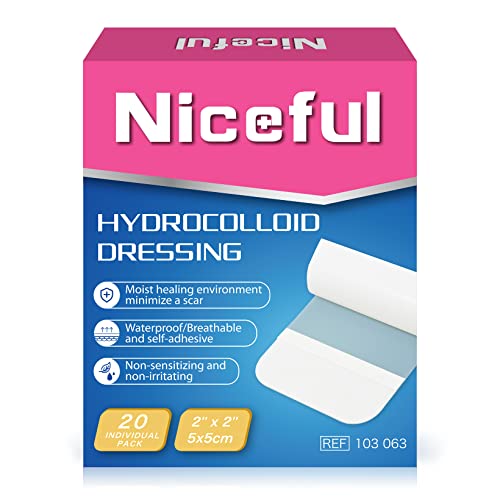
The 2-by-2-inch square gives a defined coverage area, unlike the customizable roll. Niceful says its carboxymethyl cellulose hydrocolloid forms a gel on contact with wound fluid and has a thin, borderless design with gentle adhesion. The pack contains 20 dressings, which may suit someone managing several small coverage needs. Its fixed square shape is less adaptable around curved or irregular areas than a trimmed roll, and a dressing is only for covering a minor wound—not for drawing out or curing a boil.
Bottom line: Choose the square format for a small, clearly bounded area.
Amazon Basics Large Hydrocolloid Gel, 4 Count

The 2.32-by-3.07-inch size offers a larger fixed dressing than the smaller options here. Amazon Basics says the sterile gel bandages cushion minor wounds, absorb excess fluid, and form a waterproof seal for multi-day wear. This format may suit a broader minor wound where the full rectangle can sit on intact surrounding skin. The pack has four bandages, so it offers less quantity than the 14- and 20-count options. Do not use a larger patch as a substitute for care when a boil is deep, spreading, or worsening.
Bottom line: Choose this for a broader minor wound that fits the rectangular shape.
BAND-AID Pro Heal Assorted, 14 Count

The maker says these ultra-thin hydrocolloid bandages are waterproof and designed for up to five days of continuous protection on minor cuts, scrapes, burns, and blisters. That makes the pack more appropriate for general first-aid coverage than a boil-specific dressing. Since the size mix is unclear, confirm that a bandage can cover the wound with room to adhere to intact skin before choosing it.
Bottom line: Choose this for assorted minor-wound coverage when a size fits.
Amazon Basics Regular Hydrocolloid Gel, 20 Count

The 0.83-by-1.65-inch format is the smallest fixed-size choice in this group, making it suited to a narrow, small area rather than broad coverage. Amazon Basics says the sterile bandages cushion minor wounds, absorb excess fluid, and support a moist environment with a waterproof seal for extended wear. The 20-count pack offers multiple small bandages, but the limited width may not leave enough surrounding skin for secure adhesion on a larger boil site. Do not place multiple patches over a worsening boil instead of getting it assessed.
Bottom line: Choose this only when the small dimensions fully cover the minor wound.
When a hydrocolloid dressing is suitable for a boil
Hydrocolloid is a wound covering, not a boil treatment. These dressings absorb some wound fluid and form a gel, but a boil is a deeper skin infection that may need evaluation or drainage by a clinician. Use a dressing only for a small, superficial area after drainage, and keep it off skin that is hot, increasingly red, very painful, or producing worsening symptoms. Do not squeeze or pierce a boil at home. A fever, red streaks, rapid spread, or a boil on the face warrants prompt medical advice; people with diabetes or weakened immunity should also contact a clinician early. If the boil has not opened, the dressing cannot make it drain safely.
How to choose a dressing size and shape
Choose a dressing that covers the wound and has intact, clean skin around its edges for adhesion; a patch that ends at the wound margin is more likely to lift. The fixed choices here span 0.83 by 1.65 inches to 2.32 by 3.07 inches, while the roll is 2 inches wide and can be cut to length. For a round, small site, a square or trimmed roll can avoid excess material; for a broader minor wound, a rectangle may fit better. Do not stretch a patch over a crease or hairy area where it will not seal. Clean hands and clean scissors matter when cutting roll material.
This table separates the dressing formats by how their size is chosen.
| Format | Useful when | Trade-off |
|---|---|---|
| Fixed small bandage | The wound fits its dimensions | Little flexibility in shape |
| Fixed larger dressing | A broader area needs coverage | Needs more surrounding skin to adhere |
| Cut-to-fit roll | The wound needs a custom outline | Requires trimming and careful application |
How to apply and change a hydrocolloid patch
Apply a hydrocolloid dressing to clean, dry skin, with the wound centered and the adhesive edge pressed onto intact skin. A patch needs a continuous seal around the wound to stay in place; lotion, moisture, hair, and skin folds can interfere. Follow the specific product’s wear directions, and change the dressing sooner if it leaks, loosens, or becomes soiled. Do not peel off a dressing repeatedly to inspect a boil, because disturbing healing skin can cause irritation. If drainage increases, redness spreads, or pain worsens while covered, remove the dressing and seek medical advice rather than adding another layer.
When a boil needs medical care
A boil that is large, worsening, recurrent, or accompanied by fever needs professional assessment rather than a larger bandage. Boils can require drainage, and squeezing at home can spread infection or injure surrounding tissue. Seek prompt care for facial boils, red streaking, rapidly spreading redness, severe pain, or fever. People with diabetes, immune suppression, or multiple boils should contact a clinician promptly even when the area seems small. A bandage may protect a minor draining wound from friction, but waterproof claims do not mean an infected area is safe to soak or leave unmonitored. Use medical advice to decide how to cover a drained site.
Frequently Asked Questions
Can I put a hydrocolloid bandage on an unopened boil?
A hydrocolloid bandage is not a treatment for an unopened boil and cannot make it drain safely. Do not squeeze or pierce it; seek medical advice if it grows, becomes very painful, or does not improve.
How often should I change a boil dressing?
Change a dressing if it leaks, loosens, or becomes soiled, and follow its specific wear directions. A boil with increasing drainage, spreading redness, or worsening pain needs medical assessment rather than simply more frequent patch changes.
Should I cut a hydrocolloid roll around a boil?
A roll can be cut to shape, but the dressing should cover the wound while its adhesive rests on clean, intact skin. Use clean scissors and do not apply it over an actively worsening boil.
Can I shower while wearing a hydrocolloid bandage?
Some products in this group are described as waterproof, but a seal can fail if the edges lift. After showering, check whether the dressing remains sealed and replace it if it leaks or loosens.
When should I see a doctor for a boil?
Seek prompt medical advice for fever, red streaks, rapidly spreading redness, severe pain, a facial boil, or a boil that is large or worsening. Contact a clinician early for recurrent boils or if you have diabetes or a weakened immune system.