
Best Fully Automatic Egg Incubators Compared by Capacity

Brinsea Ovation 28 EX suits most people who want fully automatic egg incubation because it combines turning and automatic humidity control in a 28-egg capacity. Choose GleeGearNex Gen IV 12-Egg for a smaller batch or JAEDO 176-Egg Incubator when you need room for as many as 176 eggs.
An egg incubator maintains conditions for eggs to develop and hatch; capacity and the type of eggs determine which model fits. Buyers seeking more than 176 eggs at once should choose a larger-capacity option instead.
We earn a commission if you buy through links on this page. As an Amazon Associate I earn from qualifying purchases. Products are compared on manufacturer specifications, not hands-on testing.
- Best overall: Brinsea Ovation 28 EX – It combines automatic turning and humidity control with capacity for 28 eggs.
- Best for small batches: GleeGearNex Gen IV 12-Egg – Its capacity is up to 12 chicken eggs or 24 quail eggs.
- Best for larger batches: JAEDO 176-Egg Incubator – It holds 176 eggs and includes a built-in candler.
| Product | Best for | Capacity | Automatic functions | Distinct feature | Shop |
|---|---|---|---|---|---|
| Brinsea Ovation 28 EX | Automated humidity | 28 eggs | Turning, humidity | Temperature alarms | Check Price on Amazon |
| GleeGearNex Gen IV 12-Egg | Small batches | 12 chicken / 24 quail eggs | Turning, temperature, humidity | Candler and alarm | Check Price on Amazon |
| JAEDO 176-Egg Incubator | Large batches | 176 eggs | Turning, temperature, humidity | Built-in candler | Check Price on Amazon |
| 108-Egg Multi-Layer Incubator | Mixed egg types | 108 eggs | Turning, temperature, water replenishment | Multi-layer trays | Check Price on Amazon |
Fully Automatic Egg Incubators
Compare capacity and automation first, then match the incubator to your egg types and batch size.
Brinsea Ovation 28 EX

Brinsea Ovation 28 EX stands out for its integrated humidity pump, which manages humidity without opening the lid. It holds 28 eggs and includes automatic turning, digital temperature and humidity readings, and high- and low-temperature alarms. Brinsea says its dual-airflow system supports consistent circulation; that is a maker performance claim, not a guaranteed hatch result. This model suits a smaller batch when reducing routine adjustments matters. Its 28-egg capacity is the limitation for larger hatches, so choose a higher-capacity incubator if you need more space.
Bottom line: Choose this when automated humidity matters more than a large batch capacity.
GleeGearNex Gen IV 12-Egg
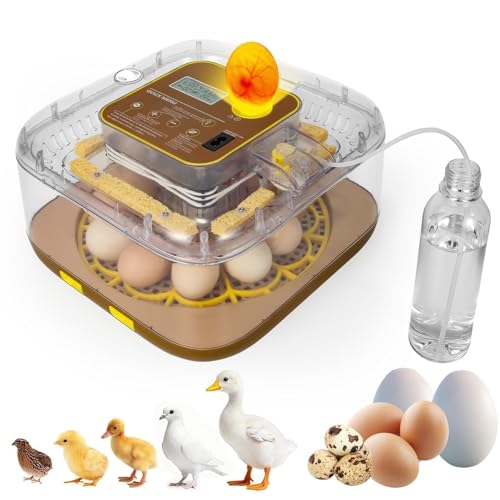
GleeGearNex Gen IV 12-Egg is the smallest capacity here, with room for up to 12 chicken eggs or 24 quail eggs. Its feature set includes sensor-based temperature and humidity management, adjustable automatic turning with auto-stop, an alarm, and a candler. The preset temperature range is 68–104°F and the preset humidity range is 20–75% RH; the maker notes a manual humidity boost can go higher. This suits a beginner or hobbyist with a small batch. The capacity may be restrictive for a larger hatch, and the ambient operating range is 64–86°F with humidity above 40% RH.
Bottom line: Choose this for a small batch that fits its operating conditions.
JAEDO 176-Egg Incubator

JAEDO 176-Egg Incubator offers the largest capacity among the exact-fit options, holding up to 176 eggs. Its rollers rotate 360 degrees, and adjustable roller spacing accommodates chicken, duck, goose, and other bird eggs. A built-in candler lets you check eggs without removing them, while the unit is designed for incubation through hatching. The maker specifies temperature control from room temperature to 104°F and power consumption under 60 watts. This capacity suits small poultry operations or educational use. Its larger footprint—19.5 inches long, 17 inches wide, and 16 inches high—can be a drawback where setup space is limited.
Bottom line: Choose this when the 176-egg capacity and built-in candler fit your setup.
108-Egg Multi-Layer Incubator
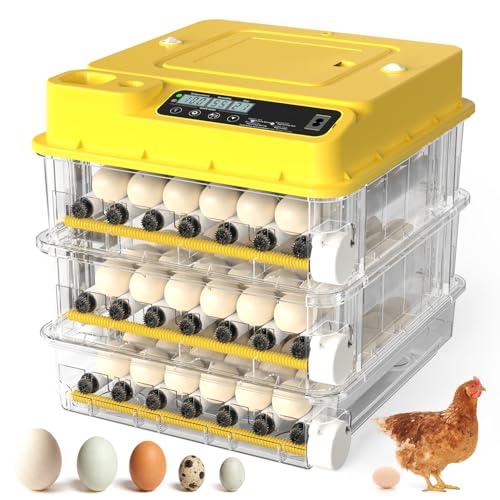
108-Egg Multi-Layer Incubator uses a multi-layer layout for separating different egg types, with a double-fan system and automatic turning. Its humidity setup uses bottles for automatic water replenishment; the maker recommends one bottle early in incubation and all three during the final three days. That bottle-based approach is the distinguishing feature for buyers who want replenishment without a built-in pump. It suits batches of up to 108 eggs across poultry and reptile types named by the maker. The bottle routine still requires adding water, so it is less hands-off than a system with an integrated humidity pump.
Bottom line: Choose this for separated egg types and bottle-fed water replenishment.
How to choose a fully automatic egg incubator
Choose by batch size, egg type, and which tasks the incubator automates. Capacity varies substantially across these options, from 12 chicken eggs to 176 eggs, and the capacity can differ by species: one model gives separate chicken and quail counts. Turning, humidity management, and temperature monitoring are distinct functions; a rotating tray does not by itself automate humidity. For a batch of 12 chicken eggs or fewer, a small-capacity model may be sufficient; for more than 28, compare the larger units. Also compare how humidity is supplied: a pump, sensor-managed system, or water bottles create different maintenance routines.
Egg turning, humidity, and temperature basics
Chicken eggs generally incubate for about 21 days, and turning is commonly stopped for the final three days so chicks can position for hatching. Turning several times a day is a standard practice; automatic turning reduces that routine, but the incubator’s settings still need attention. Chicken eggs are typically incubated near 99.5°F in a forced-air incubator, while humidity commonly starts around 45–55% RH and rises to about 65–70% RH for hatch. Species and incubator design can change those targets. Use the egg type’s incubation schedule rather than applying chicken settings to duck, goose, quail, or reptile eggs.
Where to place and set up an incubator
Set an incubator in a stable indoor room away from direct sun, drafts, heaters, and cold exterior walls; sudden ambient changes can destabilize internal conditions. A room temperature around 70–75°F is a practical target, and the small-batch model here gives an acceptable ambient range of 64–86°F. Leave space around ventilation openings and keep the unit level. Before setting eggs, run the incubator empty for at least 24 hours and compare its temperature with a separate thermometer at egg height. Avoid repeatedly opening the lid during hatch, because humidity loss can dry membranes and make hatching harder.
Safe handling and common incubation mistakes
Clean hands and clean, uncracked eggs help limit contamination; do not wash hatching eggs unless the species-specific process calls for it, because washing can remove the protective bloom. Store eggs point-down in a cool place before incubation and avoid prolonged storage; many hatchers aim to set eggs within seven days. A common mistake is changing temperature or humidity based on a single brief reading: allow the incubator to stabilize and use a reliable thermometer and hygrometer. During the final hatch period, stop turning and keep the incubator closed as much as possible. Keep electrical equipment dry and follow safe handling around water reservoirs.
Frequently Asked Questions
How long do chicken eggs take to hatch?
Chicken eggs typically hatch after about 21 days of incubation. Breed, storage before setting, and sustained temperature differences can shift the timing, so assess development rather than relying on the calendar alone.
When should I stop turning eggs in an incubator?
Stop turning chicken eggs around day 18, the start of the final three-day hatch period. Turning during this phase can interfere with positioning for hatch.
What humidity should chicken eggs have while incubating?
Chicken eggs commonly use about 45–55% relative humidity for most of incubation, rising to roughly 65–70% for hatch. Egg weight loss and incubator airflow can affect the appropriate target.
How often should an incubator turn chicken eggs?
Chicken eggs are commonly turned at least three times daily, with an odd number of turns helping avoid the same side resting upward overnight. Automatic turning removes the need for that manual schedule, but verify the turning mechanism works before setting eggs.
Can I incubate duck and chicken eggs together?
You can incubate them together only when their temperature, humidity, and hatch schedules can be managed compatibly. Chicken eggs hatch around day 21, while common duck eggs often need about 28 days, so their different hatch timing complicates a shared cycle.