
WANPTEK DC Power Supply: 3 Models Compared

For most repair benches, the WANPTEK TPS-C3010 WANPTEK TPS-C3010 30V 10A is the straightforward pick because it combines 0–30V, 0–10A output with memory presets. Choose another model if you specifically want USB output-current monitoring or a 0–32V range.
A bench power supply provides adjustable DC voltage and current for circuit testing; match its output limits and controls to the device under test.
We earn a commission if you buy through links on this page. As an Amazon Associate I earn from qualifying purchases. Products are compared on manufacturer specifications, not hands-on testing.
- Best overall: WANPTEK TPS-C3010 30V 10A – Provides 0–30V and 0–10A output with memory presets and an output switch.
- Best for USB monitoring: WANPTEK 30V 10A USB Monitor – Its display shows the USB port’s real-time output current.
- Best for saved settings: WANPTEK EPS-Blue 32V 10A – Three memory keys store voltage and current combinations for recall.
| Product | Best for | Output voltage | Notable control or port | Shop |
|---|---|---|---|---|
| WANPTEK TPS-C3010 30V 10A | General repair | 0–30V | Memory presets; USB fast charge | Check Price on Amazon |
| WANPTEK 30V 10A USB Monitor | USB monitoring | 0–30V | USB current display | Check Price on Amazon |
| WANPTEK EPS-Blue 32V 10A | Preset workflows | 0–32V* | 3 memory keys; USB-A and Type-C | Check Price on Amazon |
WANPTEK DC Power Supplies
Compare output ranges and controls first, then choose the features that fit your bench routine.
WANPTEK TPS-C3010 30V 10A

The WANPTEK TPS-C3010 pairs 0–30V and 0–10A output with memory presets, making it the most balanced choice here for general repair and lab work. Its encoder adjustment supports digit-by-digit setting, and the unit also has an output switch, key lock, and overcurrent protection. The four-digit LED display gives a direct view of settings. Choose it if saved settings and a dedicated output switch matter; its voltage ceiling is 30V, so circuits requiring more voltage need a different supply. The maker says the unit includes USB fast charging.
Bottom line: Pick this for a repair bench where saved settings and an output switch are useful.
WANPTEK 30V 10A USB Monitor
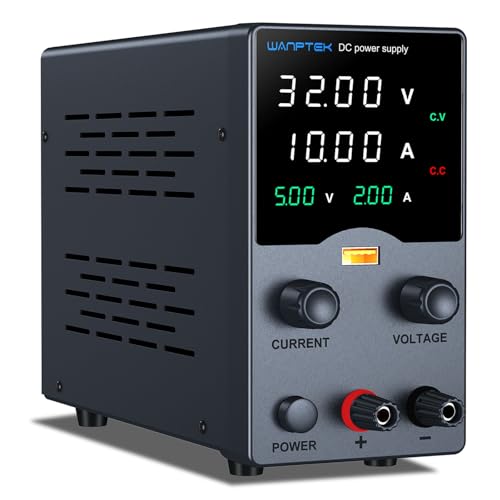
The WANPTEK 30V 10A USB monitor model stands apart by showing the USB port’s real-time output current on its screen. It also uses a precision encoder knob and a four-digit LED display, with a USB fast-charging port for compatible devices. That combination suits a bench where you want to observe USB charging current without adding a separate inline meter. Its output range tops out at 30V and 10A, so it is not the match for work that needs a higher voltage or current ceiling. The maker describes the USB port as fast charging.
Bottom line: Choose this when viewing USB output current is a priority.
WANPTEK EPS-Blue 32V 10A

The WANPTEK EPS-Blue is the only model here whose name gives a 0–32V ceiling, and it adds three memory keys for frequently used voltage-current combinations. The controls let you select a digit and rotate the encoder to set values; an output button lets you turn the output off while adjusting settings. Confirm the voltage range before ordering if the extra 2V matters.
Bottom line: Choose this for stored settings, after confirming its voltage ceiling.
How to choose a bench power supply
Choose a supply whose voltage and current ceilings exceed the circuit’s requirements, while keeping the current limit low enough to protect delicate parts during initial testing. For a circuit needing no more than 30V and 10A, a 30V/10A unit covers that range; needing more than either ceiling rules it out. Constant-voltage mode holds the set voltage until the load reaches the current limit, then many supplies transition to constant-current behavior. Resolution and accuracy are different: a display that changes in small increments does not by itself prove equally small measurement error. Also compare controls: memory presets speed repeated setups, while coarse/fine controls suit users who want separate adjustment steps.
How to set voltage and current safely
Set the voltage to the circuit’s required value and begin with a conservative current limit, especially when powering an unfamiliar board or component. A bench supply can deliver enough current to damage a shorted circuit even at a low voltage, so current limiting is a core protection step, not a substitute for correct wiring. Turn the output off while moving leads, verify positive and negative polarity, and check that the load is connected to the intended terminals before enabling output. Keep exposed conductors from touching; a short across the output can trigger protection or stress leads and components. A USB charging port is a separate function from the adjustable DC output, so do not assume its voltage is adjustable.
What output ratings mean for repair work
The voltage rating is the maximum output potential, while the amp rating is the maximum current available when the load draws it; a 10A rating does not force 10A into every circuit. The connected load and current-limit setting determine the actual current. For a simple resistive load, power in watts equals volts multiplied by amps, so 30V at 10A corresponds to 300W only if a supply can sustain both maxima simultaneously. The specifications do not establish simultaneous full-range power for every model, so avoid assuming it. Match both voltage and current to the device, and leave headroom only where the supply’s rated output supports it.
How to compare presets and charging ports
Memory keys save common voltage-current combinations, while encoder controls change setpoints; neither replaces checking the displayed values before enabling output. A model with three stored combinations can reduce repeated dialing, but saved values are useful only when they match the next device’s safe limits. USB current monitoring can help observe output draw, but it does not prove battery condition or charging completion. When output range is the deciding issue, resolve conflicting voltage figures before purchase rather than relying on a model name alone.
Frequently Asked Questions
What does a 0–30V 10A rating mean?
A 0–30V, 10A rating indicates adjustable output up to 30 volts and a current ceiling of 10 amps. The load draws the current, subject to the supply’s current-limit setting.
Should I set the current limit before connecting a circuit?
Yes, set a conservative current limit before enabling output on an unfamiliar circuit. A short or wiring error can otherwise draw damaging current even at a modest voltage.
Does a four-digit display guarantee high accuracy?
No; display resolution and measurement accuracy are different specifications. A display may show fine increments without confirming that the delivered voltage or current is equally accurate.
Can a bench supply charge a USB device?
A model with a USB charging port can charge compatible devices through that port. The port’s supported charging behavior and a device’s protocol compatibility affect charging results.
What is the difference between constant voltage and constant current?
Constant-voltage mode holds the selected voltage while the load draws current below the set limit. When the load reaches that current limit, a supply may transition to constant-current operation and reduce voltage.