
Lab Charge Ionic Air Purifier: 3 Packs Compared

Lab Charge Ionic Purifier, 5-Pack is the named Lab Charge ionic air purifier, and its five-unit pack is the deciding choice if you need the most units; each unit claims coverage up to 250 square feet. An ionizer releases charged particles rather than filtering air through a replaceable HEPA media.
Choose a different pack count if you need four units or an eight-unit bundle; the unit dimensions and coverage are the same across these options.
We earn a commission if you buy through links on this page. As an Amazon Associate I earn from qualifying purchases. Products are compared on manufacturer specifications, not hands-on testing.
- Best overall: Lab Charge Ionic Purifier, 5-Pack – Five units, each with claimed coverage up to 250 square feet.
- Best for four rooms: Lab Charge Ionic Purifier, 4-Pack – The four-unit pack keeps the same coverage per unit.
- Best for eight rooms: Lab Charge Ionic Purifier, 8-Pack – The eight-unit bundle has the largest unit count with the same coverage.
| Product | Best for | Pack count | Shop |
|---|---|---|---|
| Lab Charge Ionic Purifier, 5-Pack | Five-room setups | 5 units | Check Price on Amazon |
| Lab Charge Ionic Purifier, 4-Pack | Four-room setups | 4 units | Check Price on Amazon |
| Lab Charge Ionic Purifier, 8-Pack | Eight-room setups | 8 units | Check Price on Amazon |
Lab Charge Ionic Air Purifiers
These options share the same unit size and coverage, so choose by pack count and review ionizer limitations before relying on one for particle removal.
Lab Charge Ionic Purifier, 5-Pack

Lab Charge Ionic Purifier, 5-Pack is the five-unit version of the Lab Charge plug-in ionic purifier, making pack size its main distinction from the four- and eight-unit options. Each compact black unit measures 3.5 inches high, 1.5 inches long, and 2 inches wide, and the maker claims coverage up to 250 square feet per unit. The maker describes it as silent and filterless, using high-density ions. This suits someone outfitting several small spaces; it is not a conventional HEPA air cleaner, so buyers who need a verified particle-removal rate should choose a purifier with a published CADR instead.
Bottom line: Pick this pack if five plug-in units match the number of spaces you want to address.
Lab Charge Ionic Purifier, 4-Pack

Lab Charge Ionic Purifier, 4-Pack provides four units, one fewer than the five-pack and four fewer than the eight-pack. Each black purifier is 3.5 inches tall and has a 250-square-foot coverage claim; the maker describes the operation as quiet and filterless. The product name mentions a free cleaner, but the specifications do not explain what that means, so do not base the decision on it. The smaller bundle can suit a four-space setup, but ionizers do not collect settled particles in a filter; dust that lands on surfaces still needs ordinary cleaning.
Bottom line: Choose this option when four units are enough for your intended rooms.
Lab Charge Ionic Purifier, 8-Pack
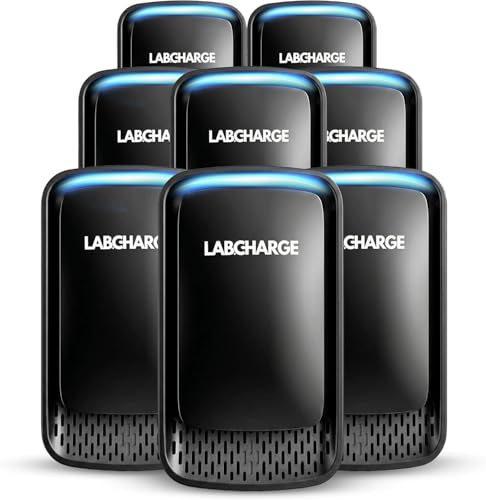
Lab Charge Ionic Purifier, 8-Pack is the eight-unit bundle, the largest pack in this comparison. Its units share the 3.5-inch height and claimed 250-square-foot coverage found on the other options. The maker says the device uses negative ions and has no fan or replaceable filter. Those features distinguish its approach from a fan-driven purifier, but the fields provide no measured CADR or ozone-emissions figure. That limitation matters if you need quantified particle reduction or are concerned about ozone; check emissions information before choosing an ionizer for occupied rooms.
Bottom line: Pick this pack if you need eight units and accept an ionizer rather than a rated filter purifier.
How to Choose a Lab Charge Ionic Air Purifier
Choose a bundle by the number of spaces you want to equip, then decide whether ionization suits your air-cleaning goal. These options share a 250-square-foot coverage claim per unit, but that claim is not a clean-air delivery rate (CADR). For a conventional particle-filtering purifier in a room with an 8-foot ceiling, a common sizing rule is a smoke CADR of at least two-thirds of the room’s square footage; taller ceilings call for more capacity. A room’s doors, layout, and pollution sources can also affect how well one unit serves it.
Use the bundle count as a quantity guide, not a performance ranking.
| Need | Pack choice | Per-unit coverage claim |
|---|---|---|
| Four units | Lab Charge Ionic Purifier, 4-Pack | 250 sq ft |
| Five units | Lab Charge Ionic Purifier, 5-Pack | 250 sq ft |
| Eight units | Lab Charge Ionic Purifier, 8-Pack | 250 sq ft |
How Ionic Air Purifiers Handle Particles
An ionizer electrically charges airborne particles instead of drawing air through a replaceable filter. Charged particles may clump together or settle on nearby surfaces, so an ionizer does not necessarily remove them from the room; settled dust still needs wiping or vacuuming. A mechanical HEPA purifier works differently: air passes through filter media that captures particles, and its clean-air delivery rate helps compare airflow and particle removal. For a measurable particle-cleaning target, use a purifier with a published CADR matched to the room rather than treating a square-foot coverage claim as equivalent.
Room placement matters for either approach: keep a purifier’s air intake and outlet clear, and avoid assuming a small unit serves multiple closed rooms equally.
Ionizer Safety and Ozone Checks
Check ozone emissions before using an ionizer in an occupied room, because ozone can irritate the lungs. Ozone is not the same as the charged particles an ionizer produces, and a “filterless” design does not establish that a device emits none. UL 2998 is a recognized validation protocol for zero-ozone-emission claims; look for certification or independent emissions measurements rather than relying on a general claim of quiet operation. People with asthma or other respiratory sensitivities should be especially cautious about ozone exposure.
Do not use an air purifier as a substitute for source control or ventilation: remove smoke or odor sources where possible, and ventilate when outdoor conditions allow. For particle removal, compare verified CADR and ozone data before choosing ionization over filtration.
Frequently Asked Questions
Do ionic air purifiers use HEPA filters?
No, an ionizer charges particles rather than trapping them in HEPA media. HEPA filters capture particles as air passes through the filter; these products are described as filterless.
Can an ionizer remove dust from a room?
Ionizers can cause some airborne particles to settle onto nearby surfaces, but settling is not the same as capturing them in a filter. Wipe or vacuum surfaces regularly so settled dust does not remain in the room.
Can air ionizers produce ozone indoors?
Some ionizers can emit ozone, which is a lung irritant. Check an independent ozone-emissions certification or measurement before using an ionizer in an occupied room, especially around people sensitive to air irritants.
How large a room can a 250-square-foot purifier cover?
The specifications give a claimed coverage of 250 square feet per unit, but coverage claims do not establish a CADR. For an 8-foot ceiling, a typical sizing rule for a particle-filtering purifier is smoke CADR of at least two-thirds of the room’s square footage.
Do filterless ionizers need regular cleaning?
A filterless design avoids replacing a filter, but it does not eliminate routine room cleaning. Particles that settle on floors or furniture need to be removed by wiping or vacuuming.