
Coax RF HDMI Modulators: Four Options Compared

Thor Broadcast HDMI to Coax Modulator suits most people who need HDMI converted to a digital RF channel because it supports several digital broadcast formats, including ATSC and QAM. For a CRT or other older set that tunes analog channel 3 or 4, choose an NTSC model such as PROZOR HDMI to RF Modulator instead.
We earn a commission if you buy through links on this page. As an Amazon Associate I earn from qualifying purchases. Products are compared on manufacturer specifications, not hands-on testing.
- Best overall: Thor Broadcast HDMI to Coax Modulator – Its digital RF output supports DVB-C/T, ATSC, and ISDB-T formats.
- Best for older TVs: PROZOR HDMI to RF Modulator – It outputs analog NTSC on channel 3 or channel 4 and includes a 1-meter RG6 cable.
- Best for fixed NTSC output: ECHTNATAV HDM61 HDMI to Coax Adapter – It gives the channel 3 and 4 frequencies: 61.25 MHz and 67.25 MHz.
| Product | Best for | Input | RF output | Supported input resolution | Shop |
|---|---|---|---|---|---|
| Thor Broadcast HDMI to Coax Modulator | Digital RF distribution | HDMI | DVB-C/T, ATSC, ISDB-T | 720p, 1080i, 1080p | Check Price on Amazon |
| PROZOR HDMI to RF Modulator | Older analog TVs | HDMI | NTSC, CH3 or CH4 | 1080p input | Check Price on Amazon |
| ECHTNATAV HDM61 HDMI to Coax Adapter | NTSC channel output | HDMI | NTSC-M, CH3 or CH4 | 1080p | Check Price on Amazon |
| HDMI/RCA to RF Modulator | HDMI or RCA sources | HDMI or RCA | Analog NTSC coax | — | Check Price on Amazon |
Coax RF HDMI Modulators
Match the modulator’s RF output format to the tuner in the television or distribution system receiving it.
Thor Broadcast HDMI to Coax Modulator
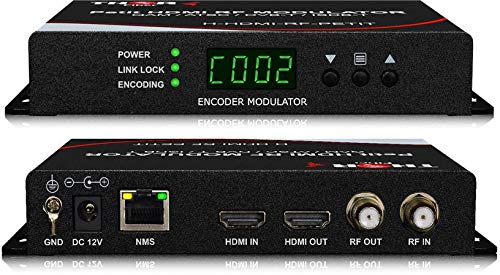
Unlike the analog channel 3/4 converters, this Thor Broadcast unit sends HDMI video through a digital RF format. The maker says it supports DVB-C/T, ATSC, and ISDB-T output, with MPEG2 encoding and AC3 Dolby Audio. Supported source resolutions are 720p, 1080i, and 1080p, and configuration uses the maker’s GUI on a PC. This is the best fit when the receiving TVs or distribution equipment can tune the selected digital standard. It is not the right match for a television that only receives analog NTSC channels 3 or 4.
Bottom line: Choose this when your receiving equipment can tune its digital RF format.
PROZOR HDMI to RF Modulator

For older televisions that tune analog VHF, this PROZOR unit outputs NTSC on channel 3 or 4 rather than a digital cable or broadcast format. The maker says it accepts HDMI 1.4 and HDCP 1.4 sources, including inputs up to 1080p, and includes a 1-meter RG6 cable. Its channel selection makes it a practical fit for a CRT or rotary-dial TV with an analog tuner. The limitation is direction: it converts HDMI to RF only, so it cannot send an RF signal back to an HDMI display.
Bottom line: Pick this for an analog TV when the included coax cable is useful.
ECHTNATAV HDM61 HDMI to Coax Adapter

Where a precise analog frequency matters, this ECHTNATAV adapter specifies both NTSC-M channel frequencies: channel 3 at 61.25 MHz and channel 4 at 67.25 MHz. It accepts HDMI and converts in one direction to analog RF coax output; the maker says setup requires no extra driver software. The compact 5.12-by-3.94-inch dimensions may help when placement space is limited. Its output is analog NTSC, not a digital ATSC or QAM channel, so it will not suit a receiver that requires digital RF.
Bottom line: Choose this when you need the NTSC-M channel frequencies.
HDMI/RCA to RF Modulator

This converter accepts either HDMI or composite RCA video and sends the signal to coax RF, giving it a different source-input choice than HDMI-only units. Its name specifies a channel switch, and its uses include game systems, streaming devices, and other modern equipment connected to older TVs. It may be useful when the source has RCA output rather than HDMI. The specifications do not provide an input resolution or a specific RF channel, so confirm that its selectable output matches the receiving TV before choosing it.
Bottom line: Pick this when you need both HDMI and RCA input options.
How to choose a coax RF HDMI modulator
Choose the output format your television or RF distribution system can tune; the word “coax” alone does not tell you whether the signal is analog or digital. Analog NTSC modulators typically put the source on VHF channel 3 or 4, while digital units encode to a standard such as ATSC or QAM. A digital cable channel and analog channel 3 are not interchangeable, even though both travel over coax. If the receiving set is an older CRT, look for analog NTSC output; if the system uses digital tuners, verify its supported standard before selecting a modulator.
Resolution claims describe the HDMI input, not the picture resolution carried by an analog RF output. Match the source’s HDMI compatibility and any copy-protection requirements to the converter, then check the receiving TV’s tuner format and channel scan options. A channel mismatch can leave a working source and cable with no picture.
Analog NTSC and digital RF compared
Analog NTSC channel 3 uses 61.25 MHz, and channel 4 uses 67.25 MHz. These fixed frequencies are useful when pairing a basic modulator with a TV that manually tunes VHF channels. Digital RF modulators instead encode audio and video into a broadcast or cable format; the receiver must support that same format and scan or tune the assigned channel.
Use this distinction before comparing resolution or input ports:
| Output type | Typical receiving equipment | What to match |
|---|---|---|
| Analog NTSC | Older analog TV tuner | Channel 3 or 4 |
| Digital RF | Digital ATSC, QAM, or other compatible tuner | Modulation standard |
Do not assume a television with a coax jack supports every RF format. Some newer televisions have digital tuners but will not tune an analog NTSC output; check the manual’s tuner capabilities or perform a channel scan with the intended modulator.
Connecting HDMI sources to older televisions
An HDMI-to-RF modulator converts a digital HDMI source into a signal a compatible RF tuner can receive over coax. Connect the HDMI source to the modulator, connect its RF output to the television’s antenna or coax input, select the output channel, and tune the TV to the matching channel. For a digital output, scan for the generated channel using the TV’s matching tuner mode.
Keep the direction straight: HDMI-to-RF does not convert a television’s RF input back into HDMI. RF-to-HDMI is a separate conversion direction and requires a different device. For a source output of 1080p, remember that this is the input accepted by the converter; an analog NTSC output does not become a 1080p RF picture.
Coax connection and channel matching
A coax cable carries the modulator’s RF signal, but it does not fix a mismatch between the modulator and the TV tuner. Analog channel 3 and channel 4 are close together in the VHF band, so select the same channel at both ends; if reception is poor, try the other supported channel and tune again. Digital modulators require their output standard to match the receiver, such as ATSC or QAM where supported.
For whole-home distribution, the same RF channel can be shared across compatible TVs, but the source generally appears on that assigned channel rather than as a separate HDMI input at each set. Avoid using an amplifier or splitter as a substitute for format conversion: those components change signal distribution or level, not analog-versus-digital compatibility.
Frequently Asked Questions
Can an HDMI modulator work with an analog CRT TV?
Yes, if the unit outputs analog NTSC on a channel the CRT can tune. Channel 3 is 61.25 MHz and channel 4 is 67.25 MHz; a digital-only RF output will not work with an analog-only tuner.
What is the difference between HDMI to RF and RF to HDMI?
HDMI-to-RF converts an HDMI source for a coax-equipped tuner, while RF-to-HDMI converts an incoming RF signal for an HDMI display. They are opposite signal directions, so a one-way converter cannot substitute for the other.
Does a 1080p input mean 1080p over coax?
No; 1080p describes an accepted HDMI input, not necessarily the RF output format. An analog NTSC output is tuned as channel 3 or 4 rather than as a 1080p HDMI picture.
Do digital RF modulators work with every coax TV?
No; the television needs a tuner that supports the modulator’s digital format, such as ATSC or QAM. Check the tuner mode and scan for the assigned channel before relying on a coax jack alone.
Why does my TV show no picture on channel 3?
The modulator and TV may be set to different channels, or the television may not support the output format. If the modulator offers channel 4 at 67.25 MHz, tune both ends to channel 4 and rescan or retune.