
Best Walking Pad for Tall People: 4 Models Compared

Acezoe P11 PRO Walking Pad suits most tall walkers because its handlebar adjusts from 38.5 to 48.5 inches, while THERUN 40-Inch Belt Walking Pad offers a 40-inch belt for those prioritizing walking space. A walking pad is a compact treadmill designed mainly for walking, often under a desk.
Choose another model if you need a higher weight capacity or an auto-incline feature; compare those specifications rather than relying on overall frame length as a measure of usable walking space.
We earn a commission if you buy through links on this page. As an Amazon Associate I earn from qualifying purchases. Products are compared on manufacturer specifications, not hands-on testing.
- Best overall: THERUN 40-Inch Belt Walking Pad – Its belt is specified at 40 inches long by 15 inches wide, giving a concrete walking-surface measurement to compare with your stride.
- Best for adjustable support: Acezoe P11 PRO Walking Pad – Its handlebar has five settings from 38.5 to 48.5 inches.
- Best for higher capacity: MERACH UltraWalk W60 – Its product name gives a maximum capacity of 400 pounds.
| Product | Best for | Weight capacity | Shop |
|---|---|---|---|
| Acezoe P11 PRO Walking Pad | Adjustable handlebar | — | Check Price on Amazon |
| THERUN 40-Inch Belt Walking Pad | Belt dimensions | 300 lb | Check Price on Amazon |
| MERACH UltraWalk W60 | Higher capacity | 400 lb | Check Price on Amazon |
| 12% Auto-Incline Walking Pad | Higher capacity | 450 lb | Check Price on Amazon |
Walking Pads for Tall People
Compare the usable walking space and support features that matter most when choosing a pad for a longer stride.
Acezoe P11 PRO Walking Pad
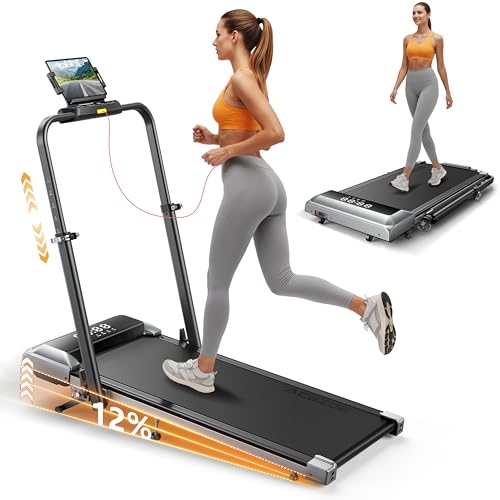
Five handlebar height settings distinguish this model for tall walkers who want adjustable hand support. The bar ranges from 38.5 to 48.5 inches, and the treadmill has three manual incline levels: 1%, 6%, and 12%. It also has app control and a foldable design. This suits someone who values adjustable support and uphill walking.
Bottom line: Choose this if adjustable handlebar height matters more than a known belt length.
THERUN 40-Inch Belt Walking Pad

A 40-inch-long, 15-inch-wide belt gives this model the clearest walking-surface dimensions for tall walkers comparing stride room. The speed range is 0.6 to 3.8 mph, and six silicone shock absorbers support the five-layer anti-slip belt. Its frame measures 45.5 inches long by 19.6 inches wide. This suits buyers who want a known belt size and portable design. The belt may still be too short for some natural strides, so compare its usable length with your own comfortable stride before choosing it.
Bottom line: Choose this when a measured belt and stride fit are your main priorities.
MERACH UltraWalk W60

The product name gives a 400-pound maximum capacity, setting this model apart for buyers who need a higher load rating. Its frame measures 51.4 inches long by 22 inches wide, and the name also identifies 12 auto-incline settings. The maker gives a 1.25 CHP rating and 3.5 HP peak rating for its brushless motor; these are maker performance claims. This suits buyers who value capacity and incline options, but tall walkers should compare belt dimensions directly, since frame length does not establish usable walking space.
Bottom line: Choose this if capacity and auto-incline outweigh the need for stated belt dimensions.
12% Auto-Incline Walking Pad

A 450-pound capacity and nine-level auto-incline up to 12% set this walking pad apart for buyers who prioritize load rating and uphill adjustment. Its frame measures 48 inches long and 21 inches wide, and it includes a Bluetooth speaker and FitYo app connectivity. Choose it for capacity and incline, but confirm belt length before deciding whether it will accommodate your stride.
Bottom line: Pick this if its capacity and automatic incline are your priorities.
How to choose a walking pad for a tall stride
Start with usable belt length, not the treadmill’s outside length. A 40-inch belt is the only belt length specified among these choices; overall frame dimensions cannot be substituted for the walking surface. Tall walkers should compare the belt against their own comfortable stride at the speed they expect to use. If the usable belt is shorter than that stride, choose a longer walking surface or shorten the stride only if that feels natural and stable. Belt width matters too: a 15-inch belt gives less side-to-side room than a wider surface. Before buying, measure a few comfortable steps on level ground and confirm the treadmill’s usable walking area, not just its frame footprint.
Handlebar height and walking posture
Adjustable support can help a tall walker avoid reaching down to a fixed bar, but handlebar height is not the same as belt fit. One model here provides five settings from 38.5 to 48.5 inches; the other specifications do not give bar height. Set a handlebar so your shoulders stay relaxed and elbows remain slightly bent rather than reaching forward or shrugging. If the bar is too low or too high at your natural posture, it may be less useful as support. Handles are not a substitute for balance or a safety tether, so confirm whether a particular model includes the safety features you need before use.
Walking pad dimensions and room fit
Measure the storage footprint and walking area separately. Frame lengths in these options range from 45.5 to 53.94 inches, but a longer frame does not prove a longer belt. Widths range from 19.6 to 28.27 inches overall; allow additional space around the unit so mounting and stepping off are not cramped. A walking pad used under a desk also needs enough clearance for natural arm movement and a desk height that does not force a hunched posture. Use this comparison as a fit guide, not a belt chart:
| Need | Compare |
|---|---|
| Longer walking surface | Usable belt length and your stride |
| Adjustable hand support | Handlebar height range |
| Desk use | Pad height, desk clearance, and walking posture |
| Storage | Frame footprint and available floor space |
Keep the treadmill on a stable, level floor and preserve a clear area behind it for stepping off.
Incline, speed, and safe use
Incline changes walking effort, so start on a level setting and raise the grade gradually rather than beginning with a steep climb. The options with incline list either manual levels or automatic adjustment; these controls are not interchangeable, since one requires changing the incline by hand. Walking pads are designed for walking speeds, and the range on one model is 0.6 to 3.8 mph. Keep hands, loose clothing, and cords away from the moving belt, and do not step onto a belt that is already moving. Check capacity against the heaviest intended user, and stop if the belt shifts or the unit feels unstable.
Frequently Asked Questions
How long should a walking pad belt be for a tall person?
There is no single belt length that fits every tall walker because stride varies with height and pace. Compare the usable belt length with your comfortable walking stride, and treat a 40-inch belt as a specific dimension to evaluate rather than a universal fit.
Does a longer walking pad frame mean a longer belt?
No, outside frame length includes more than the walking surface. Compare the usable belt measurement directly; this set of specifications gives one belt length, 40 inches, while the other frame lengths do not establish belt size.
What handlebar height works for a tall walker?
The best height lets you hold the bar with relaxed shoulders and slightly bent elbows. One option adjusts from 38.5 to 48.5 inches, so check that range against your comfortable standing posture before choosing.
Can tall people use a walking pad under a desk?
Yes, if the belt accommodates their stride and the desk leaves room for an upright posture. Set the desk so your arms can rest naturally without hunching, and keep the area behind the pad clear for a safe step-off.
Is a walking pad’s weight capacity the same as its motor rating?
No, capacity is a load limit, while motor ratings describe the motor. Check the maximum capacity against the heaviest intended user, and treat horsepower or motor-life claims as maker performance claims rather than a substitute for belt fit.