
40 Urea Cream for Feet: Compare 5 Formulas

For most people seeking 40% urea cream for feet, OUKEYA 40% Urea Cream is the straightforward choice because its formula lists 40% urea without salicylic acid. Choose a different formula if you specifically want added exfoliating ingredients or a cream marketed for broader body use.
Urea creams are moisturizers that also soften thick, rough skin; the higher concentration here is best approached cautiously on sensitive or broken skin.
We earn a commission if you buy through links on this page. As an Amazon Associate I earn from qualifying purchases. Products are compared on manufacturer specifications, not hands-on testing.
- Best overall: OUKEYA 40% Urea Cream – Its 40% urea formula has no listed salicylic acid, for buyers who want a simpler ingredient profile.
- Best for exfoliating blend: Ebanel Urea 40% + Salicylic Acid 2% – Pairs 40% urea with 2% salicylic acid and Epsom salt.
- Best for USA-made claim: PurOrganica Urea Cream 40% – The product says it is formulated and bottled in a facility in the USA.
| Product | Best for | Size | Salicylic acid | Shop |
|---|---|---|---|---|
| OUKEYA 40% Urea Cream | Urea-only formula | 5.29 oz | — | Check Price on Amazon |
| Ebanel Urea 40% + Salicylic Acid 2% | Dual-active formula | 4.6 oz | 2% | Check Price on Amazon |
| VREKEF Urea 40% + Salicylic Acid 2% | Rough heel care | 5.29 oz | 2% | Check Price on Amazon |
| NUVADERMIS Urea Cream 40% | Broader dry skin | 5.3 oz | 2% | Check Price on Amazon |
| PurOrganica Urea Cream 40% | Simple heel care | 4 oz | — | Check Price on Amazon |
40% Urea Creams for Feet
Compare the formulas by their added ingredients and package size before choosing one for rough heels or dry skin.
OUKEYA 40% Urea Cream

OUKEYA 40% Urea Cream focuses on 40% urea with no salicylic acid named in its product name or formula description, making it the clearest fit for buyers who want urea without a second exfoliating active. Glycerin, avocado, sucrose, and corn starch are also included. The 5.29-ounce container is intended for hands, heels, and feet. Its limitation is that the formula description does not identify an added exfoliant, so choose a different option if you specifically want one alongside urea.
Bottom line: Choose this if you want a 40% urea cream without a named salicylic acid addition.
Ebanel Urea 40% + Salicylic Acid 2%

Ebanel Urea 40% + Salicylic Acid 2% combines 40% urea with 2% salicylic acid and Epsom salt, unlike the formula centered on urea alone. Its humectants include glycerin and hyaluronic acid, with shea butter, coconut oil, jojoba oil, and vitamin E. At 4.6 ounces, it is presented for feet as well as knees, elbows, hands, and toenails. The extra exfoliating active may not suit someone seeking a simpler formula; salicylic acid can irritate sensitive or cracked skin.
Bottom line: Pick this if you want salicylic acid alongside urea for rough, built-up skin.
VREKEF Urea 40% + Salicylic Acid 2%

VREKEF Urea 40% + Salicylic Acid 2% pairs 40% urea and 2% salicylic acid with glycerin, aloe vera, and sucrose, and is specifically positioned for rough thick skin and calluses. The 5.29-ounce size is larger than the 4.6-ounce option, while the active percentages match. The product also describes itself as dermatologist-tested, a maker claim rather than a guarantee of individual tolerance. Because this blend includes salicylic acid, buyers with sensitive or fissured skin should consider whether an exfoliating formula is appropriate.
Bottom line: Choose this for a 5.29-ounce urea-and-salicylic acid blend aimed at calluses.
NUVADERMIS Urea Cream 40%
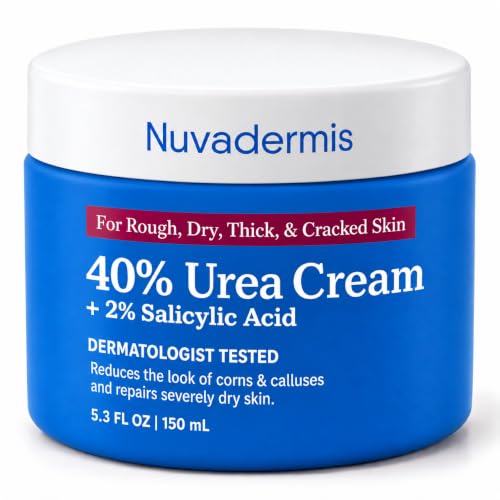
NUVADERMIS Urea Cream 40% is described for feet, hands, elbows, knees, and body, giving it broader intended coverage than the products focused primarily on foot care. Its name identifies both 40% urea and 2% salicylic acid, and the container holds 5.3 ounces. The product also mentions keratosis pilaris, but it is still a topical cosmetic cream rather than a substitute for medical advice. Its multi-area positioning may be unnecessary if you only need a foot cream.
Bottom line: Pick this if you want one formula intended for feet and several other dry-skin areas.
PurOrganica Urea Cream 40%

PurOrganica Urea Cream 40% offers a 4-ounce 40% urea cream for feet, cracked heels, calluses, hands, elbows, and knees. Its product text highlights dry and scaly skin and says it is formulated and bottled in a facility in the USA. The smaller container may be less suited to someone planning regular use across several body areas.
Bottom line: Choose this if a 4-ounce urea cream with a USA facility claim suits your intended use.
How to choose 40% urea cream for feet
Start with the active ingredients: 40% urea alone is different from a blend that also contains salicylic acid. Urea is a humectant and a keratolytic, meaning it draws water into the outer skin and helps soften thick scale; salicylic acid loosens dead skin cells. A 2% salicylic acid addition may be useful for rough buildup, but it can sting irritated or fissured skin. For skin that is merely dry, a lower-strength urea cream or a plain moisturizer may be a gentler starting point. If you have diabetes, poor circulation, or a deep heel crack, ask a clinician before using concentrated keratolytic creams on your feet.
How to use concentrated urea on heels
Apply a small amount to intact rough skin and avoid open cracks, cuts, and the spaces between toes. A practical first-use rule is to try it on a small area once daily for several days; stop if burning, redness, or worsening irritation occurs. Many foot-care routines apply moisturizer after bathing, when skin is slightly damp, and cotton socks can limit transfer to bedding. Do not use a blade or aggressive scraping to speed peeling: callus removal can injure skin, especially when sensation or circulation is reduced. If thick skin persists despite gentle care, get professional advice rather than layering multiple exfoliants.
Urea cream ingredients compared
Use the active combination to narrow the choice: products with salicylic acid add an exfoliating ingredient, while formulas without it keep the named active profile simpler. Container size is a separate factor, not a measure of strength.
| Formula type | What it adds | Consider when |
|---|---|---|
| 40% urea | Urea as the named active | You want to avoid a named salicylic acid addition |
| 40% urea + 2% salicylic acid | Urea plus an exfoliating acid | You are targeting thick rough buildup and tolerate exfoliants |
Check the package’s ingredient list and directions before applying any concentrated cream, since formulas and cautions can change.
When cracked feet need extra care
Deep, bleeding, swollen, or painful heel fissures need more than cosmetic softening; seek medical advice, particularly with diabetes, neuropathy, or circulation problems. Thickened skin often builds where footwear pressure or friction concentrates, so a wider toe box and well-fitting shoes can reduce repeated rubbing. Avoid applying urea or salicylic acid into open skin, and do not share foot files between people. For ordinary dry heels, gentle filing after a short soak and regular moisturizing are safer than trying to remove a large callus at once. Stop treatment if the skin becomes increasingly tender or inflamed.
Frequently Asked Questions
Can 40% urea cream go on open heel cracks?
No; avoid applying concentrated urea or salicylic acid to open, bleeding, or deeply fissured skin. Clean the area gently and seek medical advice if it is painful, swollen, or not closing.
How often should I apply 40% urea cream?
Start with once daily on a small patch of intact rough skin and watch for irritation over several days. Use less often or stop if burning or redness develops, and follow the product’s own directions.
Should I use socks after applying foot cream?
Cotton socks can help keep moisturizer on the heels and off bedding after application. Avoid tight or damp socks, since trapped moisture between the toes can contribute to skin problems.
Can I use salicylic acid and a foot file together?
Avoid aggressive filing while using a salicylic acid cream, since both can irritate or injure thickened skin. If filing, use gentle pressure on intact skin and stop at tenderness or redness.
Is 40% urea cream safe for people with diabetes?
People with diabetes, reduced foot sensation, or poor circulation should ask a clinician before using concentrated urea or salicylic acid on their feet. Small cuts or irritation may be harder to notice and heal.