
Cell Phone Signal Booster Sticker Options Compared

For a cell phone signal booster sticker, MOV Mobile Phone Stickers, 5-Pack is the closest match if you want five small, self-adhesive mobile-phone patches. Choose a different option if you need a larger trim-to-fit sticker, a reusable patch, or a three-piece set marketed for several device types.
We earn a commission if you buy through links on this page. As an Amazon Associate I earn from qualifying purchases. Products are compared on manufacturer specifications, not hands-on testing.
- Best overall: MOV Mobile Phone Stickers, 5-Pack – Five self-adhesive stickers are intended for mobile phones.
- Best for a three-piece set: Harper Grove Internal Antenna Booster, 3-Pack – This three-pack is marketed for phones and several other device types.
| Product | Best for | Pack count | Intended devices | Shop |
|---|---|---|---|---|
| MOV Mobile Phone Stickers, 5-Pack | Mobile phone use | 5 | Mobile phones | Check Price on Amazon |
| PUSOKEI Enhancement Stickers, 5-Pack | Phone and radio use | 5 | Phones, two-way radios, buzzers | Check Price on Amazon |
| ASHATA Cell Phone Booster Stickers, 5-Pack | Phone and cordless devices | 5 | Phones, walkie-talkies, buzzers | Check Price on Amazon |
| Harper Grove Internal Antenna Booster, 3-Pack | Multi-device compatibility | 3 | Phones, tablets, radios, pagers | Check Price on Amazon |
Cell Phone Signal Booster Stickers
Compare the pack formats and intended device uses before choosing a sticker.
MOV Mobile Phone Stickers, 5-Pack

MOV Mobile Phone Stickers, 5-Pack is the clearest match for a phone-focused five-piece adhesive set. Its backing is designed to stick to a phone, and the compact, lightweight construction is presented as easy to carry. The maker says the stickers are intended to improve reception in challenging places such as elevators, cars, tunnels and mountains, and to reduce static electricity. The package also names ships and buildings. The limitation is that the dimensions are supplied without units, so confirm the physical size before ordering if space behind a case or on a handset matters.
Bottom line: Choose this if you want a five-piece adhesive set expressly intended for mobile phones.
PUSOKEI Enhancement Stickers, 5-Pack

PUSOKEI Enhancement Stickers, 5-Pack distinguishes itself by naming two-way radios and buzzers alongside mobile phones, giving it a broader stated device range than a phone-only patch. The five-piece set uses a self-adhesive design and is described as small and lightweight. The maker says the stickers are intended for weak-signal situations such as elevators and climbing, and for reducing static around vehicles, buildings, tunnels and mountains.
Bottom line: Pick this when you want a five-piece set also marketed for two-way radios and buzzers.
ASHATA Cell Phone Booster Stickers, 5-Pack

ASHATA Cell Phone Booster Stickers, 5-Pack stands out for explicitly including cordless phones at home in its device range, in addition to mobile phones, walkie-talkies and buzzers. The five stickers use a peel-and-stick backing and are described as small and lightweight. The maker claims improved reception for difficult settings including elevators, tunnels and mountains. Because the set provides no measurements, buyers needing to place a patch under a fitted case should check the physical size first. Its broad device claims make it a phone-compatible option, but do not establish compatibility with every handset or accessory.
Bottom line: Choose this for a five-piece phone set that also names cordless phones and radios.
Harper Grove Internal Antenna Booster, 3-Pack
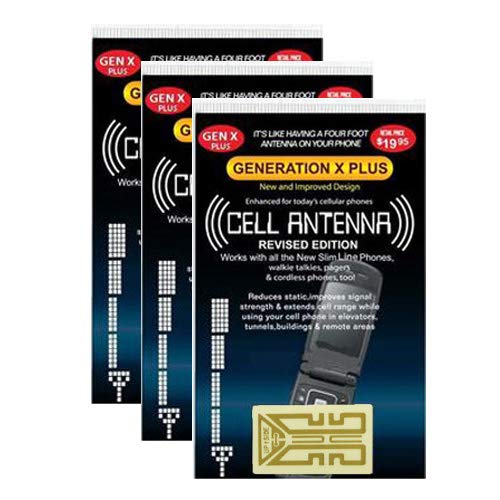
Harper Grove Internal Antenna Booster, 3-Pack differs from the five-piece adhesive patches with a three-piece set described as an internal antenna signal reception booster. It names Android, Apple, BlackBerry, LG, Microsoft, Motorola and ZTE devices, as well as tablets, walkie-talkies and pagers. The maker says installation is easy and claims the product can improve signal strength, reduce static and dropped calls, and strengthen cell range. The maker identifies the color as gold but do not describe the attachment method; that matters if you need a surface-mounted sticker rather than an internal component, so verify the installation style before choosing.
Bottom line: Pick this when the range of phone brands and other device types is the priority.
How to choose a cell phone signal booster sticker
Start with the sticker’s format and dimensions, not its signal claim. Small adhesive patches are intended for placement on a phone, while a 4.2-by-2.4-inch sheet gives more area and can be trimmed; larger pieces are easier to shape but may not fit beneath a tight case. Count also matters: the options here range from three to six pieces. Confirm the attachment style if the sticker will sit inside a case, since adhesive placement and an internal antenna part are not interchangeable. A sticker cannot substitute for a powered cellular repeater: a repeater uses an outside antenna, an amplifier and an indoor antenna to rebroadcast a carrier signal, while a passive sticker has no powered amplifier.
Where phone stickers fit among signal solutions
A phone sticker is a small accessory, not a complete building-coverage system. Cell reception depends on the carrier band, distance from a cell site, building materials and obstacles such as concrete or metal; changing rooms or moving near a window can help identify whether location is the issue. For coverage across a home or vehicle, powered boosters use an outside antenna and indoor antenna and must be compatible with the carrier bands in use. Check that any powered booster is authorized for the networks and bands it will amplify, and install it according to its manufacturer’s guidance to avoid interference. For a weak signal affecting only one phone, first compare coverage in another location and check that phone’s carrier and network settings.
Sticker placement and phone fit
Place an adhesive accessory only where it does not block the camera, buttons, charging port, microphone or speaker. Phone antennas are built into different frame locations, so there is no universal sticker position that suits every model. A phone case adds another variable: a patch attached to the outside may be easier to reposition, while a thick or metal case can affect radio reception independently. If choosing a trim-to-fit sheet, cut only the portion needed and keep edges clear of openings. Avoid covering a phone’s antenna bands or seams with metal-backed material; conductive coverings can interfere with wireless signals rather than improve them.
Signal booster sticker claims and realistic expectations
Adhesive patches do not have the powered components used by cellular repeaters, so treat claims of improved signal as maker claims rather than a guaranteed result. Reception bars are not a precise measure of data speed or call quality, and performance can change with network congestion, signal band and the phone’s position. A simple comparison is to check the same handset, carrier and location before and after applying a patch, then repeat in more than one spot; keep other conditions as similar as possible. If calls remain unreliable indoors or across several devices, investigate carrier coverage or a properly matched powered booster instead of relying on a passive sticker.
Frequently Asked Questions
Do cell phone signal booster stickers actually work?
Adhesive stickers do not contain the powered amplifier used in a cellular repeater, so their advertised reception improvements are not guaranteed. Signal can change with the carrier, phone position, building materials and network congestion.
Where should I put a sticker on my phone?
Keep a sticker clear of the camera, ports, speakers and buttons, and avoid metal-backed coverings over antenna seams. Phone antenna locations differ by model, so compare reception in the same spot after placement rather than assuming one universal position.
Can a phone sticker improve reception inside a house?
A sticker may be marketed for indoor weak-signal areas, but it cannot rebroadcast a carrier signal like a powered repeater. Concrete, metal and distance from a cell site can weaken indoor coverage; compare reception near a window or in another room first.
What is the difference between a sticker and a cell repeater?
A repeater uses an outside antenna, an amplifier and an indoor antenna to rebroadcast cellular service. A sticker is an adhesive accessory without those powered components, so it does not provide whole-home coverage.
Can I cut a phone signal sticker to fit?
Only choose a trim-to-fit format when its material is intended to be cut; one option here measures 4.2 by 2.4 inches and is described as trimmable. Keep any cut piece clear of phone openings and avoid conductive backing over antenna areas.