
120V to 12V Power Supply Options Compared

For most 12V devices, choose ALITOVE 12V 10A Cigarette-Lighter Adapter when its 10A output and cigarette-lighter socket match the device; it accepts 100–240V AC input and provides up to 120W. Choose a different supply if your device needs a barrel connector, more current, or bare-wire/clamp connections.
A 120V-to-12V power supply converts household AC into 12V DC, but the device’s current draw, startup surge and connector determine whether a particular unit fits.
We earn a commission if you buy through links on this page. As an Amazon Associate I earn from qualifying purchases. Products are compared on manufacturer specifications, not hands-on testing.
- Best overall: ALITOVE 12V 10A Cigarette-Lighter Adapter – Its 12V, 10A output supports compatible car devices drawing up to 10A, with a cigarette-lighter socket.
- Best for barrel plugs: ALITOVE 12V 5A Barrel-Jack Adapter – It supplies 12V at up to 5A through a 5.5 × 2.5 mm jack.
- Best for clamp connections: EAGWELL 12V 50A Peak Clamp Converter – Its built-in cables and alligator clips are intended for direct 12V connections.
| Product | Best for | Output capacity | Input range | Connection | Shop |
|---|---|---|---|---|---|
| ALITOVE 12V 10A Cigarette-Lighter Adapter | Car-device socket | 12V, 10A, 120W max | 100–240V AC | Cigarette-lighter socket | Check Price on Amazon |
| ALITOVE 12V 5A Barrel-Jack Adapter | Barrel-plug device | 12V, 5A, 60W max | 100–240V AC | 5.5 × 2.5 mm barrel jack | Check Price on Amazon |
| Yaheeda 12V 50A Peak Switch Converter | Higher-current projects | 12V, 50A peak, 600W peak | AC 85–145V or 185–265V | Built-in wire | Check Price on Amazon |
| EAGWELL 12V 50A Peak Clamp Converter | Clip-on wiring | 12V, 50A peak, 600W peak | 110V AC | Built-in cables, alligator clips | Check Price on Amazon |
| IMAYCC 12V 50A Peak Switch Converter | Switched clamp setup | 12V, 50A peak, 600W peak | AC 85–145V or 185–265V | Switch, clamp wires | Check Price on Amazon |
120V to 12V power supplies
Match the DC output, input range and connection style to the device before choosing a converter.
ALITOVE 12V 10A Cigarette-Lighter Adapter
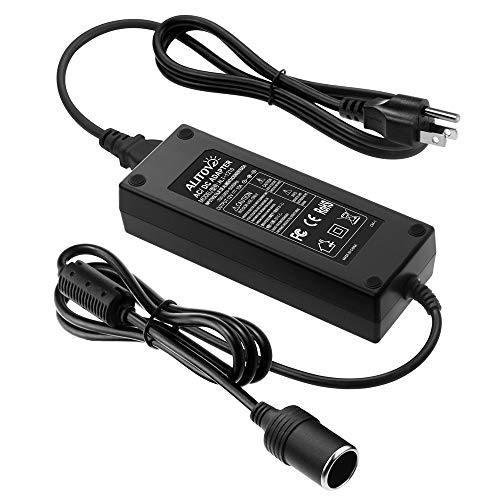
Unlike the barrel-jack and clamp-style options, this adapter powers a car device through a cigarette-lighter socket. It accepts 100–240V AC and delivers 12V DC at up to 10A (120W); its cord is 8 feet long. The maker says it includes overload, overvoltage, overtemperature and short-circuit cutoffs. It suits a compatible automotive accessory drawing no more than 10A. The maker cautions against powering loads above 120W for long periods, so this is not the choice for a higher-current device.
Bottom line: Choose it for a compatible 12V car accessory with a cigarette-lighter plug and a draw of 10A or less.
ALITOVE 12V 5A Barrel-Jack Adapter

Its 5.5 × 2.5 mm barrel-jack makes this the specific fit among these options for devices with a matching DC input. The adapter supplies 12V at up to 5A, or 60W, from 100–240V AC. The maker says the jack is compatible with 5.5 × 2.1 mm inputs and lists overload, overvoltage, thermal and short-circuit protection. It suits a 12V LED strip or other device whose draw stays at or below 5A. A barrel plug can fit physically yet have the wrong polarity, so check polarity as well as diameter before connecting.
Bottom line: Pick it for a 12V device that matches the barrel size and draws no more than 5A.
Yaheeda 12V 50A Peak Switch Converter

This converter offers a higher peak output than the compact adapters, with adjustable AC input selection for 110V or 220V mains. The maker gives example output points of 10A/120W, 20A/240W and 35A/420W, and recommends equipment below 40A/480W; 50A/600W is peak capacity, not the recommended operating target. Its built-in wire and on/off switch suit fixed projects such as pumps or LED strips. The maker also notes motors may need more than twice their rated power at startup, so a motor with a large surge may exceed its practical fit.
Bottom line: Choose it for a wired project below the maker’s 40A/480W recommendation, after accounting for startup surge.
EAGWELL 12V 50A Peak Clamp Converter

Built-in cables with alligator clips distinguish this converter from the unit with a barrel-jack or cigarette-lighter socket. The maker specifies 600W peak and 50A capacity for 12V applications and describes tool-free attachment to a compatible connection point. Its clamp setup suits a project that needs direct clip connections, such as a car stereo or LED controller. The maker explicitly says it is not for battery charging. Because the rating is a peak figure, match the device’s sustained draw to the converter’s usable output rather than treating 50A as a continuous rating.
Bottom line: Select it when clip connections fit the setup and the application is not battery charging.
IMAYCC 12V 50A Peak Switch Converter

This converter combines an on/off switch with clamp wires, which can be useful when a project needs both direct connections and a local power control. The maker specifies selectable 110V/220V AC input ranges and a 12V output with 50A/600W peak; its recommended equipment limit is below 40A/480W. It is intended for loads such as a diesel heater, car stereo or pump. For a motor, the maker advises allowing peak supply power above twice the motor’s power, so check startup demand before selecting it; a 50A peak label alone does not establish continuous capacity.
Bottom line: Choose it for a switched clamp-wire setup within the recommended load and startup limits.
How to choose a 120V to 12V power supply
Start with the device’s 12V DC requirement and maximum current, then match the supply’s output rating. At 12V, watts equal volts multiplied by amps: 5A is 60W, 10A is 120W, and 40A is 480W. A supply rated for less current than the device needs can overload; a higher current capacity does not force the device to draw that amount. For motors, pumps and inflators, startup current can exceed the running draw. A useful rule is to avoid a supply whose recommended output is below the device’s maximum or surge demand; for motor loads, the maker of some supplies recommends peak capacity above twice motor power. Check whether the input supports US household 120V AC.
Check 12V connector and wiring fit
Connector compatibility is more than a plug that fits. Barrel plugs commonly come in nearby sizes such as 5.5 × 2.1 mm and 5.5 × 2.5 mm; verify the device jack’s dimensions and DC polarity before connecting. A cigarette-lighter socket is a different interface from a barrel-jack or bare wires, so choose the supply whose output connection matches the device or its proper adapter. Clamp leads need secure contact with the intended terminals, with polarity observed. For supplies with exposed screw terminals or bare wiring, disconnect AC mains before making connections and keep live terminals inaccessible during operation. Never connect a 12V output to a device that requires a different voltage.
Understand peak output and load type
Peak power and everyday operating capacity are not interchangeable. Several high-output units here name 50A or 600W as peak, while one gives a recommended operating ceiling below 40A or 480W; use that lower recommendation for sustained equipment rather than treating the peak as continuous. Resistive loads, such as some heating elements, generally need less startup headroom than motors. As a sizing check, a resistive load may call for supply peak power at least 1.25 times its rated power, while a motor may need more than twice its rated power, according to the maker’s guidance for these units. If startup requirements are unknown, don’t assume the peak rating guarantees a successful start.
Match a supply type to the application
The output connection often narrows the choice before wattage does. Use this guide to identify which style fits your device and installation; current and startup demand still need to fit the supply rating.
| Device connection or need | Supply style | Check before use |
|---|---|---|
| Cigarette-lighter plug | Socket adapter | Device draw within the rated current |
| DC barrel input | Barrel-jack adapter | Diameter, polarity and voltage |
| Direct wired terminals | Built-in wires or clamps | Polarity, sustained draw and startup surge |
Do not treat a power supply as a battery charger unless it is specifically designed for charging; one clamp-style unit expressly excludes battery charging. For any mains-powered installation, keep connections protected from accidental contact and disconnect AC before changing wiring.
Frequently Asked Questions
Can a 12V power supply run a 12V device?
Yes, if the device uses 12V DC and the supply can provide its maximum current and startup demand. Also match connector dimensions and polarity; a plug that fits can still be wired incorrectly.
How many watts does a 12V 10A supply provide?
A 12V supply rated at 10A provides 120W, because watts equal volts multiplied by amps. Keep the device’s sustained draw within the supply’s rating and allow extra capacity for motor startup.
Can a 120V power supply work on 220V?
Only if the input range explicitly includes 220V AC. A supply labeled for 100–240V accepts it, while a unit labeled only for 110V input may not.
What size power supply does a 12V pump need?
Use the pump’s maximum current or wattage and account for motor startup, which can exceed running demand. For a motor, a common sizing rule is supply peak power greater than twice the motor’s rated power; confirm the pump’s surge requirement if available.
Does a higher-amp 12V supply damage a device?
A correctly regulated 12V supply with a higher current capacity does not push all available amps into a device; the device draws what it needs. The voltage and polarity must still match, and wiring must handle the load.