
Best Engine Block Sealer: 5 Formulas Compared

K&W Block Seal Permanent Metallic, 16 oz is the best engine block sealer for most buyers because it specifically targets cracks and holes in cast-iron and aluminum blocks and covers several other cooling-system components. Choose K-Seal ST3501 Pour & Go, 16 oz instead if coolant compatibility is a priority, or Moroso Ceramic Engine Seal, 1 pint if you can thoroughly clean the system and use a sealer that must not be mixed with antifreeze.
Engine block sealers circulate through the cooling system to try to plug leaks; they are not a substitute for mechanical repair when damage is extensive.
We earn a commission if you buy through links on this page. As an Amazon Associate I earn from qualifying purchases. Products are compared on manufacturer specifications, not hands-on testing.
- Best overall: K&W Block Seal Permanent Metallic, 16 oz – Targets cast-iron and aluminum block cracks as well as head gaskets, freeze plugs, radiators and heater cores.
- Best for coolant compatibility: K-Seal ST3501 Pour & Go, 16 oz – The maker says it works with all types of coolant and seals leaks up to 0.64 mm.
- Best for a clean system: Moroso Ceramic Engine Seal, 1 pint – Works with aluminum or cast-iron blocks, but the cooling system must be clean and free of antifreeze.
- Best for head-gasket leaks: Bar’s Leaks HG-1 Head Seal – The maker says it is compatible with 50-50 mix coolant and requires no flushing.
| Product | Best for | Container size | Coolant compatibility | Leak targets | Shop |
|---|---|---|---|---|---|
| K&W Block Seal Permanent Metallic, 16 oz | Block and radiator | 16 oz | Water-cooled systems | Blocks, gaskets, plugs, radiators | Check Price on Amazon |
| Moroso Ceramic Engine Seal, 1 pint | Antifreeze-free system | 1 pint | Must not use with antifreeze | Aluminum or cast-iron blocks | Check Price on Amazon |
| K&W FiberLock Head Gasket & Block Repair, 32 fl oz | Larger leak repair | 32 fl oz | Pour-in; no drain required | Head gaskets, blocks, cracks | Check Price on Amazon |
| K-Seal ST3501 Pour & Go, 16 oz | Coolant compatibility | 16 fl oz | All coolant types | Leaks up to 0.64 mm | Check Price on Amazon |
| Bar’s Leaks HG-1 Head Seal | Head and intake gaskets | Pack of 1 | 50-50 mix coolant | Head/intake gaskets, heads, blocks | Check Price on Amazon |
Engine Block Sealers Compared
Compare the intended leak targets and coolant requirements before choosing a formula.
K&W Block Seal Permanent Metallic, 16 oz

K&W Block Seal Permanent Metallic, 16 oz covers the broadest range of cooling-system leak points among these choices, including engine blocks, head gaskets, freeze plugs, radiators and heater cores. The 16-ounce formula is intended for water-cooled diesel and gasoline vehicles, and K&W says it seals cast-iron and aluminum parts and exceeds ASTM D6107. That breadth makes it a strong match when the leak location is uncertain but appears to be in the cooling system. Its limitation is that the maker’s compatibility is for water-cooled vehicles, so it is not a fit for an air-cooled engine.
Bottom line: Choose this when you need a formula aimed at block cracks and several other cooling-system components.
Moroso Ceramic Engine Seal, 1 pint
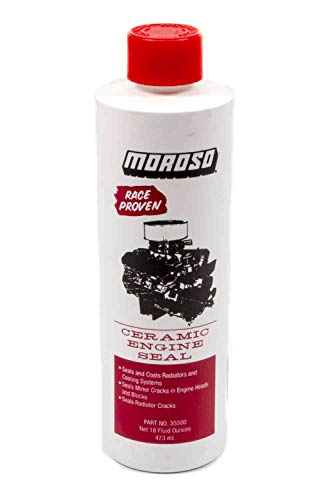
Moroso Ceramic Engine Seal, 1 pint is the clear choice for a system you can thoroughly clean and run without antifreeze during application. Moroso says the ceramic sealer works in aluminum or cast-iron blocks, but explicitly warns not to use it with antifreeze. That restriction is the key difference from formulas whose makers claim coolant compatibility. The 1-pint bottle suits buyers who can prepare the cooling system for the product rather than pour it into an antifreeze-filled system. It is a poor match if you cannot remove antifreeze or need a product compatible with the coolant already in the vehicle.
Bottom line: Choose this only if you can thoroughly clean the system and keep antifreeze out during use.
K&W FiberLock Head Gasket & Block Repair, 32 fl oz
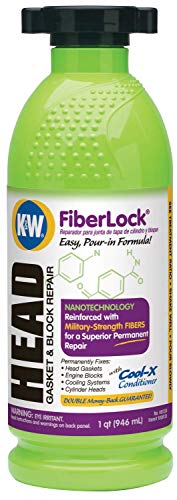
K&W FiberLock Head Gasket & Block Repair, 32 fl oz stands out for its 32-fluid-ounce pour-in treatment and its claim that it can be used without draining the cooling system. K&W says its fibers form a layered repair over cracks and that nanotechnology addresses small crevices; the maker also claims repairs in 30 minutes or less. This suits buyers looking for a larger-volume formula that specifically names head-gasket and block repair. Its claims do not identify a maximum hole size, so buyers who need a defined leak-size limit should compare it with K-Seal ST3501 Pour & Go, 16 oz, which gives one.
Bottom line: Choose this for a larger-volume pour-in formula that names both head-gasket and block repair.
K-Seal ST3501 Pour & Go, 16 oz

K-Seal ST3501 Pour & Go, 16 oz gives buyers a specific leak-size limit: K-Seal says its ceramic micro-fiber formula seals holes up to 0.64 mm. The maker also claims compatibility with all types of coolant and a range of engine materials, making this the clearest option here for someone prioritizing coolant compatibility. It is intended for head gaskets, cracked heads and porous engine blocks, with a one-step application. The maximum is 0.64 mm, so a leak larger than that falls outside the maker’s claim; a persistent or worsening leak needs diagnosis beyond a sealer.
Bottom line: Choose this when coolant compatibility and a maximum leak size matter most.
Bar’s Leaks HG-1 Head Seal

Bar’s Leaks HG-1 Head Seal is aimed particularly at blown head and intake gasket leaks, while also naming warped or cracked heads and blocks. Bar’s Leaks says it works with all types of 50-50 mix coolant, requires no flushing, and may suit a vehicle that can idle for 15 minutes without overheating or needing added coolant. That idle condition is a useful screening rule for buyers considering the product. The maker’s guidance makes it a weaker fit for a vehicle that cannot meet that condition; ongoing overheating calls for diagnosis rather than relying on a sealer.
Bottom line: Choose this for head- or intake-gasket leaks if the vehicle meets the maker’s 15-minute idle condition.
How to Choose an Engine Block Sealer
Start with the leak location and coolant requirement: a block-specific formula is different from a product aimed mainly at head gaskets. Check whether the sealer can be used with the coolant currently in the vehicle; Moroso Ceramic Engine Seal, 1 pint specifically must not be used with antifreeze, while K-Seal ST3501 Pour & Go, 16 oz and Bar’s Leaks HG-1 Head Seal claim compatibility with coolant. A maximum leak size also helps set expectations: K-Seal ST3501 Pour & Go, 16 oz gives a limit of 0.64 mm. A sealer is a temporary repair approach, not a replacement for fixing a cracked block or failed gasket when damage is extensive. If the engine overheats rapidly or loses coolant faster than it can safely be monitored, stop running it and seek mechanical diagnosis rather than relying on a pour-in product.
Coolant Compatibility and Preparation
Read the coolant restriction before pouring in any sealer, because products can have opposite preparation requirements. Moroso Ceramic Engine Seal, 1 pint requires a thoroughly clean system and must not be used with antifreeze; Bar’s Leaks HG-1 Head Seal claims compatibility with 50-50 mix coolant and no flushing requirement. Mixing incompatible fluids can undermine the intended repair, so do not assume one product’s process applies to another. Cooling systems are pressurized when hot, and opening a radiator cap can release scalding coolant or steam. Let the engine cool completely before opening the system, and never remove a hot pressure cap. Keep coolant away from children and pets, and clean spills promptly because ethylene-glycol coolant can be toxic.
What a Cooling-System Sealer Can and Cannot Do
A cooling-system sealer circulates with coolant and is intended to plug certain leak paths; it does not restore a broken component’s original structure. Formulas may use fibers, ceramic particles or other materials, and the specifications here identify those ingredients only for K&W FiberLock Head Gasket & Block Repair, 32 fl oz and K-Seal ST3501 Pour & Go, 16 oz. A sealant can also restrict narrow passages if it accumulates, so treat heater output or circulation changes after use as reasons to stop and investigate. The most useful decision rule is to match the named repair target: choose a block-focused formula for block cracks, and a product naming head or intake gaskets for those suspected failures. Do not use a leak sealer to dismiss repeated overheating, which can cause further engine damage.
When to Stop and Get a Mechanical Diagnosis
Persistent overheating, repeated coolant loss or visible bubbles at the reservoir can signal a larger fault than a sealer can address. K-Seal ST3501 Pour & Go, 16 oz specifically warns that bubbles or failure to seal may indicate an over-pressurized system; do not keep driving an overheating vehicle to see whether the product eventually works. A cooling-system pressure test can help locate external leaks, while a combustion-gas test can help identify exhaust gases entering coolant. These tests distinguish a hose, radiator or cap problem from a possible internal engine leak. If the engine cannot idle without overheating, do not treat Bar’s Leaks HG-1 Head Seal’s stated 15-minute candidate condition as satisfied; arrange diagnosis before further operation.
Frequently Asked Questions
Can engine block sealer work with antifreeze?
Some formulas claim coolant compatibility, but Moroso Ceramic Engine Seal, 1 pint explicitly must not be used with antifreeze. K-Seal ST3501 Pour & Go, 16 oz claims compatibility with all coolant types, and Bar’s Leaks HG-1 Head Seal claims compatibility with 50-50 mix coolant.
How large a crack can engine sealer close?
The only product here with a limit is K-Seal ST3501 Pour & Go, 16 oz, whose maker says it seals leaks up to 0.64 mm. A larger crack or structural failure should be mechanically assessed rather than assumed repairable with sealer.
Should I open a radiator cap before adding sealer?
Only when the engine is completely cool. A hot cooling system is pressurized and can release scalding coolant or steam when its cap is opened.
Can a cooling system sealer clog the heater core?
Sealant can accumulate in narrow coolant passages, including the heater core, so a change in heater output or coolant circulation warrants stopping and investigating. Do not add multiple sealers or repeat treatment without diagnosing why the leak continues.
When should I stop driving with a coolant leak?
Stop driving if the temperature rises above its normal range or coolant loss prevents safe monitoring. Continuing to run an overheating engine can cause more damage; arrange a diagnosis instead.