
Japanese Deep Frying Pots: 5 Models Compared by Fit

For most cooks, 11-Inch 4.6-Quart Deep Fryer Pot is the clearest fit because its 4.6-quart capacity is paired with a built-in Fahrenheit thermometer and removable drain rack. Choose a smaller pot if counter or storage space is your priority, or a model with a lid if that feature matters to your setup.
A Japanese deep frying pot is a stovetop vessel for frying foods such as tempura, typically with a thermometer and rack to monitor oil and drain fried food.
We earn a commission if you buy through links on this page. As an Amazon Associate I earn from qualifying purchases. Products are compared on manufacturer specifications, not hands-on testing.
- Best overall: 11-Inch 4.6-Quart Deep Fryer Pot – Its 4.6-quart capacity, built-in Fahrenheit thermometer, and removable drain rack suit larger batches.
- Best for cooktop flexibility: cuomaop 304 Stainless Steel Frying Pot – It is described as compatible with gas, electric, and induction cooktops.
- Best for a lid: Saltlas 11-Inch 4.4-Quart Tempura Pot – It includes a domed lid alongside a Fahrenheit thermometer and detachable rack.
| Product | Best for | Capacity | Diameter | Thermometer | Shop |
|---|---|---|---|---|---|
| 11-Inch 4.6-Quart Deep Fryer Pot | larger batches | 4.36 qt | 11 in | Built-in, °F | Check Price on Amazon |
| Saltlas 11-Inch 4.4-Quart Tempura Pot | covered frying | 4.16 qt | 11 in | Built-in, °F | Check Price on Amazon |
| 4.2-Liter Tempura Fryer Pot | oil management | 4.44 qt | — | — | Check Price on Amazon |
| cuomaop 304 Stainless Steel Frying Pot | cooktop flexibility | — | 9.4 in | Temperature gauge | Check Price on Amazon |
| 9.5-Inch Japanese Tempura Frying Pot | compact tempura | — | 9.5 in | Up to 200°C | Check Price on Amazon |
Japanese Deep Frying Pots Compared
Compare each pot’s capacity, thermometer, and included oil-draining features to match your batch size and cooking setup.
11-Inch 4.6-Quart Deep Fryer Pot

With the largest capacity among these pots, this 11-inch model holds 4.36 quarts and is described as suitable for serving five to six people. It has a built-in Fahrenheit thermometer, removable oil-drain rack, insulated handle, and V-shaped spout for pouring. The maker also identifies it as dishwasher safe. This is a practical match for cooks making several servings at once; cooks with limited storage space may prefer a smaller-diameter pot.
Bottom line: Pick this for larger batches and a built-in Fahrenheit temperature reading.
Saltlas 11-Inch 4.4-Quart Tempura Pot

The included domed lid sets this pot apart from the other options, while its 4.16-quart capacity is close to the 4.36-quart model. It is made from 304 stainless steel and comes with an insulated handle, detachable oil-drip rack, V-shaped pouring mouth, and Fahrenheit thermometer. The capacity is intended for a family of four to six. Choose it when a lid is useful in your cooking setup; its 11-inch diameter still calls for storage space similar to other large pots.
Bottom line: Choose this when a domed lid and Fahrenheit thermometer are priorities.
4.2-Liter Tempura Fryer Pot

This 4.44-quart pot emphasizes oil handling with an oil-drain rack, bird’s-beak oil guide, and a splash-proof lid described with a 45-degree inward tilt. The maker says its 304 stainless steel construction works on gas and induction cookers. Its capacity is close to the 4.16-quart model. This option suits cooks who want the specific lid and pouring features; thermometer type is not given in the product name.
Bottom line: Pick this for the described splash-control lid and oil guide.
cuomaop 304 Stainless Steel Frying Pot
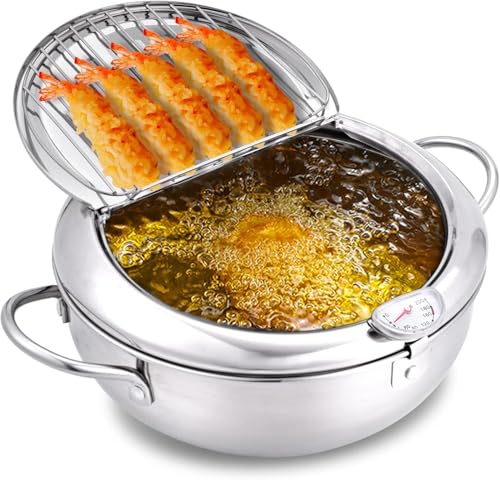
Cooktop flexibility is the main distinction here: the maker describes this pot as compatible with gas, electric, and induction cooking. It is made from 304 stainless steel and includes a temperature gauge, oil drain, and lid according to its name. The diameter is 9.4 inches, smaller than the 11-inch options, making it a reasonable choice when a more compact pot is preferable. The product name gives no capacity, so compare the 9.4-inch size with your typical batch needs before deciding.
Bottom line: Choose this for the gas, electric, and induction compatibility.
9.5-Inch Japanese Tempura Frying Pot

This 9.5-inch pot includes a removable cover, independent thermometer, and removable oil-filter rack, making its included parts distinct from the larger-capacity options. It is made from food-grade 304 stainless steel, and its thermometer measures up to 200°C. The maker says it works with induction and gas cookers.
Bottom line: Pick this for a compact pot with a separate thermometer and removable cover.
How to Choose a Japanese Deep Frying Pot
Choose by batch size, cooktop, and the temperature-reading setup you prefer. Home deep-frying commonly uses oil in the 325°F to 375°F range: lower temperatures suit many dense foods, while lighter items often cook at the higher end. A thermometer helps you track heat as cold food lowers the oil temperature. For tempura or other foods cooked in batches, a drain rack gives fried pieces a place to shed surface oil between batches. Compare stated pot capacity with the amount you cook at once, and leave enough headroom for bubbling oil rather than filling the vessel to its rim.
Cooktop compatibility is a separate decision from material. A stainless steel pot is not automatically suitable for induction; confirm induction compatibility when that is your cooktop. For a smaller footprint, the 9.4- and 9.5-inch models are narrower than the 11-inch options, though diameter alone does not establish capacity.
Oil Temperature and Safe Frying
Keep frying oil between 325°F and 375°F for common home-frying tasks, adjusting for the food and recipe. Oil that is too cool can leave food greasy, while oil overheated past its smoke point can smoke and ignite. Heat oil gradually, monitor it with the pot’s thermometer, and lower food gently in small batches so hot oil does not surge over the rim.
Never add wet food or water to hot oil; pat ingredients dry and use long-handled tools. Keep the pot stable on a burner, avoid leaving hot oil unattended, and have a fitted lid or appropriate kitchen fire extinguisher accessible. Never pour water onto a grease fire. Do not carry a pot full of hot oil, and let oil cool completely before handling or straining it.
Pot Size, Capacity, and Batch Fit
Capacity and diameter answer different questions: quarts or liters indicate volume, while inches describe width. Among these choices, the capacities range from 4.2 liters to 4.6 quarts, and the diameters range from 9.4 to 11 inches. A wider pot can offer more cooking surface, but the ingredient amount and oil depth still limit each batch.
Use a simple fit rule: choose an 11-inch model if your burner and storage space can accommodate that width and you regularly fry larger portions; consider a 9.4- or 9.5-inch pot for a narrower footprint. Do not infer capacity from diameter alone. If the amount you plan to fry matters, confirm the usable volume before ordering, particularly for a model without a capacity.
Thermometers, Racks, and Lids Compared
Thermometers, draining racks, and lids serve different roles, so prioritize the one that solves your cooking problem. A thermometer tracks oil heat; a rack drains food after frying; a lid can help cover the pot during handling or storage, but it should not be used to trap steam over active frying. Check that the thermometer scale is readable for your preferred recipes, especially if it uses Celsius rather than Fahrenheit.
The table compares the functions that distinguish these pots. Always follow safe stovetop practice, and keep the pot uncovered while actively frying unless the recipe specifically calls for otherwise.
| Feature need | What to compare | Why it matters |
|---|---|---|
| Oil heat monitoring | Built-in or separate thermometer; scale and range | Helps maintain a suitable frying temperature |
| Draining fried food | Removable rack or drain feature | Lets excess oil drip away after cooking |
| Cooktop fit | Gas, electric, or induction compatibility | Material alone does not establish induction use |
Frequently Asked Questions
What temperature should oil reach for tempura?
Tempura is commonly fried in oil around 340°F to 360°F. Use a thermometer and adjust if the recipe or ingredients call for a different temperature.
How much oil should go in a frying pot?
Keep oil below halfway up the pot as a cautious home-frying rule, leaving room for bubbling food. Never exceed the pot maker’s fill guidance.
Can stainless steel pots work on induction stoves?
Some stainless steel pots work on induction, but stainless steel alone does not guarantee compatibility. Check for an induction-compatible designation before use on that cooktop.
Why does frying oil temperature drop?
Adding food cools the oil, especially when a batch is large or wet. Fry smaller, dried batches and allow the oil to return to the target range between additions.
Can I reuse oil after frying tempura?
Oil can often be reused if it has not smoked, scorched, or developed an off odor. Let it cool fully, strain out crumbs, and store it sealed away from heat and light.