
RV Tank Heating Pads: 4 Options Compared by Power

For the named RV tank heating pads, RV Tank Heater Pad 12V/13.5V, 3-Pack is the closest match if you need a 12V/13.5V three-pad set; the other options use 120V power. Choose a 120V model instead if your installation has a suitable AC supply, and match pad quantity to the tanks you need to cover.
These electric pads attach to a holding tank and warm it to reduce freezing risk. Tank shape, mounting surface, power availability and whether the tank is empty all affect the right choice.
We earn a commission if you buy through links on this page. As an Amazon Associate I earn from qualifying purchases. Products are compared on manufacturer specifications, not hands-on testing.
- Best overall: RV Tank Heater Pad 12V/13.5V, 3-Pack – The only set described as operating at 12V/13.5V, with three 12-by-18-inch pads and automatic thermostat control.
- Best for thermostat control: Kohree 120V RV Tank Heater Pad, 2-Pack – Its 120V pads automatically switch on at 41°F and off at 59°F, with a separate high-temperature cutoff.
- Best for multi-tank coverage: Datanly 120V RV Tank Heating Pad, 6-Pack – The set includes six 120V pads plus two rolls of underbelly tape.
| Product | Best for | Power | Pad count | Thermostat/control | Shop |
|---|---|---|---|---|---|
| RV Tank Heater Pad 12V/13.5V, 3-Pack | 12V installations | 12V/13.5V | 3 pads | 45°F on; 68°F off | Check Price on Amazon |
| Kohree 120V RV Tank Heater Pad, 2-Pack | Controlled 120V heating | 120V | 2 pads | 41°F on; 59°F off | Check Price on Amazon |
| H&G Lifestyles 120V RV Tank Heater, 2-Pack | Long cord reach | 120V, 45W | 2 pads | Constant-temperature plate | Check Price on Amazon |
| Datanly 120V RV Tank Heating Pad, 6-Pack | Six-pad coverage | 120V, 60W | 6 pads | — | Check Price on Amazon |
RV Tank Heating Pads Compared
Compare electrical supply, quantity and control behavior before choosing pads for your holding tanks.
RV Tank Heater Pad 12V/13.5V, 3-Pack

RV Tank Heater Pad 12V/13.5V, 3-Pack is the only option here described for 12V/13.5V power, making it the relevant choice when the installation is built around a 12-volt supply rather than standard 120V AC. The set contains three 12-by-18-inch pads, and the maker says its thermostat switches on at about 45°F and off at about 68°F, each with a 5-degree tolerance.
It is intended for fresh, gray or black water tanks up to 50 gallons. Confirm the available voltage and that each pad fits a flat tank surface; this set is a poor fit where only 120V AC is available.
Bottom line: Choose this set when a 12V/13.5V supply and three-pad coverage match the installation.
Kohree 120V RV Tank Heater Pad, 2-Pack

Kohree 120V RV Tank Heater Pad, 2-Pack stands out for its thermostat thresholds and an additional internal temperature cutoff: the maker says the pads switch on at 41°F, switch off at 59°F, and cut power if internal temperature exceeds 158°F. Its two 12-by-18-inch pads are designed for tanks up to 50 gallons, so it suits an AC-powered installation needing a narrower operating range than the 45°F/68°F control on RV Tank Heater Pad 12V/13.5V, 3-Pack.
The limitation is its 120V supply, which requires compatible AC power at the installation. The product name gives the pad dimensions, but the separate dimensions in the fields conflict, so confirm the physical size before ordering.
Bottom line: Pick this when 120V power and its 41°F-to-59°F thermostat range suit your setup.
H&G Lifestyles 120V RV Tank Heater, 2-Pack

The two pads measure 12 by 18 inches and are intended for tanks up to 50 gallons. The maker says the pads maintain tank water above freezing at ambient temperatures as low as -20°F.
Unlike RV Tank Heater Pad 12V/13.5V, 3-Pack and Kohree 120V RV Tank Heater Pad, 2-Pack, its features describe constant-temperature heating rather than thermostat on/off thresholds. That makes it a less direct fit for someone who specifically wants a published switching range; unplug it when the tank is empty or ambient temperature is above 40°F, as the maker advises.
Bottom line: Choose this if a 10-foot cord and constant-temperature heating fit the installation.
Datanly 120V RV Tank Heating Pad, 6-Pack
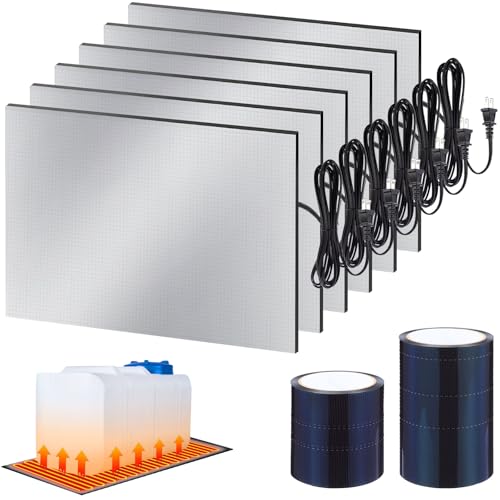
Datanly 120V RV Tank Heating Pad, 6-Pack provides the largest quantity in this group: six 12-by-18-inch pads, two rolls of underbelly tape, and 60W output. That combination is aimed at installations needing several pads or tape for related underbody work, rather than a small one- or two-tank setup. The pads use 5 mm flame-retardant material, heating wire and a waterproof aluminum-foil outer layer.
The maker says to unplug a pad when its tank is empty to avoid dry heating. The features do not describe automatic thermostat control, so this set is not the right choice if you need automatic temperature switching; plan how each pad will be safely powered and controlled.
Bottom line: Choose this for a multi-pad project that benefits from the included tape.
How to choose RV tank heating pads
Start with voltage, tank coverage and control type: a pad cannot be used on a supply it was not designed for. These choices span 12V/13.5V and 120V, while pad counts range from two to six. Tank capacity alone does not establish fit; tank footprint and available flat mounting area matter because these pads are 12 by 18 inches.
Heating capacity is also affected by insulation, wind exposure, ambient temperature and how much water is in the tank. For colder, exposed underbodies, insulation around the tank can reduce heat loss, but do not cover a pad in a way that conflicts with its installation requirements. Compare the thermostat thresholds where available, and do not treat a pad as a substitute for winterizing plumbing that remains exposed.
Voltage and thermostat control
Choose 12V/13.5V only for a compatible low-voltage circuit; choose a 120V pad only where an appropriate AC source and protected wiring are available. The control behavior differs: one option specifies on/off thresholds of 45°F and 68°F, another gives 41°F and 59°F plus a high-temperature cutoff, and the other 120V pads describe constant heating or omit thermostat behavior.
Tank heater pads draw electrical power continuously while energized, so estimate the circuit load from the product’s wattage and supply voltage, then allow headroom rather than combining loads blindly. A 45W load at 120V is about 0.38 amps; a 60W load at 120V is 0.5 amps. Keep connections protected from water and follow applicable RV electrical safety practices.
Pad fit, mounting and tank coverage
A 12-by-18-inch pad needs a suitably flat, clean surface on the tank, not merely a tank with a matching gallon capacity. Measure the available surface before installation and check for ribs, seams, drain fittings and clearance from moving parts; less than 12 by 18 inches of uninterrupted area means that pad may not fit as intended.
Heating pads are typically mounted directly to the tank surface, while underbody insulation helps limit heat loss from wind. Adhesive compatibility, tank material and surface preparation affect attachment, so verify those points before installation. Do not install a heating pad on an empty tank: dry operation can overheat the pad or tank, and one maker explicitly warns to unplug when empty.
Winter use and freeze protection limits
A tank pad warms the tank surface; it does not automatically protect every valve, pipe, pump or exposed water line. RV plumbing can freeze at temperatures around 32°F, and wind exposure or stagnant water can make vulnerable fittings freeze sooner than a sheltered tank. Protect exposed lines separately and maintain power during cold conditions.
Use this decision rule: if the tank will be empty, disconnect its pad; if the RV lacks a compatible continuous power source, do not rely on an energized pad for freeze protection. A maker’s operating temperature is not a guarantee that an entire RV water system remains unfrozen. Know how to drain and winterize the system before temperatures fall below freezing.
Frequently Asked Questions
Can RV tank heating pads run on a 12-volt battery?
Only a pad designed for 12V/13.5V should connect to a compatible 12-volt system. The 120V options require an appropriate AC supply, and a battery inverter must be sized for the load and runtime.
How many tank heater pads does one RV need?
Count the tanks that need protection and measure each tank’s usable flat area; the pads here are 12 by 18 inches. A multi-tank RV may need multiple pads, but do not exceed the product’s tank capacity or power-circuit limits.
Should a tank heater pad stay on when empty?
No; disconnect it when the tank is empty. Heating without water can cause dry operation and overheating, and the maker of one option specifically warns against it.
Do holding tank pads protect RV water lines too?
No, a tank pad warms the tank surface and does not establish that nearby pipes, valves or pumps are protected. Insulate or heat exposed plumbing separately, since water can freeze near 32°F and fittings exposed to wind may be more vulnerable.
Where should a tank heating pad be installed?
Mount it on an appropriate flat area of the tank after checking that a full 12-by-18-inch surface is available. Avoid seams, fittings and surfaces that compromise attachment, and verify compatibility with the tank material before installation.