
General’s Pastel Chalk Pencils: 3 Sets Compared

General’s MultiPastel 12-Color Set is the best starting point for most artists who want a range of colors, since its set includes 12 shades and cedar barrels. Choose General’s G4401 24-Color Set or General’s Multi-Pastel 24-Color Kit if you want 24 pencils instead; General’s Multi-Pastel 24-Color Kit also includes a sharpener, storage container, and project booklet.
Pastel chalk pencils put a chalk-based color core inside a pencil, making them useful for controlled lines and small areas. For white-only marks, a white pencil set is a better fit than these assorted-color sets.
We earn a commission if you buy through links on this page. As an Amazon Associate I earn from qualifying purchases. Products are compared on manufacturer specifications, not hands-on testing.
- Best overall: General’s MultiPastel 12-Color Set – Its 12-color set offers a useful range and cedar barrels.
- Best for 24 colors: General’s G4401 24-Color Set – The set contains 24 assorted pastel chalk pencils.
- Best for kit extras: General’s Multi-Pastel 24-Color Kit – The 24-pencil set includes a sharpener, reusable container, and project booklet.
| Product | Best for | Pencil count | Color range | Shop |
|---|---|---|---|---|
| General’s MultiPastel 12-Color Set | Everyday color range | 12 | Multicolor | Check Price on Amazon |
| General’s G4401 24-Color Set | More color choices | 24 | Assorted | Check Price on Amazon |
| General’s Multi-Pastel 24-Color Kit | Tools and projects | 24 | Assorted colors | Check Price on Amazon |
General’s pastel chalk pencils
Compare the exact-fit sets by color count and what comes with each one.
General’s MultiPastel 12-Color Set
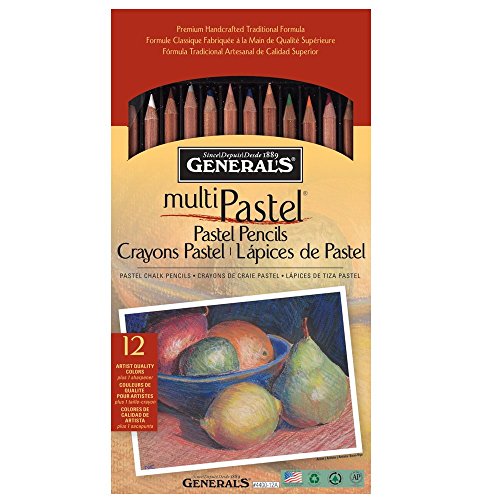
For a smaller assorted set, this 12-color option combines a broad enough palette for blending and shading with cedar wood barrels. The pencils are pre-sharpened, and the maker says the acid-free, oil-free cores are suitable for paper and mixed media. That makes the set a practical match for artists who want ready-to-use pencils without moving straight to 24 colors. The main tradeoff is the smaller palette: projects needing many distinct hues may call for a larger set.
Bottom line: Choose this set for a ready-to-use selection of 12 colors.
General’s G4401 24-Color Set

This 24-pencil set doubles the color count of the 12-color option, so it suits artists who want more hues available without relying as much on mixing. It contains assorted colors and focuses on the pencils themselves, rather than add-on tools or project materials. A larger palette can help when drawing layered subjects with several distinct color areas. The limitation is that the set information does not establish any extra tools, so buyers who want a sharpener or storage container should consider a kit that explicitly includes them.
Bottom line: Pick this set when having 24 assorted colors matters most.
General’s Multi-Pastel 24-Color Kit

This 24-pencil option stands apart by adding a sharpener, reusable storage container, and project booklet. The pencils are intended for fine lines on chalk drawings, and the set carries PMA certification. It fits artists who want a larger assortment with basic project and storage extras together. The included sharpener is a useful convenience, but the set’s extra materials do not make it a different core type; choose it for the bundled accessories rather than expecting a different drawing medium.
Bottom line: Choose this kit if the sharpener, container, and booklet are useful to you.
How to choose pastel chalk pencils
Choose by palette size first, then by whether you need tools or project materials. A 12-color set leaves fewer distinct hues on hand, while a 24-color set provides more options before blending. Pastel pencil marks are made by pigment deposited from a chalk-like core, and paper tooth—the small surface texture—helps hold that pigment. Smooth paper can make color application less effective, so test the surface before committing to a finished drawing.
For fine details, keep the point sharp and use light pressure; heavy pressure can flatten the tip and make narrow lines harder to control. If you expect to work across several hues, choose a set with enough colors to reduce repeated mixing. Pick a kit with a sharpener or storage container when those extras will be used, rather than treating them as a substitute for paper suited to dry media.
Paper and surface fit for pastel pencils
Pastel pencils work best on paper with a visible tooth or a surface made for dry media. Textured pastel paper, drawing paper, and toned paper are common choices; the paper’s texture affects how much pigment it can hold and how smoothly marks blend. Very smooth paper may limit layering, while overly rough paper can make tiny details more difficult.
Test a few light strokes in a corner or on a scrap of the same paper before starting a final piece. Pastel pigment can transfer or smudge, so keep a clean sheet beneath the drawing hand and avoid rubbing finished areas accidentally. A fixative can change a pastel drawing’s appearance or color, so test it on a sample before applying it to finished artwork.
Blending, sharpening, and storage
Blend pastel pencil marks gently with a blending stump, soft cloth, or fingertip, building color in light layers rather than pressing hard at the start. Layering preserves room for later colors and reduces the risk of flattening the paper’s texture. A sharp point helps with outlines and small features, while a slightly blunter point covers broader areas more quickly.
Sharpen pastel pencils carefully because their cores can be softer and more fragile than ordinary graphite. Turn the sharpener gently and avoid forcing a broken or jammed pencil. Store pencils in a container or case so the cores do not knock against one another; keep dust away from food and wash hands after handling art materials.
Pastel pencil choices by need
Match the set to how many colors you expect to use and whether bundled accessories matter. A larger assortment can reduce the need to mix every shade, while a smaller assortment can be easier to manage for limited palettes. The table compares the exact-fit options by their contents.
| Need | Set choice | Reason |
|---|---|---|
| 12 ready-to-use colors | General’s MultiPastel 12-Color Set | Pre-sharpened 12-color set with cedar barrels |
| 24 assorted colors | General’s G4401 24-Color Set | 24 pencils in an assorted palette |
| 24 colors plus extras | General’s Multi-Pastel 24-Color Kit | Includes a sharpener, container, and booklet |
When the drawing is primarily fine line work, a sharp point and controlled pressure matter more than having extra accessories. For broader colored areas or subjects with many hues, a wider palette may be more convenient. Keep the finished work protected from rubbing, since loose pastel pigment can smudge.
Frequently Asked Questions
What paper works best with pastel chalk pencils?
Textured paper or paper made for pastel and other dry media usually gives the pigment more tooth to grip. Smooth paper can limit layering, so test a few strokes before using it for a finished drawing.
Can pastel chalk pencils be blended?
Yes, pastel pencil marks can be blended with light pressure using a blending stump, soft cloth, or fingertip. Build color in thin layers so the paper texture remains available for additional pigment.
How should I sharpen pastel chalk pencils?
Use a sharpener gently, turning the pencil rather than forcing it against the blade. Softer cores can break under pressure, and a sharp point is most useful for narrow lines and small details.
Does fixative change pastel pencil drawings?
Fixative can affect a pastel drawing’s appearance or color. Test it on a sample made with the same paper and pencils before applying it to finished work.
How can I keep pastel pencil marks from smudging?
Keep your hand from rubbing over finished areas and place a clean sheet beneath it while drawing. Store pencils so their cores do not knock together, and protect completed work from friction.