
Copperhead Pocket Hose: 5 Expandable Hoses Compared

Pocket Hose 75 FT Copper Head is the closest match for Copper Head buyers who want a 75-foot expandable hose with a 10-pattern thumb-control nozzle. Choose a different option if you need a shorter hose or a 100-foot reach; the other choices range from 25 to 100 feet.
We earn a commission if you buy through links on this page. As an Amazon Associate I earn from qualifying purchases. Products are compared on manufacturer specifications, not hands-on testing.
- Best overall: Pocket Hose 75 FT Copper Head – It is the Copper Head model and combines a 75-foot length with a 10-pattern nozzle.
- Best for 100-foot reach: Pocket Hose Ballistic Double UV 100 FT – Its expandable length is 100 feet, the longest among these options.
- Best for short runs: Pocket Hose Copper Bullet 25 FT – Its 25-foot length suits watering areas close to the faucet.
| Product | Best for | Length | Nozzle | Shop |
|---|---|---|---|---|
| Pocket Hose 75 FT Copper Head | Longer garden runs | 75 ft | 10-pattern thumb-control | Check Price on Amazon |
| Pocket Hose Ballistic Double UV 100 FT | Longest reach | 100 ft | — | Check Price on Amazon |
| Pocket Hose Ballistic 50 FT | Compact storage | 50 ft | — | Check Price on Amazon |
| Pocket Hose Copper Bullet 50 FT | Included spray nozzle | 50 ft | 10-pattern | Check Price on Amazon |
| Pocket Hose Copper Bullet 25 FT | Short watering runs | 25 ft | 10-pattern | Check Price on Amazon |
Copperhead pocket hoses compared
Compare hose length and included features against the distance and watering tasks in your yard.
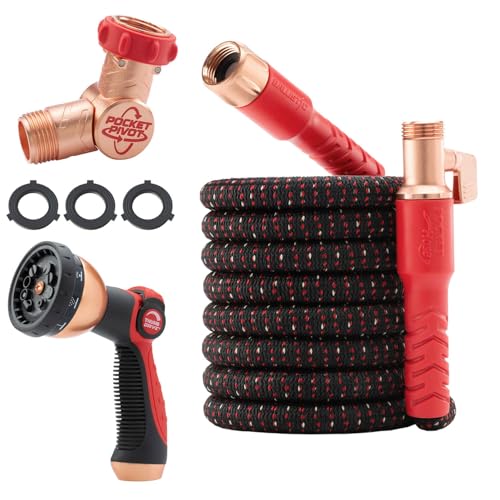
Pocket Hose 75 FT Copper Head

The 75-foot Copper Head is the only Copper Head-branded option here, and it includes a 10-pattern thumb-control nozzle. The maker says the hose resists tangling, has a 360-degree swivel, and is lead-free and drinking-water safe. Its 650 PSI anti-burst rating is a burst figure, not a suggested operating pressure. The 75-foot reach suits a yard where a 50-foot hose falls short, but it may be more hose than needed for a small patio. Measure the faucet-to-farthest-plant route before choosing a length.
Bottom line: Pick this if you want the Copper Head model and need its 75-foot reach.
Pocket Hose Ballistic Double UV 100 FT

At 100 feet, this Ballistic model reaches farther than the Copper Head and the other options here. Its name identifies Double UV protection, and the maker says its reinforcing sleeve uses a liquid crystal polymer strand and that the hose expands up to three times its size. The feature set also names a 360-degree swivel and lead-free construction. This is the choice for a distant garden bed, but a long expandable hose can be cumbersome to route around tight corners; choose a shorter option if you do not need the extra reach.
Bottom line: Choose it when 100 feet of reach matters more than a compact run.
Pocket Hose Ballistic 50 FT
This 50-foot Ballistic option is shorter than the Double UV model and returns to a compact form for storage, according to the maker. The maker also says it expands up to three times its size and has a reinforced anti-burst sleeve with a swiveling connector. It is suited to everyday watering where a 50-foot reach is enough and storage space is limited. Unlike the 25- and 50-foot Copper Bullet options, the product name does not identify a nozzle, so buyers who need a spray nozzle included should choose an option that names one.
Bottom line: Pick this for a 50-foot expandable hose with compact storage in mind.
Pocket Hose Copper Bullet 50 FT

The Copper Bullet 50-foot model pairs a mid-length hose with a 10-pattern nozzle and a 650 PSI anti-burst rating. The maker describes it as the original expanding hose and says it expands under water pressure. Its length fits routine watering when the faucet is within reach, while the included nozzle offers several spray patterns without needing a separately named accessory. The 650 PSI figure describes anti-burst capacity, not normal faucet pressure; do not use it to infer that the hose should be operated near that pressure.
Bottom line: Choose it for a 50-foot Copper Bullet with a named 10-pattern nozzle.
Pocket Hose Copper Bullet 25 FT

This 25-foot Copper Bullet is the shortest option here and is paired with a 10-pattern thumb spray nozzle. Its name also identifies 3/4-inch fittings, lead-free construction, solid copper and anodized aluminum; the maker gives an anti-burst rating up to 650 PSI. A short run is easier to manage near a patio faucet or container garden than a longer hose, but it will not cover a distant lawn without moving the faucet connection. The maker cautions that a sprinkler can move as the hose retracts, so disconnect the sprinkler before shutting off the main water source.
Bottom line: Pick it for a close-in watering area where 25 feet is enough.
How to choose an expandable garden hose
Choose hose length by measuring the route from the faucet to the farthest watering point, then allow a little slack for turns. A 25-foot hose suits close beds and patios; 50 feet covers a larger area, while 75 to 100 feet reaches farther but leaves more hose to handle. Expandable hoses lengthen under water pressure and contract when pressure is released, so their working reach changes with water flow and routing. Avoid treating a burst-pressure number as an operating-pressure recommendation: a burst rating describes a failure threshold, not the pressure to run continuously. For most yards, choose the shortest length that reaches every target without stretching tightly around corners.
Hose length and fitting compatibility
Measure the actual path rather than the straight-line distance; a route around beds, walls and furniture can use several extra feet. US garden hose connections commonly use 3/4-inch GHT threads, but verify the faucet and any connector before ordering if compatibility is critical. Do not confuse hose diameter with thread size: a 3/4-inch thread designation describes a connection, not necessarily the inside diameter of the hose. A hose that is too short strains connections, while excess length can snag on corners and plants. For an awkward faucet or unusually long route, check the fitting and usable reach before deciding on a model.
Expandable hoses versus conventional hoses
Expandable hoses trade a compact, lighter-feeling form when drained for a changing length during use; conventional rubber or vinyl hoses keep a more consistent shape whether full or empty. Expandable designs need water pressure to extend and should be drained before storage so they can contract. Conventional hoses are often available in common 5/8-inch inside diameters, while flow through any hose also depends on length, faucet supply and nozzle restriction. Here, lengths and included nozzle features differ, so choose by reach and watering task rather than assuming all expandable hoses deliver the same flow. A shorter hose is usually simpler to route when the faucet is nearby.
Using and storing an expandable hose
Open the faucet gradually and let an expandable hose fill before pulling it across the yard; sudden pressure and sharp snags can stress the hose and its fittings. After watering, shut off the supply and release downstream pressure so the hose can contract before storage. Keep hoses away from sharp edges, hot surfaces and vehicle tires, and do not leave a pressurized hose unattended. A nozzle pattern controls the spray at the outlet, but a narrow spray is not a substitute for safe handling around people or animals. For sprinkler use, follow the product-specific warning: one option cautions that its retracting hose may move the sprinkler when the main water is shut off.
Frequently Asked Questions
How long should an expandable garden hose be?
Choose the shortest hose that reaches the farthest watering point with slack for turns. Common choices in this group span 25 to 100 feet, so measure the routed distance before selecting.
Do expandable hoses need water pressure to grow?
Yes, expandable hose designs extend as they fill with water pressure and contract after pressure is released. Open the faucet gradually and allow the hose to fill rather than pulling it taut while empty.
Is 650 PSI a safe operating pressure for a garden hose?
No, an anti-burst rating is not the same as a recommended operating pressure. Typical household water pressure is roughly 40 to 80 PSI; use a regulator if your supply exceeds the hose maker’s operating limit.
Can an expandable hose stay connected to a sprinkler?
A sprinkler can shift as an expandable hose retracts when water is turned off. One product’s warning specifically says to disconnect the sprinkler before shutting off the main water source.
Are garden hose fittings usually 3/4 inch?
US garden hose connections commonly use 3/4-inch GHT threads. Verify that the faucet and any adapter use compatible threads, since a thread measurement is not the hose’s inside diameter.